
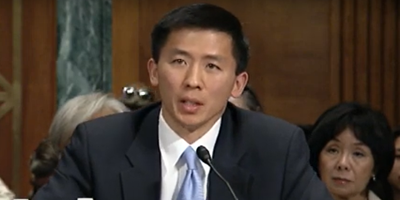



California Supreme Court Justice Goodwin Liu
LOS ANGELES - The California Supreme Court has ruled a mother should be allowed to continue her legal efforts to stop L.A. County DCFS from placing her name on a state registry of child abusers, as the state high court said parents who used reasonable force to defend themselves amid fights with their children should be able to attempt to avoid the consequences that come from their names landing on that list.
The woman, identified as S.F., has been engaged in litigation with the Los Angeles County Department of Children and Family Services regarding its attempts to submit her name to California’s Child Abuse Central Index, which L.A. DCFS claims is a statutory requirement.
Justice Goodwin Liu wrote the Dec. 1 opinion, joined by Justices Lisa Guerrero, Carol Corrigan, Leondra Kruger, Joshua Groban, Kelli Evans and Martin Jenkin. Liu also filed a concurring opinion, which Evans joined.
Liu detailed the root incident, an altercation focused on S.F. and her oldest daughter, then age 22, with the mother insisting that daughter and her boyfriend move out of the home. The younger daughters, ages 16 and 12, were present during — and at times involved in — a heated confrontation during which S.F. allegedly hit and poked the 16-year-old with the pole end of a shovel and allegedly brandished a camping knife toward the 16-year-old.
The mother claimed she acted out of self defense when she used the weapons.
“Based on the incident,” Liu wrote, DCFS “removed the middle and youngest daughters. Following the detention hearing, the middle and youngest daughters stated that the eldest daughter used the ‘sister code’ to manipulate their answers to the responders about the incident and surrounding circumstances. The middle daughter reported the injury on her side torso was not caused by Mother using the shovel and appeared dark from her rubbing it at the eldest daughter’s direction. The middle daughter also said Mother unintentionally hit her when she was physically intervening between Mother and the eldest daughter.”
During a court hearing, the parties agreed S.F. acted in self defense but disagreed over whether her actions were reasonable. The juvenile court removed the younger daughters from the home, but returned them after a six-month review hearing. After 12 months the court terminated its jurisdiction. Several months later, an appeals court considered dismissing as moot S.F.’s challenge to the initial juvenile court ruling. At that time she urged the court to review the underlying facts because that finding is what made her reportable to the state justice department for registry inclusion.
However, the appeals court dismissed the case on jurisdictional grounds without reviewing the merits of the case. Liu said the top court agreed to consider whether such appeals should survive if a parent shows the allegation that underlies a court’s conclusion is a reportable offense.
Liu said S.F. adequately showed an ongoing harm. Liu noted the threat of being included on the CACI list isn’t speculative and would carry “serious legal consequences for her lifetime.” He noted her argument that “reversal of the finding that she committed severe child abuse would result in her removal from the CACI or, at the least, would preserve her right to an administrative grievance hearing to challenge any refusal by the Department to reclassify its report as not substantiated.”
DCFS noted that even reversal of a jurisdictional finding doesn’t automatically mandate a parent’s name be removed from the CACI, but Liu said that distinction doesn’t dictate whether S.F.’s challenge is moot. While DCFS insisted a grievance hearing wouldn’t be fruitful because S.F. invoked self defense rather than disputing allegations of her physical acts, Liu said that point shouldn't stop courts from concluding a merits review is proper.
“The salience of the department’s argument only arises in the event that the Court of Appeal reverses the jurisdictional finding based on Mother’s self-defense claim and the department reports her for inclusion in the CACI despite that ruling,” Liu wrote. “For purposes of addressing a mootness challenge, courts need not predict what child welfare authorities will actually do with respect to a CACI report. Instead, courts should examine whether reversal can redress an ongoing harm.”
The court remanded S.F.’s case to the Court of Appeal and said she may challenge the abuse allegation, including by invoking self defense.
In his special concurrence, Liu tackled the DCFS’ position that even assuming S.F. acted in self defense, the conduct is still reportable to the CACI. After reiterating that argument wasn’t relevant to the question of mootness, he explained why lawful self defense is not a basis for being included in the registry.
“Although there are specific provisions regarding mutual fighting between minors and reasonable force by police officers, those circumstances are distinct from self-defense and do not suggest the Legislature intended ‘child abuse or neglect’ to include lawful acts of self-defense as defined in background statutes,” Liu wrote. “Although the Legislature could have specified that child abuse or neglect would encompass acts of self-defense ‘notwithstanding’ longstanding statutes affirming the lawfulness of such acts, it did not.”
By demonstrating instances where courts found reasonable resistance to a minor’s use of force to be legal, as well as recognizing a parent’s privilege to impose reasonable physical discipline, parents accused of abuse should have the same protections during civil Child Abuse and Neglect Reporting Act proceedings as when facing criminal charges.
Liu said DCFS shouldn’t report lawful self defense incidents to the CACI and should be telling the justice department to remove people listed if they are later determined to have acted in self defense.
S.F. was represented by attorney Sean Angele Burleigh, of Cortaro, Arizona.
L.A. County attorneys represented the county DCFS.