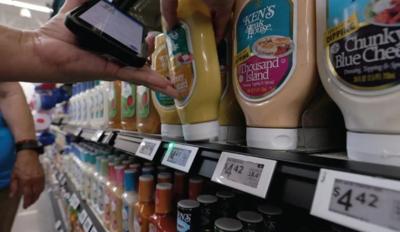


WASHINGTON – Grocery retailers are not varying prices for individual customers, and an industry group says that longstanding policy should continue.
According to a new board policy from The Food Industry Association (or FMI), the group agrees grocers shouldn’t use personal inforomation to raise an individual shopper’s regular prices. But the group defends pricing technology while calling for clearer discounts, privacy safeguards and oversight.
The voluntary statement from The Food Industry Association draws a distinction between using technology to provide savings and using personal characteristics to charge someone more. The policy comes amid debate over the practices examined in Lindsay Owens’ book, “Gouged: The End of a Fair Price — and What That Means for Your Wallet.”
“Personal information should not be used to increase the regular retail price charged to an individual consumer based on that consumer’s personal characteristics,” the FMI policy states.
Other retail groups agree that such actions simply aren’t happening.
At the same time, FMI says digital shelf labels and grocery loyalty programs help stores improve accuracy, reduce waste and compete through discounts. It calls those tools sources of consumer value rather than evidence that grocers secretly tailor higher prices to individual shoppers.
While the FMI statement does not mention Owens or her book, it sets out principles for how retailers should operate, rather than presenting findings about whether particular companies have engaged in surveillance pricing.
FMI’s board policy acknowledges that grocery prices reflect numerous factors, including supply and demand, labor and energy costs, inventory, promotions, shelf life, competition and seasonal conditions. It supports innovation but says its use should reinforce consumer confidence.
“As pricing technologies evolve, innovation should continue to support accuracy, value, transparency, and consumer confidence,” the statement says.
FMI rejects the contention that grocery stores use digital shelf labels to track shoppers or impose surge prices.
“Grocers do not use DSLs to enable ‘surge pricing,’ surveillance-based pricing or to set prices at all,” Michael Green, FMI’s director of state and local government relations, wrote in an April 7 blog post. “DSLs do not collect personal information, do not track shoppers and do not change prices while you browse.”
The labels replace paper tags with electronic displays that can be updated more quickly. FMI says linking shelf information and checkout systems helps prevent discrepancies between the price shoppers see and the price they pay.
The association’s fact sheet says an average grocery store manually changes more than 7,000 price tags each week. Digital updates can reduce errors and make promotions available more quickly, it says.
Jennifer Shawgo, FMI’s senior director of technology strategy and programs, described the labels as part of a broader connection between store shelves, inventory systems, online orders and checkout technology.
“ESLs help close that gap by allowing shelf information to update from the same source of truth as the register,” Shawgo wrote May 12. “In grocery, accuracy is not administrative housekeeping. It is part of the trust contract with the shopper.”
FMI says faster price updates also allow stores to mark down fresh and prepared foods before they spoil.
“When stores can mark down short-dated items faster, shoppers get access to lower prices and retailers reduce waste,” Shawgo wrote.
According to industry data cited in FMI’s fact sheet, 92% of price changes occur between 2 and 5 a.m., when stores are closed. FMI attributes changes during operating hours to markdowns, inventory management and competition. The fact sheet does not identify the underlying dataset or methodology for that percentage.
FMI makes a similar distinction in defending grocery loyalty programs: Customer information can be used to offer relevant discounts without increasing an individual’s regular price.
“Enrolling in a store’s loyalty program is completely voluntary,” the association says in a September explainer video, which describes digital coupons, rewards points and promotions tailored to products customers buy.
“Loyalty programs are part of how we compete for your business through savings, not surveillance,” the video says.
The association also says contact information can help grocers notify customers about product recalls. It warns that broadly written surveillance-pricing laws could restrict coupons and rewards along with the practices lawmakers intend to stop.
“Grocers share the goal of protecting your data,” the video says. “Let’s just not throw out the savings while we do it.”
The board policy pairs that defense with expectations for accessibility and disclosure.
“Retailers should seek to make discounts and savings opportunities reasonably accessible to consumers, recognizing that shoppers use different technologies and methods to engage with retailers,” it says.
Retailers also should explain material eligibility requirements, restrictions and conditions attached to discounts and loyalty benefits. Program terms and privacy notices should remain accessible and accurately reflect how the programs operate and how information is used.
The statement calls for limiting personal information to appropriate business purposes and protecting it with safeguards suited to its sensitivity and use.
It says shoppers should have reasonable mechanisms to exercise applicable privacy rights, including deleting information where required or otherwise offered by the retailer, and managing or closing loyalty accounts. Those mechanisms remain subject to identity verification, legal retention requirements and other lawful exceptions.
FMI also calls for governance and oversight of pricing technology. Depending on the application, that may include testing, monitoring, human review, security measures and risk-based oversight of outside technology providers.
“Retailers should maintain reasonable processes for identifying and addressing material pricing or price-display errors and responding to consumer questions concerning displayed or advertised prices or promotions,” the policy says.
The policy’s central limitation is that its commitments are nonbinding.
“The principles do not create or expand legal duties, establish a standard of care, or prescribe business practices or technologies,” the statement says.
It does not establish a compliance certification, reporting requirement or enforcement process. Nor does it define precisely what constitutes a shopper’s “personal characteristics” or explain how the restriction on raising a “regular retail price” applies when shoppers receive different discounts.
Each retailer remains responsible for independently determining its prices and business practices under applicable law. The policy expressly avoids recommending price levels, algorithms, promotional timing or other competitively sensitive decisions.
That makes the statement a declaration of industry principles, not proof that every grocer follows them. Its position is nevertheless explicit: Pricing technology should support accuracy and savings, while personal information should not become a means of raising an individual customer’s regular price.