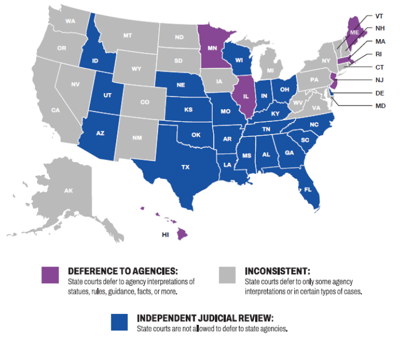

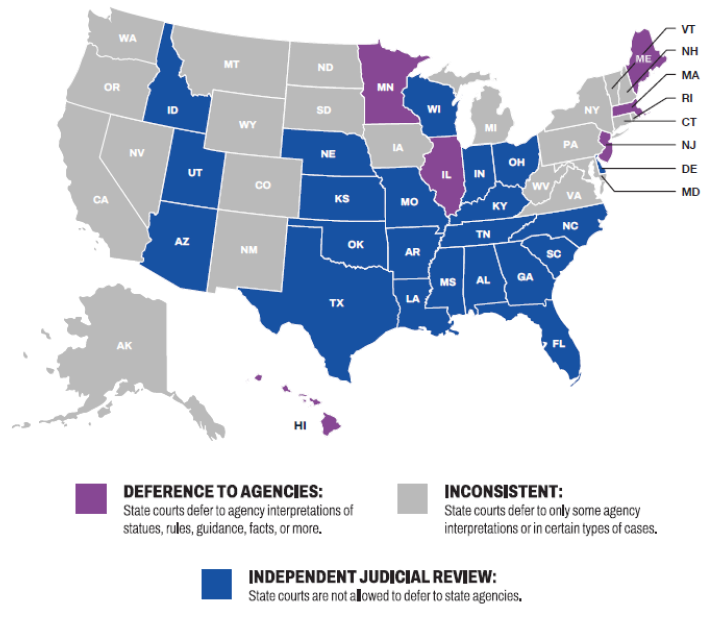
A map from the report, Judicial Deference Reformed, shows which U.S. states have adopted measures to end judicial deference and which still engage in or require the practice when interpreting laws and evaluating regulations.
ARLINGTON, VIRGINIA — Across the U.S., a growing number of states are joining a movement to rewrite the rules governing how courts interpret the laws, explicitly declaring that courts can no longer simply defer to unelected bureaucrats and state regulators when deciding what state laws actually mean, according to a new report.
On July 13, the American Legislative Exchange Council (ALEC) released its newest report, titled "Judicial Deference Reformed: How States Are Reclaiming Judicial Autonomy from Bureaucratic Influence."
According to ALEC, the report "highlights the work states across the country have done to restore separation of powers."
"If you tell Americans that a judge who is asked to interpret a law must adopt what unelected bureaucrats say a law says, intuitively, they will almost always agree that doesn't make sense," said Nino Marchese, director of ALEC's Judiciary Task Force and author of the report.
And the degree to which states are now moving away from such a standard, Marchese says, "it speaks to the health of our republic."
For decades, American courts of all kinds operated under a legal standard under which courts will essentially defer to the opinion of government agencies when deciding how to interpret laws and decide if government actions are proper.
That regime, commonly known as "Chevron deference," had been established under a 1984 U.S. Supreme Court decision, which had established a system of review that required and conditioned courts to readily accept the interpretation of laws by government regulatory agencies when government regulations actions are challenged in court.
Such regulatory actions could involve a very long list of rules affecting virtually every aspect of life and business in America, including environmental and emissions standards, vehicle ownership, land use, trade, housing, wages, employment, discrimination rules, and much more.
While the decision was constitutionally binding only on federal courts, many U.S. states still took their cue from the Chevron decision, and in many instances, engaged in their own versions of Chevron deference when addressing legal challenges to their own state agencies' actions and rules.
"Instead of courts independently interpreting statutes enacted by legislatures (or administrative rules derived from them), states often permit and demand that their courts defer to the agency’s interpretations of the law," the ALEC report said. "At both the federal and state levels, the practice of judicial deference has raised significant concerns about accountability, democratic legitimacy, and the expected role of the judiciary."
However, in 2024, the U.S. Supreme Court at last reversed the Chevron ruling. In the decision known as Loper Bright v Raimondo, the high court declared federal courts can consider the interpretation of the law advanced by regulators, but cannot give undue "deference" to those interpretations.
Essentially, the Supreme Court ruled federal judges were authorized under the Constitution to toss out regulations, if the courts alone determine the agencies didn't abide by the law when enacting the regulations
As before, states were not obligated to abide by Loper Bright when interpreting their own laws, either.
But in the two years since Loper Bright, the ALEC report said an increasing number of states have moved to end "deference" in their courts, as well.
According to the report, 22 states have now moved to pull the plug on such a regime, and to mandate that judges must establish that government regulators are correct when they establish rules governing how laws are enforced.
Even before the Supreme Court's Loper Bright ruling, some states had forbidden judicial deference, most notably including Florida and Arizona, who each outlawed the practice in 2018.
However, the movement has accelerated since Loper Bright. In the past three years, 12 more states have enacted either legislation or amended their state constitutions to forbid judicial deference. Those states have notably included Texas and Missouri, in 2025, and Georgia in the first half of 2026.
And Marchese said in 2026, 11 bills have been introduced in state legislatures to restore judicial autonomy and end deference in those states. He declined to predict which states may be the next to enact such laws or otherwise strike down judicial deference.
However, at this point, 28 U.S. states still require judicial deference to administrative agency interpretations, in full or at some level.
These states include some of the most prominent states dominated by Democrats, including Illinois, Massachusetts and Minnesota, which the report says require full judicial deference, and the states of California, New York and Pennsylvania, which the report says "apply deference principles inconsistently," but often mostly favor state bureaucrats in court.
While the majority of states that have forbidden judicial deference are typically considered "red states," or states with strong Republican majorities, Marchese said the deference abolition movement is not to advance a particular political end or policy.
He said the end goal, of empowering judges to interpret laws based on evidence, history and other traditional methods of constitutional interpretation, "isn't really a partisan issue."
Rather, he said it's about restoring the judiciary to its proper place as "the final arbiter" of the meaning of laws.
In the report, ALEC said their goal isn't "to diminish the legitimate role of administrative agencies." Rather, ALEC said they seek "to reestablish the proper boundary between executing the law and interpreting it."
"By restoring independent judicial review, states reinforce democratic accountability, preserve legislative supremacy, and prevent the consolidation of governmental power," ALEC said. "In doing so, they reaffirm a foundational premise of American governance: that the meaning of the law must ultimately be determined by courts, not the bureaucracies charged with its enforcement."