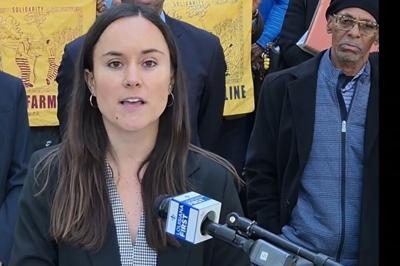



Samantha Pourciau, the lead attorney for the plaintiffs, speaks at a press conference after presenting evidence for a lawsuit aimed at ending the Angola prison farm line.
Louisiana advocacy groups pressed their case in federal court proceedings and before the public last week to put an end to the farm line at the state’s Angola prison, which they see as inhumane and unconstitutional.
The presentation of evidence in the Middle District of Louisiana in Baton Rouge took place Feb. 5 in the case of Voice of the Experienced (VOTE) v. LeBlanc. In a press conference after the court proceedings, plaintiff advocates challenged the forced farm labor program at Louisiana State Penitentiary as dehumanizing and a violation of the Constitution’s Eighth Amendment.
"In Louisiana, incarcerated men are forced to work in fields on what is known as the farm line at great risk to their lives, to their health and are forced to do so at the threat of violence, being put in the dungeon, degraded and humiliated," Samantha Kennedy, executive director of the Promise of Justice Initiative (PJI), said during the group’s post-hearing press conference.
Samantha Pourciau, PJI’s senior staff attorney and the lead attorney for the plaintiffs, said the farm line program violates the Constitution’s ban on cruel and unusual punishment and is at odds with the Americans With Disabilities Act (ADA).
“We've presented strong evidence, particularly the testimony of our clients, who are the experts in the inhumane reality of the farm line,” Pourciau told the Louisiana Record in an email. “Every man subjected to the dangerous and degrading farm line at Angola deserves humane treatment, and we remain focused on securing relief."
The lawsuit, which was originally filed in 2023, has advanced in recent months. In December, federal Judge Brian Jackson certified the case as a class action for Angola inmates who are currently working on the farm line or could be forced to in the future. The court said the class action will consist of a general class of inmates assigned to the farm line now or in the future and a sub-class who suffer from disabilities that limit their activities.
The plaintiff-inmates argue that those assigned to the farm line are at a higher risk of physical, psychological and dignitary harm, particularly due to exposure to high temperatures that occur during the growing season in the region.
But attorneys for the defendants, including the Louisiana Department of Public Safety and Corrections, argue that the work is meaningful in that it provides fresh produce to prison inmates. They contend that mitigation measures are now in place, including unlimited ice and water, regular breaks during excessive heat, and the provision of shade canopies and sunscreen.
Plaintiffs, on the other hand, see the farm line as a means of “breaking” new inmates assigned to their first prison jobs.
“We are forced to crawl, hands and knees, in the dirt, scrounging for potatoes with our fingers,” one of the class representatives, Joseph Guillory, said in a prepared statement. “An armed freeman spits tobacco. ‘You're not to leave any potatoes in the earth, boy. … Pick that up, boy. Get those sacks, boy.’”
The original lawsuit did not seek monetary damages for individual plaintiffs but instead called for the enforcement of inmates’ rights to be free from cruel and unusual punishment – and for inmates with disabilities to be given accommodations and services as guaranteed by the ADA.