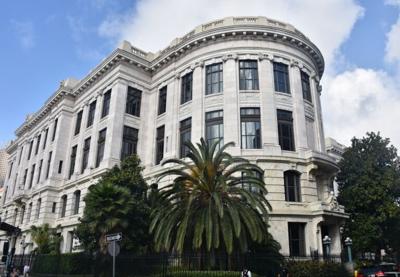



Louisiana Supreme Court
NEW ORLEANS – The Louisiana Supreme Court suspended or disbarred four Louisiana attorneys in a series of orders issued last month.
In separate orders Jan. 21, the state’s high court suspended Daniel Barzare and Jonathan Curry Harris for one year each, and disbarred Lindsey J. Leavoy. In a Jan. 28 order, the court suspended George Knox for three years.
In Barzare’s case, Geraldine Stelly had retained him to represent her in a community property partition matter in July 2019. She agreed to pay a 25 percent contingency fee.
In July 2022, she filed a complaint against Barzare with the Office of Disciplinary Counsel, alleging he asked for personal loans totaling $25,000.
However, Barzare argued Stelly made three payments to him totaling $25,000 as an advance on his $105,000 attorney’s fees in the partition matter.
The Supreme Court found that Barzare requested and received three loans from his client without reducing the agreement to writing, without advising her of the “desirability of seeking independent legal advice,” and without receiving Stelly’s informed written consent.
“At best, the evidence reveals a significant miscommunication or misunderstanding between the parties as to the loan(s) terms and conditions,” the court’s per curium opinion states. “However, without more, and in light of documents in the record, evidence of a misunderstanding is insufficient to establish that respondent’s conduct involved dishonesty, fraud, deceit, or misrepresentation.”
The court ordered Barzare to attend ethics school before seeking reinstatement.
In Harris’ case, he was hired to represent Dewey and Mildred Johnson in a legal dispute. However, he failed to appear at a scheduled pre-trial conference and file a pre-trial order, among other things.
As a result of Harris’ neglect, the Johnsons were prohibited from presenting evidence at trial. Soon after, they filed a complaint with the ODC, which filed charges against Harris.
“Considering that he also neglected a legal matter, failed to communicate with his clients, and has a prior disciplinary record for failing to cooperate with the ODC, we agree that the recommended sanction is appropriate for this matter,” the high court wrote.
In Leavoy’s case, the Supreme Court pointed to his previous history of misconduct in its decision to disbar him.
In August 2024, he was placed on interim suspension for a threat of harm to the public. Then, in 2025, he was suspended from practice for 12 months, with six months deferred, followed by a one-year period of probation for “failing to act with reasonable diligence” in representing a client, among other things.
In last month’s order, the high court found Leavoy misused his client trust account, converted client funds, engaged in a check kiting scheme, and failed to cooperate with the ODC.
“Respondent violated duties owed to his clients, the legal system, and the legal profession,” the court’s opinion states. “His conduct was knowing and intentional, causing actual harm.”
It continued, “The following aggravating factors are supported by the record: a prior disciplinary record, a pattern of misconduct, multiple offenses, bad faith obstruction of the disciplinary proceeding by intentionally failing to comply with the rules or orders of the disciplinary agency, and substantial experience in the practice of law.”
In Knox’s case, he, too, had a history of misconduct. Previously, he admitted to practicing law while being ineligible to do so and failing to cooperate with the ODC’s investigation of seven complaints. In turn, he was suspended for a year.
Then, in May, the ODC filed charges against Knox, alleging he failed to provide competent representation to a client and failed to refund an unearned fee, among other things.
Knox was retained by Consandra Charles in 2019 to represent her in a child support and alimony matter. Charles paid Knox an advance fee of $5,000.
“The committee found the following aggravating factors are present: a prior disciplinary record, a dishonest or selfish motive, a pattern of misconduct, multiple offenses, bad faith obstruction of the disciplinary process by intentionally failing to comply with rules or orders of the disciplinary agency, refusal to acknowledge the wrongful nature of the conduct, and substantial experience in the practice of law,” the high court wrote in its opinion.
“Respondent violated duties owed to his client, the public, and the legal profession. He acted knowingly, and his conduct caused actual harm.”
Because his current misconduct occurred during the same time frame as his previous misconduct, the court said a lengthier suspension is warranted.
He is suspended from practice for three years, retroactive to Dec. 21, 2023 – the date of his interim suspension.
The court also ordered Knox provide an accounting and refund any unearned portion of the advanced deposit to Charles.