
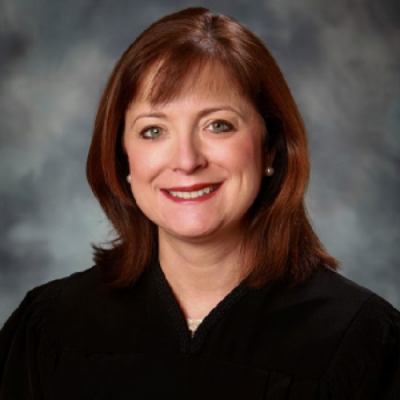


Illinois Southern District Judge Nancy Rosenstengel
EAST ST. LOUIS — A federal judge could soon terminate nearly 200 more cases from the list of thousands pending in federal court accusing the makers of commercial weed killer Paraquat of allegedly causing Parkinson's disease.
On Nov. 10, court-appointed special master Randi Ellis recommended U.S. District Judge Nancy Rosenstengel dismiss 196 more Paraquat exposure lawsuits, telling the judge that lawyers representing the plaintiffs in those cases had failed to return required plaintiff assessment questionnaires.
All of the plaintiffs in the 196 cases are represented by attorneys from the firm of Pulaski Kherkher, of Houston.
All but one of the 196 cases were filed in either 2025 or 2026, according to court records.
Since 2021, as lawsuits have piled in to her court from throughout the country as part of a so-called multidistrict litigation (MDL) consolidating all federal cases before Rosenstengel, the judge has required plaintiffs to submit the 13-page questionnaire, providing specific information about the plaintiffs' claims.
Rosenstengel currently is presiding over about 6,600 lawsuits against Syngenta and Chevron, the companies from whom plaintiffs are demanding potentially billions of dollars in settlements or jury verdicts.
Thousands more lawsuits are pending against the companies in state courts across the country, but primarily in local court in Philadelphia.
Earlier this spring, the parties had revealed in related proceedings in federal appeals court that they had reached a potential settlement to draw the federal consolidated Paraquat litigation to a close.
Terms of any potential settlement have remained secret ever since.
Settlement talks appeared to have gained traction after Rosenstengel delivered decisions harmful to plaintiffs' cases, including barring testimony from certain key experts plaintiffs had hoped to use to support their claims.
That decision was appealed in April 2024, and was the subject of the April 14, 2025, motion in which the possible settlement was first made public.
Since then, the U.S. Supreme Court also delivered a decision damaging to at least some of the claims in the plaintiffs' cases.
In that ruling, known as Durnell v Monsanto, the nation's highest court declared that plaintiffs cannot bring so-called failure to warn claims under state law against companies whose pesticide and herbicide product labels are regulated by federal agencies under federal law.
That decision had come amid the high stakes court fight waged by trial lawyers against agrichemicals giant Monsanto over their popular weed killer product, glyphosate, sold under the brand name of Roundup. In that action, plaintiffs had claimed Monsanto and its new corporate parent should pay because they didn't sufficiently warn Roundup users of the alleged risk of contracting cancer from exposure to the herbicide.
As in the Roundup litigation, the plaintiffs in the Paraquat litigation have similarly sought to use claims based in state law against defendants Syngenta and Chevron.
Following the Durnell decision, Syngenta and Chevron moved for summary judgment, or a final ruling from the court in their favor without trial, that would have pulled the plug on all state law claims in the lawsuits.
Plaintiffs have opposed that motion, asserting the Durnell reasoning should be applied more narrowly and should be read only to eliminate certain claims.
Rosenstengel has not yet ruled on that motion for summary judgment.
In the meantime, proceedings have continued on various fronts in the consolidated litigation.
Rosenstengel, for instance, ordered in October that one law firm responsible for hundreds of Paraquat cases, the Smith Law Firm, of Mississippi, reveal to the court the identities of any third-party lawsuit investors or others who may be pressuring Smith Firm Paraquat clients to opt out of the global settlement.
And at the same time, Ellis was asked by the Paraquat manufacturer defendants to review the 196 Pulaski Kherkher cases to determine if they had satisfied Rosenstengel's questionnaire requirements.
In her report, Ellis said the plaintiffs in those cases had fallen far short, failing to submit the questionnaires ever "after multiple opportunities to cure."
According to court documents, one case from 2023, for instance, is still missing the required questionnaire. And none of the 195 cases on the list that were filed in the past two years by the Pulaski Kherkher have completed the questionnaires, either, despite multiple notices provided by the defendants under Rosenstengel's order.
"Despite these efforts, none of the Plaintiffs or their Representatives identified ... has served a (questionnaire), nor has any Plaintiff ... demonstrated good cause or justified cause for failing to timely submit a (questionnaire)," Ellis wrote in her report.
Ellis recommended Rosenstengel dismiss all 196 cases for failing to abide by the court order.
Rosenstengel has not yet ruled on the recommendation. However, in the past, the judge has acted in accordance with the special master's recommendations in dismissing hundreds of other cases for the same failures.
In June 2025, for instance, Rosenstengel followed through on Ellis' recommendation in dismissing 69 cases for failure to complete the questionnaire, including 57 filed by the Pulaski Kherkher case.
Other plaintiffs' lawyers involved in the Paraquat mass litigation have asserted that lawsuits in which plaintiffs fail to complete the assessment questionnaires typically have "mostly not viable claims in the first place."


