
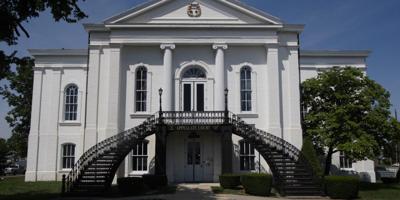


Illinois Fifth District Appellate Court, Mount Vernon
MOUNT VERNON — A state appeals panel refused to change a $29.5 million punitive damages award for a man injured in a car crash involving an intoxicated motorist.
James Wildhaber pleaded guilty to driving under the influence of alcohol, leaving the scene of a crash and failing to give information in connection with a February 2022 incident on U.S. 50 in Clinton County. According to court records, Wildhaber was drunk and driving on the wrong side of the road when he hit a Ford Taurus. The driver and backseat passenger exited the vehicle, but front-seat passenger Tracy Deadmond was still inside when a third car, driven by Phillip Clutts, struck the Taurus a minute later.
Deadmond sued the other drivers in April 2022, alleging negligence against both men, then added a punitive damages claim against Wildhaber in November. The following January he added claims of willful and wanton misconduct against Wildhaber. In December 2024, Deadmond bifurcated the punitive damages claim, and in April 2025 all parties agreed Deadmon’s medical bills had reached $700,000.
Madison County Circuit Court Judge Sarah Smith presided over the trial, which included a directed verdict for Clutts. The compensatory phase ended with a damages award of $5.95 million and a finding of willful and wanton conduct that required punitive damages. At that phase Deadmond requested $50 million, but the jury settled on $29.5 million.
Wildhaber moved to have the amount reduced, calling the total “brutally excessive” and claiming the jury overlooked critical evidence about his financial status, and had instead improperly based the verdict on passion or prejudice. He later argued the award violated his 14th Amendment due process rights. Judge Smith denied the quest in August 2025, prompting Wildhaber’s challenge to the Illinois Fifth District Appellate Court.
Justice James Hackett wrote the panel’s opinion, filed Nov. 20; Justices John Barberis and Mark Boie concurred. The order was issued under Supreme Court Rule 23, which may restrict its use as precedent.
The panel opened by noting three doctors all testified — and a defense expert functionally agreed — that Deadmond “sustained at least a moderate traumatic brain injury that would most likely be permanent” while also confirming Deadmond “had several physical, cognitive and executive function issues preventing him from being able to care for himself or live independently,” an assessment the defense expert also corroborated.
As for Wildhaber, Hackett wrote he “admitted that, before driving on the night of the accident, he knew he was intoxicated and could seriously hurt someone but chose to drive anyway … acknowledged driving 68 miles an hour on the wrong side of the road … conceded that his conduct disregarded others’ safety … confirmed that after the accident, and after seeing that (Deadmond) was hurt, he ran away and hid in a field, where police eventually found him.”
The panel noted Deadmond was already financially vulnerable before the crash, having been on disability for more than a decade and unable to recall his most recent employment. Although Wildhaber’s “actions on previous occasions amply warned him of the danger his intoxicated behavior posed to himself and others,” Hackett wrote, he had no prior interactions with Deadmond so that “factor does not contribute to the greater body of reprehensibility.”
Although the panel said “the harm caused was ultimately the result of an accident,” it nonetheless found Wildhaber’s “conduct included elements of intentional malice and deceit.”
The panel also assessed whether the jury’s award was unreasonable or excessive in relation to the actual harm inflicted on Deadmond, citing U.S. Supreme Court guidance that “single-digit ratios between punitive and compensatory damages are more likely to comport with due process,” notably in cases of particularly egregious conduct and physical injuries.
The punitive award is about five times the compensatory verdict, the panel noted, but Wildhaber contended the $29.5 million “furthers no legitimate purpose, constitutes an arbitrary deprivation of property” and overlooks the reality that during the trial he was unemployed, incarcerated and destitute. But several courts, including the Fifth District appellate panel, “have affirmed higher ratios,” Hackett wrote, finding due process wasn’t jeopardized.
Wildhaber noted the maximum criminal fine for aggravated DUI is only $25,000, arguing that context showed the punitive award was excessive. However, Hackett wrote, considering Wildhaber’s “repeated history of intoxicated driving, and prior failures of courts to deter defendant through less significant means, the jury’s punitive damages award appropriately serves the legitimate purpose of deterrence. We do not find that the award was grossly excessive or arbitrary and therefore cannot find that the award violated defendant’s due process rights.”
The panel also reviewed Judge Smith’s choice to deny a request to lower the award on the grounds of jury passion or prejudice and found she did not abuse discretion.
“The jury heard significant evidence concerning defendant’s financial status, including that defendant had not been able to work since he had gone to prison; that his checking account was empty at the time of trial; that he intended to resume working upon his release from prison; that he anticipated having some difficulty getting hired; and that he had two children under the age of 10,” Hackett wrote.
“Additionally, before deliberations on punitive damages took place, the trial court instructed the jury that the ‘verdict must not be based on speculation, prejudice or sympathy.’ Absent evidence to the contrary, the jury is presumed to have followed the trial court’s instructions. However, other than his own dissatisfaction with and inability to pay the award, (Wildhaber) offers no evidence that the jury’s decision overlooked the financial evidence presented or was based on passion or prejudice.”
