
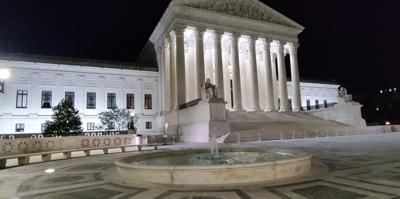

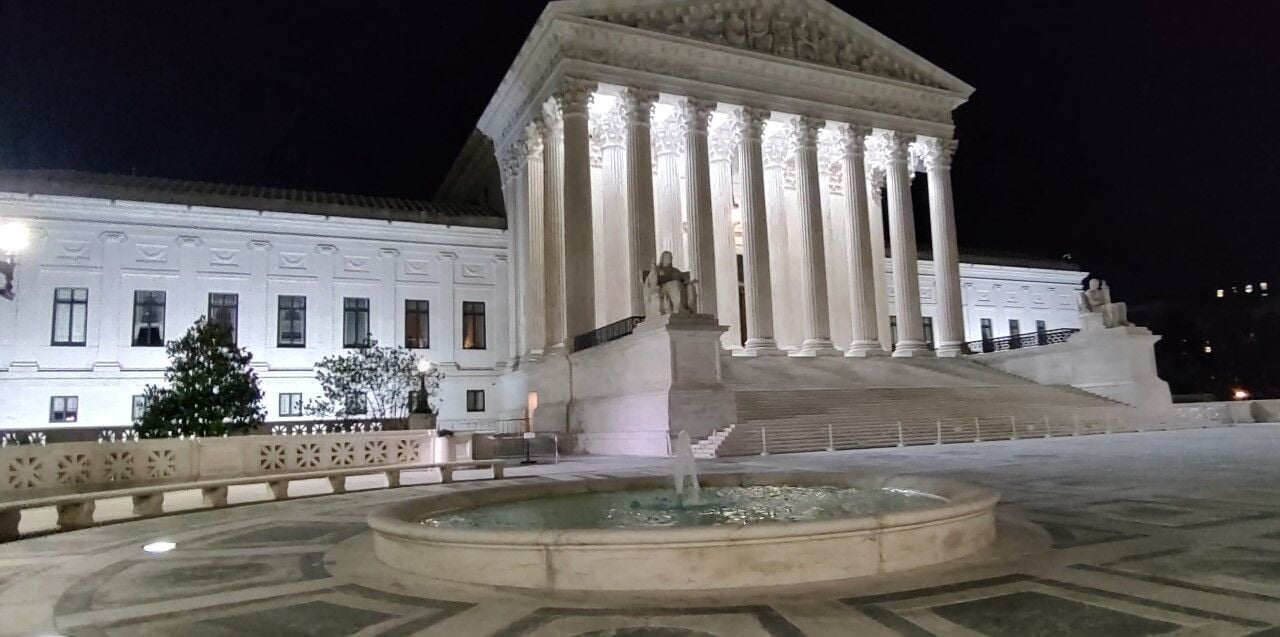
U.S. Supreme Court
WASHINGTON, D.C. — The U.S. Supreme Court appears to have refused an attempt by Cook County's state's attorney to allow Cook County to exit and potentially reshape the upcoming arguments over the fate of so-called "assault weapons" bans in Illinois and elsewhere.
On Nov. 23, the Supreme Court granted the request of those challenging Cook County's gun ban to allow Cutberto Viramontes, one of the lead plaintiffs, to exit the legal action, while still allowing the overall challenge to proceed.
The court did not include any statement explaining the decision.
Oral arguments remain on pace to be heard at the high court next week.
The Supreme Court is scheduled to hear oral arguments in the dispute over the constitutionality of Cook County's gun ban, as well as Connecticut's similar statewide ban, on Dec. 2.
The court has also updated the docket to replace Viramontes with his co-petitioner, Christopher Khaya, as the lead named challenger in the action against Cook County.
The decision comes about three weeks after attorneys for the petitioners filed a motion asking the court for permission to dismiss Viramontes from the case.
Petitioners have never explained why Viramontes wished to exit the case just weeks before the Supreme Court was scheduled to hear the legal challenge to which he has joined his name for years.
But Cook County State's Attorney Eileen O'Neill Burke seized on the motion to attempt to pull the plug on the case against Cook County's ban on so-called "assault weapons," telling the Supreme Court Viramontes' withdrawal from the case undermines the entire legal challenge, rendering it moot.
In the motion, Cook County asserts Khaya shouldn't be allowed to step into the action in place of Viramontes and continue the case because, while Khaya seeks to own a gun that is banned by Cook County's ordinance, it is not an AR-15 semiautomatic rifle. Burke asserts that should end the case because the Supreme Court allegedly only agreed to hear the case on the question of whether the Constitution guarantees Americans "the right to possess AR-15 platform and similar semiautomatic rifles."
Attorneys for the petitioners, however, responded that O'Neill Burke was grasping at a distinction without a difference in a last minute bid to exit the legal challenge.
In a response filed earlier this month, the petitioners noted Khaya is a Cook County resident who is still attempting to buy a semiautomatic rifle that is banned under Cook County's ordinance and should easily qualify as a weapon that is "similar" to an AR-15.
The high court appears to have agreed with the petitioners on the question and appears to have allowed the case to advance to oral arguments with Khaya serving as the lead named petitioner.
The arguments and resulting decision carry with them high constitutional stakes for gun owners and others throughout the U.S. Should the high court declare the Cook County and Connecticut gun bans unconstitutional, it would likely similarly write the end of similar "assault weapons" bans in 10 states, including Illinois' state gun ban law.
The Illinois law is not yet directly before the Supreme Court, even though it has also been the subject of years of court challenges since it was enacted in 2023.
Democratic state lawmakers and Gov. JB Pritzker passed the law in direct response to the massacre at the 2022 Fourth of July parade in suburban Highland Park. The attack was carried out by a lone gunman wielding a semiautomatic rifle manufactured by Smith & Wesson, which the state has included on a list of so-called "assault weapons" Illinois Democrats believe should be banned in the state.
Second Amendment rights supporters, however, say the Illinois state law and similar gun bans are blatant violations of the Second Amendment, particularly as interpreted by the U.S. Supreme Court in two decisions, New York State Rifle & Pistol Association v Bruen and the earlier landmark Second Amendment decision, District of Columbia v Heller.
The Cook County "assault weapons" ordinance predates the Illinois law and in some ways served as the model for the constitutionally questionable law. The county first banned certain semiautomatic weapons in 1993. But the ordinance was strengthened and lengthened in the years since to ban a longer list of firearms and so-called "large capacity magazines."
The ordinance has also been the subject of long-running legal challenges.
To this point, courts in Illinois, in particular, mostly have sided with the state and Cook County.
For the most part, judges, including at the U.S. Seventh Circuit Court of Appeals and other appeals courts, have ruled that the banned weapons are not "arms" protected by the Second Amendment, because the courts say states and other governments have the authority to ban weapons they believe are overly dangerous or too closely related to military-style weaponry.
That view was reinforced by a 2-1 decision at the Seventh Circuit, shortly after the Supreme Court agreed to take up the challenges to the Cook County ordinance and Connecticut state law in one proceeding.
At the high court, challengers have asserted the Cook County and Connecticut bans must fall because they unconstitutionally prohibit Americans living in those places from owning weapons that are in common use and are not both "dangerous and unusual."
They note the firearms banned under the county ordinance and similar state laws are among the most commonly owned guns in America.
In response, Cook County and Connecticut have argued the Supreme Court should all but ignore ownership figures, asserting only that it is enough for lawmakers to decide the guns are too dangerous to continue to allow private ownership.
Cook County argued that its bans don't unfairly trample the constitutional rights of people living in the county or other locations that have enacted similar gun bans. Rather, they said, overturning the gun bans would instead restrict the rights of people living in heavily populated places like Cook County to decide which weapons should be permitted in their communities.
Anyone who still wishes to own such weapons, they said, are free to leave.
In the Cook County and Connecticut cases, the individual petitioners have been joined by the Second Amendment rights activist and legal advocacy groups, the Second Amendment Foundation (SAF) and Firearms Policy Coalition.
In their response to Cook County's brief addressing the constitutional question, the petitioners' legal team noted that the governments seeking to ban guns would treat no other constitutional right so blithely.
Citing language from a 2011 Seventh Circuit decision knocking down Chicago city restrictions on shooting ranges, the petitioners wrote: "'It’s hard to imagine anyone suggesting that Chicago may prohibit the exercise of a free-speech or religious-liberty right within its borders on the rationale that those rights may be freely enjoyed'” elsewhere."
And citing from the U.S. Supreme Court's own 2026 ruling ending state attempts to ban people from concealed carrying firearms onto virtually all private property, the petitioners added:
"The Second Amendment sets a uniform national standard that does not 'yield to the spirit of … the Windy City.'"
