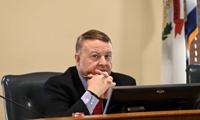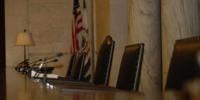


The chambers of the West Virginia Supreme Court of Appeals
CHARLESTON – The West Virginia Supreme Court has denied a former assistant county prosecutor petition to regain his law license, finding he failed to demonstrate sufficient rehabilitation after using his public office to sexually exploit three women.
In a Nov. 12 opinion, Chief Justice Bunn said Jarrell Lee Clifton II’s employment, community involvement and expressions of remorse did not establish that he had addressed the conduct that led to his 2015 disbarment. The court also ordered Clifton to pay the costs of the reinstatement proceedings.
Justices Kirkpatrick and Trump dissented. In a separate opinion, Kirkpatrick said Clifton had demonstrated his fitness to return to practice and should be reinstated under conditions that included two years of supervision by an attorney who would submit monthly reports to the Office of Disciplinary Counsel.
Clifton filed his reinstatement petition June 12, 2024. The Office of Disciplinary Counsel opposed the petition, and a Hearing Panel Subcommittee recommended its denial, citing the seriousness of the underlying misconduct and the potential damage to public confidence in the administration of justice.
The majority agreed, emphasizing Clifton’s position as an assistant Pocahontas County prosecutor was central to the misconduct.
“His position provided access to his victims, thereby allowing him to utilize their vulnerability within the criminal justice system to sexually exploit them,” Bunn wrote.
Clifton was admitted to the West Virginia State Bar in 2007 and worked as an assistant prosecutor until entering private practice in 2011. In the original disciplinary proceeding, the court found 10 violations of the Rules of Professional Conduct stemming from sexual misconduct involving three women and subsequent dishonesty to investigators and disciplinary authorities.
The women were involved in criminal matters as a defendant, a victim or someone seeking assistance for another defendant, according to the opinion. The court concluded in 2015 that Clifton used his authority to obtain sexual favors from vulnerable women and rejected a disciplinary panel’s recommendation of a two-year suspension in favor of disbarment.
One woman, who was serving probation, testified that she performed oral sex on Clifton after he insinuated that he could seek to revoke her suspended sentence if she did not comply. Another testified that, when she sought help with a charge against her son, Clifton used a recording of a prior sexual encounter to pressure her into sexual conduct. The third sought assistance with criminal justice matters, during which Clifton solicited sexual favors, according to the court’s account of its earlier findings.
Clifton was indicted on four felony charges involving the first woman in 2012. Those charges were later dismissed after the prosecutor concluded the encounters were consensual, the opinion said. The court nevertheless found the alleged acts of sexual misconduct occurred for purposes of the disciplinary proceeding.
During his reinstatement proceedings, Clifton continued to deny physical sexual contact with the women while he was a prosecutor. He acknowledged inappropriate sexual communications, photographs and videos, while recognizing the court’s contrary findings as binding in the disciplinary process.
Since his disbarment, Clifton worked as a paralegal for about seven years before purchasing an insurance agency and real estate company that he operates with his wife. He also served on the Pocahontas Memorial Hospital Board of Trustees, including as chairman, developed a youth basketball league and became a certified lay minister in the Methodist church.
The hearing panel credited Clifton with steady employment, community service, continued legal competence and “heartfelt remorse.” It also found no evidence of improper professional conduct or illegal activity since his disbarment.
But the majority said those accomplishments did not sufficiently distinguish Clifton’s present character from the respected public image he maintained at the time of his misconduct.
“His evidence of rehabilitation reveals largely the same resume of good citizenship and professionalism which he publicly exhibited at the time of his misconduct — which did not reflect his behavior behind closed doors,” Bunn wrote.
The majority also questioned the extent of Clifton’s counseling and the evidence offered to demonstrate its effectiveness. He attended seven individual therapy sessions after disbarment before transitioning to marital counseling, but had received no further professional counseling since August 2017, according to the opinion.
Clifton did not present a professional witness to discuss his rehabilitation or testimony from pastors whom he said had provided spiritual counseling. His character witnesses had not discussed the details of the misconduct with him, and all but one had only a vague awareness of the underlying allegations, the majority said.
The court said a lawyer seeking reinstatement must establish present integrity, moral character and legal competence by clear and convincing evidence. The lawyer also must demonstrate rehabilitation, and the court must determine that reinstatement would not have a justifiable and substantial adverse effect on public confidence in the administration of justice.
In dissent, Kirkpatrick said Clifton satisfied that standard.
“By all accounts, Mr. Clifton has led an exemplary life since his disbarment in 2015,” Kirkpatrick wrote.
The dissent challenged the majority’s assessment of the character witnesses, noting that several recalled reading the court’s 2015 opinion and others knew the general nature of the misconduct. Those witnesses testified and were cross-examined by disciplinary counsel, Kirkpatrick wrote.
Kirkpatrick also said there was no categorical requirement that a disbarred attorney present professional testimony to prove rehabilitation. The seriousness of Clifton’s misconduct remained relevant, the dissent said, but should not control the entire reinstatement inquiry.
The majority said Clifton’s offenses did not automatically disqualify him from reinstatement. Nevertheless, it concluded that he had not provided sufficient objective evidence that he had addressed the behavior underlying his abuse of public trust.
West Virginia Supreme Court of Appeals case number 24-330