
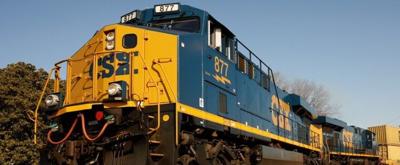


CSX train
EAST ST. LOUIS — A federal judge won’t put the brakes on a lawsuit from a St. Clair County farm trying to force CSX Railroad to pay for flood damage allegedly linked to debris that collected under a trestle.
Though the initial flooding occurred in July 2022, Keller Farms, of Caseyville, in April won permission from U.S. District Judge Nancy Rosenstengel to amend its lawsuit to also include claims over 2024 flooding, allegedly traced back to the same cause.
In a new opinion filed Nov. 9, Rosenstengel denied CSX’s motion to dismiss the amended complaint.
Keller first sued in 2024, joining with the village in a St. Clair County Circuit Court lawsuit alleging heavy rainfall led to the Little Canteen Creek becoming swollen and rising to the point it swamped a flood control levee, releasing floodwaters throughout Caseyville. According to published reports and court documents, the levee failure stemmed from an unnatural buildup of water caused when debris that had collected under a CSX railroad bridge for at least 40 years impeded creek flow.
Rosenstengel dismissed the village of Caseyville’s claim in September 2025, allowing Keller’s negligence claim to continue. CSX asked the judge for outright dismissal or to at least “substantially” narrow the lawsuit, arguing the amended complaint introduces new legal theories that they say should be either prohibited under federal law or which they say aren't recognized in Illinois. It also said Keller didn’t plausibly plead its causation theory or sufficiently argue for punitive damages.
“At this stage of the case, the court is not inclined to conduct surgery on the amended complaint to determine which duties are viable beyond those it already recognized, particularly where the parties have not briefed the issue in any depth,” Rosenstengel wrote. She explained CSX objected to allegations it was obligated “to redesign the railroad bridge, monitor the area for debris, and warn nearby property owners about the risks of a flood,” but observed “many, if not all, of these allegations were included in the original complaint.”
While the amended complaint mentions other duties, such as preventing dangerous conditions on its own and neighboring properties or to warn of such, Rosenstengel said Keller may have included them “to address the question of whether the duty of ordinary care attaches in the circumstances here.”
She also rejected the federal pre-emption argument, first by noting her earlier determination that neither the federal Interstate Commerce Commission Termination Act nor the Federal Railroad Safety Act should prevent Keller from pressing ahead with its negligence claims.
“The amended complaint does not vary substantively from the original pleading,” the judge wrote, notably with respect to whether the bridge in question acted as a dam.
Most of the revised “paragraphs merely differ slightly in wording, in large part to reflect that the Village of Caseyville is no longer a plaintiff,” while seven new paragraphs “cover Keller Farms’ allegations regarding the 2024 flooding incident.”
Once discovery closes, Rosenstengel said, CSX can renew its FRSA pre-emption argument.
As to whether Keller adequately pleaded proximate cause, Rosenstengel said CSX didn’t “cite any federal or Illinois caselaw or describe the relevant legal standard” and waived the argument as underdeveloped.
“The amended complaint clearly explains how defendants’ ‘debris-clogged bridge area would turn the Creek into a dangerous makeshift dam,’ causing water to ‘swell up to the surrounding levees,’ ” Rosenstengel wrote. “Ultimately, the pressure of the water caused the levees to collapse, unleashing a wave of water into plaintiff’s farmland. According to Keller Farms, defendants were aware this could happen because it had happened before. At least at the pleading stage, Keller Farms has plausibly alleged that it was reasonably foreseeable to defendants that harm could result from their allegedly negligent acts and that the harm was, in fact, caused by their negligent acts.”
Rosenstengel likewise said CSX’s challenge to Keller’s pursuit of punitive damages “spans a single paragraph and does not cite any pertinent legal authority” and let that claim survive. She also refused to issue an order compelling Keller “to identify what conduct it believes is actionable and what specific theories it intends to pursue,” writing CSX could “use contention interrogatories to clarify the matters at issue.”
The parties also disputed whether Baltimore & Ohio Railroad should be listed as a defendant. CSX argued B&O no longer exists as a corporate entity as of a 1987 merger, but Keller noted the St. Clair County Recorder lists B&O as owner of at least some of the parcels. Rather than rule, or defer to the summary judgment stage, Rosenstengel directed “the parties to meet and confer regarding the possibility of a stipulation to dismiss the claims against B&O.”
Keller has been represented by attorney Jason Johnson and Patrick Stufflebeam, of the James Kelly Law Firm, of Peoria.
CSX has been represented by attorney Charles Swartwout, of Reifers Holmes & Peters, of Belleville.

