
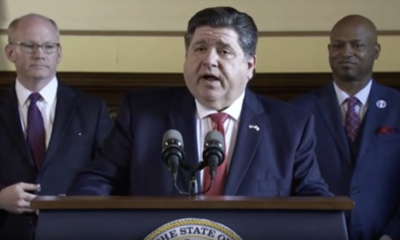


Illinois Gov. JB Pritzker, flanked by Illinois Senate President Don Harmon, left, and House Speaker Emanuel "Chris" Welch, right
EAST ST. LOUIS — Illinois Gov. JB Pritzker and fellow Illinois Democrats can't bring a quick end to the federal government's legal action seeking to block Illinois from enforcing new laws limiting how and where federal ICE can arrest illegal immigrants, and empowering illegal immigrants and social justice activists to sue if federal agents don't abide by the state's rules.
On Aug. 19, U.S. District Judge David Dugan denied the state of Illinois' motion to dismiss the challenge brought by the federal Justice Department, under President Donald Trump, against the Illinois laws seeking to limit immigration enforcement actions in the state.
In the decision, Dugan specifically rejected assertions from Illinois Attorney General Kwame Raoul that the laws don't actually pose a "credible threat" to federal authority or to federal agents themselves, even though the laws empower both state officers and trial lawyers to enforce the laws through lawsuits and other actions.
"Where the requirements of Federal immigration enforcement laws, regulations and protocols differ from those imposed by state law, personnel (federal immigration agents) are necessarily burdened with the need to choose between sworn duty and possible personal exposure to litigation," Dugan wrote.
"... Here, the threat that non-compliance brings on the one hand and the dangers associated with compliance – revelation of identity, effective control of non-peaceful protesters or mobs, etc. – on the other, places the immigration enforcement officer in a difficult quandary and one that will plausibly impede his ability to carry out his sworn duty to uphold federal law," the judge said.
The court fight over these particular Illinois state laws began in December 2025, when the Justice Department filed suit in southern Illinois federal court.
The laws, known as the Illinois Bivens Act and the Court Access, Safety and Participation Act (CASPA), were passed in 2025 by Illinois Democrats who said they intended to limit Immigration and Customs Enforcement (ICE) and Border Patrol agents from continuing to carry out certain immigration raids and other enforcement operations in Illinois.
The Bivens Act specifically created a so-called right of private action, allowing people who claim their rights were violated by immigration agents engaged in so-called "civil" immigration law enforcement to sue the agents and potentially extract big payouts for the illegal immigrants and their lawyers.
The CASPA law further seeks to prohibit immigration officers from making immigration arrests inside courthouses or in a 1,000-foot buffer zone around the buildings.
The Bivens law would allow plaintiffs to seek damages of $10,000 per violation against the agents they accuse of violating their rights or the law.
The law further allows plaintiffs to seek potentially much more excessive punitive damages against federal agents, which could be multiplied based on numerous factors, such as if the immigration agents wore a mask to conceal their face; failed to wear a badge and identify themselves when making the arrests; didn't wear a body camera to record the arrest; or were driving an unmarked vehicle without proper license plates.
Illinois Democrats and immigration rights activists have repeatedly complained of such tactics by immigration agents since the Trump administration launched the so-called "Operation Midway Blitz" and other immigration enforcement operations throughout 2025.
In passing the laws, Illinois Democratic leaders said the laws were passed to enable illegal immigrants "a clear, legal path to go after" ICE agents and "hold them accountable," in the words of State Sen. President Don Harmon, D-Oak Park.
The laws drew a swift legal response from the Justice Department, which sued to block the state from enforcing the laws that the federal lawyers said were unconstitutional.
In the lawsuit, the Justice Department argued flatly the state has no authority to limit federal immigration officers from carrying out their duties in courthouses, or any other publicly accessible spaces.
The Justice Department further said the laws are plainly intended to impede federal immigration law enforcement operations and empower anti-ICE activists and trial lawyers through "the creation of a state-sanctioned private remedy that inevitably will become a vehicle to threaten and harass federal officers."
In the filing, the Justice Department also noted Harmon, in earlier comments, had all but admitted the law was likely to lose when inevitably challenged by the federal government.
The Justice Department said Illinois' law all but flouts the "long-settled principles" of the Constitution's so-called Supremacy Clause, which limits the abilities of states to use state laws to countermand or limit federal law enforcement actions in their borders.
The federal action noted state lawmakers attempt to dance around those principles by attempting to limit the state's causes of action to so-called "civil" immigration enforcement actions initiating arrests and deportations against illegal immigrants, which Illinois Democrats have repeatedly insisted is distinct from "criminal" enforcement.
However, the Justice Department asserted such a distinction is a "fallacy."
Further, the Justice Department said Illinois Gov. JB Pritzker and Illinois Democrats are to blame for requiring ICE aents to make arrests in and around courthouses in the first place. They noted Illinois' so-called sanctuary policies explicitly prohibit county sheriffs and state and local police and correctional agencies from honoring so-called detainer requests from federal immigration agents. Under such requests, federal agents ask state and local authorities to hold criminal illegal immigrants in custody until federal agents can pick them up and remove them from the country.
Instead, ICE and other federal agents are left with little choice but to make the arrests and detain the illegal immigrants themselves in public places like courthouses.
In response to the lawsuit, Raoul claimed the federal lawsuit should be tossed because the federal government should be made to wait until either state officials take action under th laws or someone attempts to use the laws to sue ICE agents.
Otherwise, they argued, the federal government can't claim the laws are violating federal constitutional authority or interfering with federal immigration law enforcement.
Dugan, however, gave those assertions little weight, saying the Justice Department has established the threat posed by the Illinois laws to federal immigration law enforcement is "not hypothetical."
Dugan noted that Justice Department has quoted Gov. Pritzker directly as proof of the intent, as Pritzker has been quoted repeatedly "decrying the 'aggressive courthouse sweeps'" conducted by ICE. Dugan said those quotes show that Illinois intends to enforce the laws.
Further, the judge noted the Justice Department has presented enough evidence to show the laws likely extend far beyond merely protecting the sanctity of courthouses, but instead seek to essentially forbid any immigration law enforcement arrests of anyone within 1,000 feet of a courthouse at any time.
Further, Dugan noted the law "bars any action or proceeding from being commenced 'against the Illinois court system or any Illinois court system personnel acting lawfully under their duty to maintain safety and order in the courts," to protect judges and other court employees who may interfere with efforts by federal agents to enforce immigration law in violation of CASPA or the Bivens Act.
Dugan said the arguments by Raoul and other Illinois officials that CASPA, particularly, "is simply a codification of litigant privileges is without merit."
Dugan directed Raoul and Pritzker to respond to the complaint in two weeks.