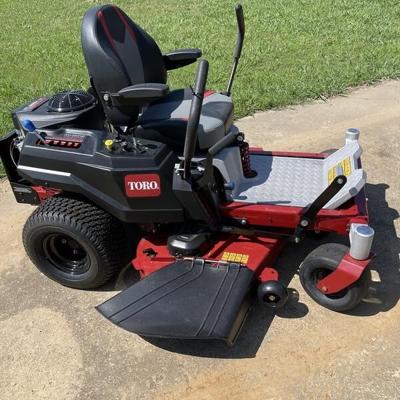


CHICAGO - A federal appeals panel has restarted part of a lawsuit from the family of a woman seeking to force lawn equipment maker Toro to pay for the loss of her lower leg in a riding lawnmower accident, which she has argued wouldn't have happened if Toro had designed the mower with more braking fail safes.
In the ruling, the appeals judges said a Rock Island federal district judge had been wrong to rule in favor of Toro, while rejecting a report from an expert witness allegedly indicating Toro could have installed a better independent brake system on that mower model, but allegedly may have chosen not to.
U.S. District Judge Sara Darrow granted summary judgment to Toro in litigation from Rebekah Hillman and her family, whose federal complaint alleged the mower lacked either a mechanical brake independent of the hydrostatic transmission or an interlock ignition system. The Hillmans also claimed a rollover protection system for rider safety might have prevented the injuries Rebekah suffered in June 2020.
According to the complaint, Hillman’s Toro Timecutter became stuck in a backyard flower bed. Her wife, Jennifer, disengaged the mower’s rear wheel by pushing in bypass pins in order to tow the mower back up a hill. But she didn’t pull those pins back out, so when Rebekah restarted the engine and pulled the motion control levers, the rear wheels didn’t engage although the parking brake released. The mower began to roll down the incline, the electric parking brake didn’t engage and when Rebekah attempted to jump off the mower the mower landed on her legs. The complaint said the fall and impact of the mower fractured her right knee and several left leg bones; surgeons ultimately amputated the left leg below the knee.
After discovery and exchange of expert reports, Toro moved for summary judgment and to exclude the Hillmans’ witnesses. The family voluntarily dismissed its breach of warranty claim, but opposed summary judgment on its other legal theories: strict products liability, negligent design and negligent failure to warn. Judge Darrow first agreed to exclude the Hillmans’ experts reports as either irrelevant or unreliable, then found the liability and design claims failed without supporting expert evidence and also granted summary judgment regarding failure to warn.
The Hillmans challenged that ruling before the U.S. Seventh Circuit Court of Appeals, focusing on the exclusion of their experts’ reports.
Seventh Circuit Judge David Hamilton wrote the panel’s opinion, filed Dec. 21. Circuit judges Frank Easterbrook and Nancy Maldonado concurred.
While the panel agreed with most of Darrow’s findings, Hamilton said they agreed evidence on the matter of an independent brake should’ve been allowed to stand in the record.
Darrow, Hamilton wrote, “satisfactorily addressed the reports by Kelly Kennett and David Bilek, and much of Thomas Berry’s report. The court explained specifically why, in its view, most of the opinions it excluded were unreliable, irrelevant or both.”
But the panel found Berry’s report on the need for an independent brake to be “relevant and reliable” and further noted Toro didn’t question his qualifications, which include a master’s degree in mechanical engineering and decades of professional experience.
Kennett also reported an independent brake would’ve entirely prevented the accident, which Darrow excluded as “too obvious,” while further explaining Kennett’s thoughts on a rollover protection system were unreliable based on a lack of testing data regarding the type of tumble involved in Hillman’s injury.
Bilek said an independent brake would’ve prevented the situation and called the absence of such a device a reason to find the Timecutter model defective and unreasonably dangerous, while drawing the same conclusion about rollover protection. Bilek also said a safety interlock would’ve prevented the accident.
Hamilton said Darrow “excluded the first because the causation opinion (like Kennett’s) was too obvious and because he conducted no testing on an independent brake. The court excluded the second opinion on a safety interlock as too obvious and excluded the third also because Bilek conducted no testing on how a rollover protection system would have prevented Rebekah’s injuries.”
Despite the panel’s deferential standard of review, Hamilton continued, it found portions of Berry’s report admissible despite his lack of testing. The panel noted Darrow also rejected Berry’s insight on a rollover system “because Berry offered no testing data on rollover protection systems in forward longitudinal rollovers, as opposed to lateral or backward longitudinal rollovers” but noted her opinion had no analysis of his independent brake report.
Because Darrow’s rejecting of Berry’s information was conclusory, Hamilton said, the panel conducted its own review and found the report satisfactory.
“He reported that at least one other zero-radius-turn mower manufactured by Toro had an independent brake,” Hamilton wrote. “He also reported that Hydro-Gear, the company that made the hydrostatic motor used in the Timecutter, ‘had available a disc brake design that could have been utilized.’ Berry also identified two other zero-radius-turn mowers with independent brakes. One was a John Deere model with a ‘simple park brake’ that ‘uses a lever to rotate two steel pawls against the rear tires’ and withstands slopes of up to 30 degrees — greater than three times the slope of the Hillmans’ lawn, at 9.5 degrees. He also identified a ‘more sophisticated brake system … such as that provided by Scag on its Patriot and Freedom Z mower,’ the latter being ‘only slightly bigger than the Toro Timecutter.’ As for reliability, Berry cited several industry publications and patents to support and explain the need for an independent brake.”
The panel took notice of Berry’s quote form the Fluid Power Safety Institute regarding “the human error of failing to pull out the bypass pins” because, Hamilton said, it “explained that operator error is not the only scenario for which an independent brake is essential.” There are other reasons for hydrostatic braking capacity to fail, the report said, all of which an independent brake could address.
“Berry did not dream up new and untested designs,” Hamilton wrote. “He relied instead on products that were on the market at the relevant time, including other zero-radius-turn mowers offered by Toro itself, as well as components offered by the manufacturer of the hydrostatic motor that Toro used in the Timecutter. He also relied on zero-radius-turn mowers offered by other companies that included independent brakes. Berry’s alternative designs were taken from comparable products actually on the market. We can reasonably infer that those mowers with independent brakes were commercially and technically practical. We see no reason to treat Berry’s alternative designs as based on speculation that required him to carry out tests before he could offer his opinion in court.”
The panel also said Toro offered alternative reasons to grant summary judgment on the independent brake theory. And although Darrow didn’t consider those arguments, Hamilton said, the positions didn’t sway the panel.
Toro argued the primary cause of injury was Jennifer’s failure to pull the bypass pins, but Hamilton said there is genuine dispute whether either woman was negligent and, if so, if that negligence caused more than 50% of the accident. Those considerations are fit for a jury, Hamilton said, not summary judgment. He likewise said the cost justification of adding an independent brake is disputed, as is whether the lack of such a brake was a material defect or complication with American National Standards Institute guidelines for zero-turn mowers.
The panel reversed judgment with respect to the independent brake theory and remanded the case for further proceedings.
The plaintiffs are represented in the case by attorneys Steven J Crowley, Edward J. Prill and Andrew L. Mahoney, of the firm of Crowley & Prill, of Burlington, Iowa.
Toro is represented by attorneys Thomas G. Grace, of Parsky & Galloway, of Chicago; and Kirk T. Florence, of Kilpatrick Townsend & Stockton, of Dallas.