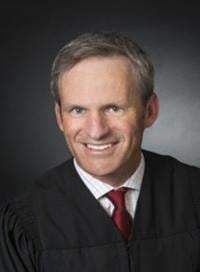

Morris
HELENA, Mont. – The federal judge who will decide whether Montana can ban corporations from making political donations already did so once.
Judge Brian Morris is presiding over a lawsuit challenging a ballot initiative passed by voters this month that labels corporations as “artificial persons.” Under Montana law, that means they can’t spend money on political candidates and causes.
Though BI-194, also called the “Montana Plan,” was aimed at overriding the effects of the U.S. Supreme Court’s ruling in Citizens United that affirmed corporate political speech as protected by the First Amendment, groups have warned that the new law will “harm everyone” – from family-owned ranches to small businesses and to the public in general, because less speech is less information.
State Attorney General Austin Knudsen has refused to defend the Montana Plan in court, where Morris, after a recusal by another judge first assigned to the case, will hear arguments.
Republican U.S. Sen. Chuck Grassley accused Morris of ignoring Citizens United when Morris was a Montana state Supreme Court justice. American Tradition Partnership had challenged Montana’s Corrupt Practices Act – a ballot initiative passed in 1912 aimed at preventing copper barons from controlling the state’s political process - in the wake of Citizens United.
In 2011, then-Justice Morris joined a majority that upheld the CPA in a ruling that was later overturned by the U.S. Supreme Court. The Montana court held that in Citizens United, which struck down a federal law, there was no “compelling interest to justify the speech restrictions at issue.”
In Justice Mike McGrath’s majority opinion, Morris and his colleagues found Montana had a sufficiently strong interest to place restrictions on speech like political spending, and that the litigants challenging the CPA had failed to show otherwise.
“The State of Montana introduced evidence of corruption at the time that the Corrupt Practices Act was enacted to establish what the Montana Supreme Court believed to be a compelling state interest,” Morris wrote in responding to questions from Grassley during the confirmation process.
“In our opinion, the evidence in the record further demonstrated that the limits on free speech contained in the Corrupt Practices Act had not materially limited the political speech of the appellees.”
On these grounds, Morris defended his choice not to join dissents filed by two other justices. Beth Baker cited Citizens United when writing “no sufficient governmental interest justifies limits on the political speech of nonprofit or for-profit corporations” and found disclosure requirements satisfactory.
Justice James Nelson said Citizens United “could not have been more clear” that corporations have rights under the First Amendment to engage in political speech. He found Montana’s arguments persuasive and said he would have preferred to rule for it but could not do so after the U.S. Supreme Court ruling, with which he “profoundly” disagreed.
“What ‘unique’ interests render Montana exempt from Citizens United,” Nelson asked. “One searches the court’s opinion in vain to find any.
“Unquestionably, Montana has its own unique history. No doubt Montana also has compelling interests in preserving the integrity of its electoral process and in encouraging the full participation of its electorate. And Montana may indeed be more vulnerable than other states to corporate domination of the political process.
“But the notion argued by the Attorney General and adopted by the Court—that these characteristics entitle Montana to a special ‘no peeing’ zone in the First Amendment swimming pool—is simply untenable under Citizens United.”
Voters in Montana this month overwhelmingly approved BI-194 on Election Day, deciding that companies should be considered artificial persons under state law. That prohibits them from expending money or anything of value to influence the outcome of a vote of the electorate.
The group that spearheaded the effort – Transparent Election Initiative – has asked to intervene in court proceedings to defend its constitutionality, since AG Knudsen said he would not do so.