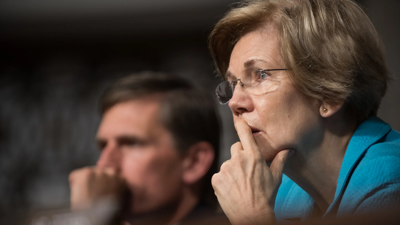


Sen. Elizabeth Warren, D-Mass., speaks during a Senate Armed Services Committee hearing on Capitol Hill in Washington, July 18, 2017.
WASHINGTON - Defense contractors and the U.S. Chamber are mobilizing to defeat a proposal embedded in the most recent defense authorization bill that would require them to obtain government approval before paying dividends or buying back their own stock.
Section 815 of the National Defense Authorization Act, sponsored by Democratic Sen. Elizabeth Warren, would bar contractors from paying distributions to shareholders, either as dividends or buybacks, unless they obtain a waiver from the War Department. The waiver process would give the government close oversight of corporate capital decisions by requiring contractors to make approved investments before they can pay any dividends.
The U.S. Chamber is leading a coalition of 40 industry groups opposing the measure, which it says would permit the federal government to interfere with decisions normally left to corporate directors. Waivers would be granted for “qualifying defense investments” directly related to increasing its defense production capacity, including plants and equipment, worker training programs and research and development.
Opponents say the rule would allow future administrations to influence decisions unrelated to defense. More than 80% of companies in the Standard & Poor’s 500 Index, including big defense contractors like Lockheed Martin and Raytheon, pay dividends or buy back shares. But the rule would also snare companies like Dell and Microsoft, which recently won a $9.7 billion contract from the War Department.
“At a time when policymakers are working to strengthen the defense industrial base, attract commercial technology companies, and encourage greater private-sector investment in national security, Section 815 moves in precisely the opposite direction,” the Chamber said in a July 14 letter to the Senate.
Section 815 has bipartisan support and is modeled partly on a January executive order from President Trump stating defense contractors are “not permitted in any way, shape, or form to pay dividends or buy back stock, until such time as they are able to produce a superior product, on time and on budget.” The executive order set up a review system similar to the one described in Section 815, with penalties including a cap on executive salaries until contractors come in compliance.
Section 815 is stricter, barring all dividends and buybacks unless companies obtain a waiver. The bill is currently stalled in the Senate due to Democrat opposition, but if passed it would go into effect in June 2027. The House version of the NDAA doesn’t have an equivalent measure.
Stock buybacks have come under particular criticism from liberal politicians, who view them as a form of market manipulation, although most economists believe there is no practical difference between returning capital to shareholders through dividends or buying back shares.
“Remember that for most of the history of the (Securities and Exchange Commission), stock buybacks were regarded as nothing more than market manipulation,” Sen. Warren said in a recent interview.