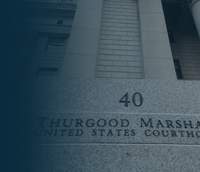


U.S. District Court for the Southern District of New York
NEW YORK – Women claiming acne medication could cause cancer have lost their lawsuits, as a New York federal judge found their arguments preempted by the Food, Drug and Cosmetic Act.
Plaintiffs including Lucinda O’Dea, who filed five lawsuits in one day after the testing laboratory Valisure said it detected benzene in medications after heating them to 170 degrees, couldn’t make state-law claims over products that had received approval from the FDA, Judge Analisa Torres wrote Sept. 15.
Several companies were sued in the aftermath of Valisure’s study – a frequent occurrence when the lab issues results, despite criticism from the FDA. At issue in Wilson’s ruling were lawsuits against L’Oreal over CeraVe Acne Foam Cream Cleanser, CeraVe Acne Foaming Cream Wash and La Roche-Posay Effaclar Duo Dual Acne Treatment.
They were mislabeled because there wasn’t a warning benzoyl peroxide could turn into benzene when super-heated, plaintiffs claimed in hoping to avoid preemption under the FDCA. But Judge Torres found that wasn’t the case.
“Plaintiffs’ argument calls for the Court to find that a benzene warning was required or the BPO products… a finding that would directly contravene the Acne Monographs explicit labeling requirements, which allow BPO (the purported source of the benzene) as an ingredient and does not require a benzene warning,” she wrote.
Valisure created tens of thousands of lawsuits with its findings on an ingredient in heartburn medication Zantac when it heated it to 266 degrees Fahrenheit in an artificial stomach to create NDMA. It also exposed Zantac to salt levels that would kill a human, and the FDA refuted those results after issuing a short-lived recall. Lawsuits have been tossed over the admissibility of plaintiff experts who attempted to back Valisure’s claims.
For the acne medicines, it heated them to 170 degrees for extended periods of time, saying it was a reasonable estimation of what might occur in a shipping container or hot car. The FDA again called bull, finding last year that even with daily use of the products for decades, “the risk of a person developing cancer because of exposure to benzene found in these products is very low.”
The FDA tested 95 drugs and found only six lots with small problems, then went on to warn labs like Valisure to use validated testing methods, saying Valisure's processes may result in much higher reported levels of contaminants like benzene.
"FDA has continued to raise concern that use of unvalidated testing methods by third-party laboratories can produce inaccurate results leading to consumer confusion," the FDA said.
The acne-med lawsuits did not allege cancer, only that plaintiffs were misled into paying for a product that could harm them. A federal panel refused to create a multi-district litigation proceeding for these and similar lawsuits against other companies.