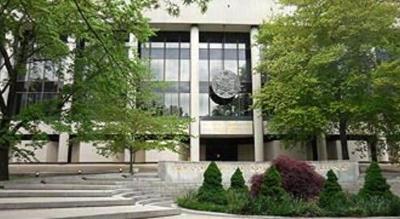



Robert C. Murphy Courts of Appeal Building in Annapolis, Md.
ANNAPOLIS, Md. - The lawful distribution of opioids is not an actionable public nuisance under Maryland law, says the Maryland Supreme Court, which declined “to recognize a public right to be free from the adverse effects associated with a lawful product being diverted, misused, or abused.”
The Maryland high court’s recent ruling answered a certified question from Maryland federal court in a public nuisance suit brought by Anne Arundel County, which is one of many local governments attempting to hold the country’s largest mail order pharmacies and pharmacy benefits managers responsible for the opioid epidemic.
The case, Express Scripts, Inc. v. Anne Arundel County, Maryland, completes a pair of losses in as many days for the County, whose attempt to use public nuisance law to hold the oil industry liable for climate change in a separate lawsuit was described by the Court as “so far afield from any area of traditional state or local responsibility that it cannot be seriously contemplated.”
In November 2023, two years after launching its effort to hold oil companies liable for the alleged effects of climate change, Anne Arundel County, like other municipalities across the country, turned its sights on making the country’s largest pharmacies pay to clean up what the County described as “the worst human-made epidemic in modern medical history – an epidemic of addiction, overdose and death caused by an oversupply of opioids flooding communities from powerful corporations who sought to profit at the expense of the public.”
The County’s single count complaint claimed that the pharmacies acted “intentionally, recklessly, or negligently” by making legal and federally approved opioids available to the residents of Anne Arundel County and “endanger[ed] or injure[d] the property, health, safety or comfort of the public in Anne Arundel County,” and, in addition to injunctive relief, sought compensatory damages and costs for abating the asserted public nuisance.
The Maryland high court refused to go along with the County’s attempt to expand the law of public nuisance in Maryland, which the defendants argued: Involves a novel public nuisance claim that does not involve real property, is nothing more than a pooling of individual injuries and seeks “monetary relief in the form of an abatement order reimbursing past and future costs of public services.”
Writing for the court, justice Brynja Booth, who also penned the Court’s opinion in the climate change case, reviewed the history of public nuisance law tracing back to the English common law and its adoption in early America and Maryland.
“Public nuisance involves an unreasonable interference with the rights of the community at large and was historically punishable as a crime,” she wrote. “[W]e have rejected claims that have attempted to expand the boundaries of nuisance beyond the traditional common law parameters.”
This included, the Court stated, attempts to adopt notions of public nuisance advanced by the Restatement (Second) of Torts § 821B, which broadly defines a public nuisance as “an unreasonable interference with a right common to the general public.”
“To recognize a general common law ‘public right’ to be free from any potentially injurious harm associated with a lawfully licensed product being diverted, abused, or misused,” the Court reasoned, “would permit nuisance liability to be imposed on an endless list of manufacturers, distributors, and retailers of manufactured products that are intended to be used lawfully, when such products are misused and cause injury.”
Ultimately, the Court skirted the issue of whether Maryland public nuisance law should be expanded consistent with the Restatement, finding that the County failed to allege that the pharmacy defendants’ distribution of opioids affected a public right.
“No case of this Court has recognized a broad public right to be free from all potential harms associated with the prescribing and dispensing of opioids,” the court found.
And that the distribution and sale of opioids is highly regulated on both the state and federal level added to the court’s hesitation to find a public nuisance.
“To the extent that the County seeks to impose tort liability for the Defendants’ lawful conduct undertaken pursuant to the federal and state regulatory schemes that authorize the lawful dispensing of opioids and the administration of benefit plans for licensed opioids, Congress and the General Assembly have determined that the social utility of the licensed dispensing of opioids outweighs the gravity of the harm in permitting their lawful dispensing,” the court wrote.
“Complex societal problems are best suited for the Legislature,” the court concluded, “and judicial restraint is the appropriate principle to apply here.”
Justice Peter Killough filed a concurrence to note that he viewed the majority’s opinion as unnecessarily closing the door to the potential expansion of Maryland’s public nuisance law. In doing so, he alluded approvingly to claims of air pollution as a public nuisance, “which directly affects everyone in the state of Maryland,” and admitted that claims related to the mental health effects of social media for adolescents is “a potentially harder case.”