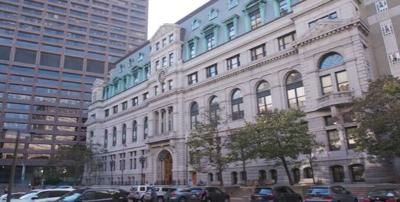



John Adams Courthouse, home of the Massachusetts Supreme Judicial Court
BOSTON - The federal Telecommunications Act of 1996 blocks attempts by a local public health board to regulate the operation of a cellular telephone tower, the Massachusetts Supreme Judicial Court has ruled.
In a July 23 ruling, the Massachusetts high court barred a lawsuit brought by residents of Pittsfield to force the Pittsfield Board of Health to reinstate an order to show cause against a cell tower operator on claims the tower was causing symptoms consistent with radiation sickness in local residents.
The case was part of a campaign by several Pittsfield residents to stop a Verizon network operator from building a cell tower near their properties. The tower was originally permitted in 2017, though construction didn’t begin until the spring of 2020. In April 2020, residents with property abutting the cell tower site sued to reverse the zoning approval.
The cell tower went online in August 2020 even while the residents took their zoning case to Massachusetts’ high court, which ultimately ruled against them in May 2022.
Undeterred by the setbacks in their zoning challenges, the residents raised claims with the Health Board that the radio frequency emissions from the cell tower was causing them headaches, tinnitus and nausea. The Board investigated, declared the tower a public nuisance and ordered the tower operator to show cause why the Board should not order the tower shut down. The order gave the operator seven days to either respond or shut down operations.
The tower operator chose a third option – it sued in federal court claiming that the federal Telecommunications Act preempted the Board’s authority to regulate cellular towers. In response, the Board withdrew its show cause order and voluntarily dismissed its case.
That still didn’t stop the residents, however. They sued the Board in Superior Court, challenging the Board’s decision to rescind its order as arbitrary and capricious and a violation of its statutory duty “to eliminate nuisances injurious to public health.”
This time it was the Board arguing that its actions were constrained by federal law, however. The trial court agreed and dismissed the case. In a unanimous opinion written by Chief Justice Kimberly Budd, the Massachusetts Supreme Court also agreed.
That the Board’s order conflicted with the federal TCA was clear to the Court. “[T]he TCA sought to remove ‘the impediments imposed by local governments upon the installation of facilities for wireless communications,’" wrote Budd. “Enforcement of the board's order would have frustrated the TCA's objective of creating uniform wireless networks nationwide,” the Court found.
For their part, the residents argued that the Board’s show cause order had limited impact on network operations and was simply an attempt to negotiate over the operation of the cell tower. “A mere order to appear and show cause cannot conceivably threaten network disruption,” they argued. “Telling Verizon to show up and talk increases communication.”
The problem, as pointed out by interested parties such as the U.S. Chamber of Commerce, is that a ruling in favor of the residents would set up a patchwork of local regulation across the country that would increase the cost of operating a nationwide cellular network. “A reliable, efficient, accessible wireless telecommunications network is crucial to millions of Americans and businesses alike,” the Chamber declared. “[I]diosyncratic state regulations increase compliance costs, reduce telecommunications coverage for American citizens and businesses alike, and ultimately harm the user experience and public safety.”
Even the Health Board agreed. “Common sense also dictates that the Board was preempted from attempting to regulate the operation of the Tower,” the Board reasoned in its brief. “To hold otherwise, leads to absurd results and is tantamount to saying ‘you can build your tower, but you cannot operate it, even though you secured a license, zoning approval, and are operating within the applicable standards.’”
For the Court, the case turned on Congress’ delegation of authority to regulate the operation of cellular networks to the Federal Communications Commission. “Congress granted the FCC the exclusive authority to set RF emission standards so that there would be one standard within which operators could freely optimize their networks across jurisdictional boundaries,” Budd wrote. “[W]here State law stands as a clear obstacle towards achievement of a clear Federal goal, as we conclude the order does, the local law must yield to the Federal law under our constitutional system.”
The Massachusetts court’s ruling is in line with others that have refused the invitation to regulate business activity through public nuisance law. In March, the Maryland Supreme Court barred Anne Arundel County from suing the country’s largest pharmacy benefits managers as a public nuisance. And federal and state courts in Pennsylvania, South Carolina, New York, California, Maryland, New Jersey and Puerto Rico have dismissed cases attempting to regulate emissions by suing oil and gas companies under theories of public nuisance.