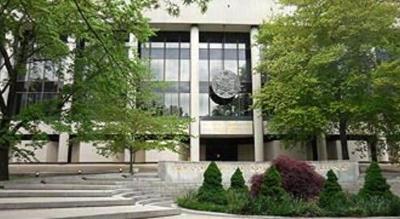



Robert C. Murphy Courts of Appeal Building in Annapolis, Md.
ANNAPOLIS, Md. - In a win for plaintiffs lawyers, the Maryland Supreme Court has found that producers of asbestos-containing products can be held strictly liable to a household member whose alleged exposure was through dust brought home on the clothes of someone exposed at work.
On April 27, the court unanimously ruled that a plaintiff claiming strict liability for design defect based on asbestos exposure need not prove, in addition to the usual elements of a strict liability claim, that companies also have a duty to plaintiffs who often claim they breathed asbestos while shaking work clothes before washing them.
The court’s ruling responded to a certified question from the District of Columbia Court of Appeals in a case against General Electric in which the plaintiff, Jo Ann Allen, alleged she was exposed to asbestos and contracted mesothelioma and lung cancer because of dust her husband carried home on his clothes.
According to Allen, her late husband Willard Phillips worked for GE installing asbestos-containing insulation at Potomac Electric Power Company’s Chalk Point power plant in Aquasco over the course of several weeks between mid-1963 and late-1964, a process that threw off significant amounts of dust in the areas where Phillips worked. Allen testified at trial that, while she never visited the Chalk Point power plant herself, every other day she shook and laundered her husband’s dusty work clothes.
In September 2020, Allen sued GE in D.C. Superior Court alleging negligence, strict liability for failure to warn and strict liability for design defect.
Allen passed away in November 2021, and Robin Quinn, the appellant in the present case, was substituted as personal representative of Allen’s estate.
During briefing on GE’s motion for summary judgment, Quinn submitted affidavits attempting to link GE’s liability to her alleged asbestos exposure. According to two expert affidavits Allen submitted, the need to avoid carrying asbestos home on clothing was well-known, at least as far back as 1965, and Allen’s exposure to dust from the insulation Phillips installed and brought home on his clothes was the cause of Allen’s mesothelioma and lung cancer.
The case ping-ponged between the D.C. trial court and appellate courts over the course of three years before the D.C. Court of Appeals, in June 2025, certified to the Maryland Supreme Court “the question of whether [under Maryland law] a person in the position of [Allen], who is a household member of a consumer or user of the product at issue but not a user or consumer herself, must prove the additional element of duty” in a case alleging strict liability for design defect. Allen’s other claims had been dismissed by the D.C. Superior Court and were not appealed.
The Maryland high court answered “no,” and held “that with respect to an asbestos product strict liability design defect claim, a person in the position of Mrs. Allen—a household member of a consumer or user of the product at issue who alleges injury caused, through no fault of her own, by exposure to asbestos from dust brought home on the work clothing of the consumer or user—is not required to prove the element of duty in addition to the four elements of an action in strict liability set forth in” Maryland precedent.
The Court’s decision, written by Justice Shirley Watts, reviewed the history of strict liability in Maryland, including its adoption of the Restatement (Second) of Torts §402A.
“’Strict liability in tort is today largely a societal decision that the cost of injury should be borne by those best able to bear such costs,’” Justice Watts wrote. “’[I]mposing strict liability on manufacturers for defective products is equitable because it shifts the risk of loss to those better able financially to bear the loss’ and ‘the requirement of proof of a defect rendering a product unreasonably dangerous is a sufficient showing of fault on the part of the seller to impose liability without placing an often impossible burden on the plaintiff of proving specific acts of negligence.’”
Though Restatement §402A does not directly address the issue of whether a manufacturer can be held strictly liable for harms caused to bystanders, i.e., people who are not direct consumers or users of the products, the court found that the comments to the Restatement do not rule out the possibility and Maryland precedent has approved of such liability.
Maryland case law “did not purport to limit the definition of the word ‘bystander’ to a person who was injured at a time or location where the product was being used,” the court stated.
“Our holding stems from the concept that it is reasonably foreseeable that a person in Mrs. Allen’s position may come into contact with the product and that, therefore, the seller may be subject to liability for physical harm caused thereby, if the elements of a strict liability design defect claim are satisfied.”
Those elements include showing “that (1) the product was defective at the time it left the control of the seller, (2) it was unreasonably dangerous to the person, (3) the defect was a cause of the injuries, and (4) the product was expected to and did reach the person without substantial change in its condition,” the court wrote.
“‘Proof of a defect in the product at the time it leaves the control of the seller implies fault on the part of the seller sufficient to justify imposing liability for injuries caused by the product,’” it added. “[B]ystanders—nonusers and non-consumers—'are protected under the doctrine of strict liability in tort.’”