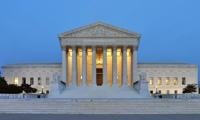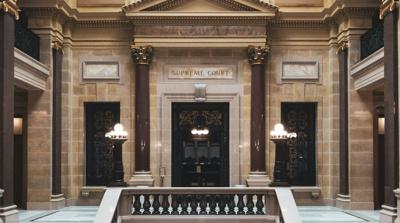



The entrance to the Wisconsin Supreme Court chamber inside the State Capitol in Madison
MADISON, Wis. – The safety of asbestos that is intact divided Wisconsin’s supreme court justices 5-2, with the majority ordering beer-maker Pabst Blue Ribbon to pay more than $20 million to the estate of a man who died from mesothelioma.
The plaintiff in the case, Gerald Lorbiecki, was diagnosed in 2017, sued PBR and other companies and later passed while his case was pending. This week’s ruling affirms a large jury verdict and faults PBR for having asbestos in its brewery, though it was undisturbed and safe before pipe workers like Lorbiecki began to chip it off.
The court will soon have five liberals to two conservatives after the election of Chris Taylor. She will replace conservative Rebecca Bradley, who joined in Justice Annette Ziegler’s critique of the ruling.
Lorbiecki was a steamfitter who was employed as an independent contractor at the PBR brewery in the mid-1970s. At issue in his case was Wisconsin’s “safe-place statute,” which Wisconsin was the first state to enact.
It says employers must provide a safe place of employment. PBR was not Lorbiecki’s employer and argued it didn’t apply to his case, but the majority said it was reasonable for the jury to conclude PBR “retained control over the place where he worked.”
And that work involved asbestos-containing pipes. Undisturbed asbestos is not harmful, but jurors decided Lorbiecki and others who worked on those pipes likely would have chipped excess off and released it into the air.
“On the basis of this evidence, a reasonable jury could have concluded that Lorbiecki was exposed to an unsafe condition – airborne, not undisturbed, asbestos – during his work at Pabst, and that the company had notice of that unsafe condition,” Justice Rebecca Dallet wrote.
PBR was the lone defendant to take the case to trial, and the jury assessed 22% of more than $6.5 million in compensatory damages to it. Jurors also hammered the company with $20 million in punitive damages after finding it acted “in an intentional disregard” of Lorbiecki’s rights.
In her dissent, Justice Ziegler argued PBR should have been granted summary judgment before the verdict because it was well-established that property owners who turn over control of safe premises to an independent contractor are not liable for an employee’s injuries.
That the PBR plant was unsafe before the contractor showed up was never proven, she said. Hazards associated with asbestos were the problem of the contractor, Ziegler wrote, and the majority ruling “blurs the distinction.”
“I indeed feel very sorry for Mr. Lorbiecki, his wife, and loved ones. No one should so suffer,” Ziegler wrote.
“But under the law, he was an employee of an independent contractor, was injured in the scope of his employment, which required him to ‘hammer and chisel away at asbestos-containing insulation.’
“Prior to that work, nothing indicates that the building was in an unsafe condition. The mere presence of asbestos on the property, particularly in an undisturbed state, does not qualify as an ‘unsafe condition’ on this record.”