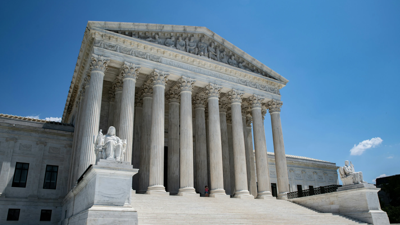



The U.S. Supreme Court stands in Washington.
WASHINGTON - A Colorado distributor of products shipped from out of state – a so called “last-mile” distributor – cannot be compelled to arbitrate disputes under the Federal Arbitration Act, says the Supreme Court.
In a unanimous opinion written by Justice Neil Gorsuch and delivered Thursday, the court ruled that the FAA’s exclusion of employment contracts for workers engaged in interstate commerce covers a local bakery distributor who never crosses state lines.
Angelo Brock is a franchised Denver-area distributor of Flowers Foods’ baked goods, which include such products as Butterscotch Krimpets, Jumbo Honey Buns, and Wonder Bread.
In 2022, Brock filed a class action lawsuit against Flowers Foods claiming the bakery misclassified Brock and other local distributors as independent contractors and underpaid them in violation of state and federal law.
Flowers Foods asked the district court to compel arbitration as provided for in its franchise agreement. Brock countered that the FAA excluded from arbitration the distribution agreements like his.
The FAA was enacted in 1925 and provides that an arbitration agreement in any contract “evidencing a transaction involving commerce” is “valid, irrevocable, and enforceable.” This provision is regularly used to compel arbitration of disputes and avoid court litigation.
There’s an exception to this statutory preference for arbitration, however. Section 1 of the FAA carves out of the Act’s coverage “contracts of employment of seamen, railroad employees, or any other class of workers engaged in foreign or interstate commerce.”
Both parties agreed that Brock never crossed state lines in his work distributing Flowers Foods’ products. As explained by Flowers Foods, “[u]nder Flowers’ ‘direct-store-delivery system,’ Brock, Inc. orders products from Flowers… delivers those products to a warehouse in Colorado, where they are unloaded by Flowers... then picks up the products from the warehouse and delivers them to his customers.”
“Mr. Brock was responsible for the last leg of that journey—from Flowers’ regional warehouse in Colorado to stores throughout the state,” Brock’s brief explained.
This distribution arrangement – where a supplier produces and delivers its products to a particular warehouse for final, local delivery by an in-state franchisee – is commonly used in a number of industries, including by nationwide retailers like Amazon.com.
The Independent Bakers Association explained, “most distributors do business within defined geographic territories that exist entirely within a single State—as respondent’s company, Brock, Inc. did—never transporting their products across state lines.”
Business groups warned that the lack of a bright-line rule placing “last-mile” distributors within the FAA’s coverage would lead to lengthy and expensive litigation over the Act’s applicability in individual cases.
“[C]ourts will be forced into a lengthy series of complex inquiries that produce unpredictable and inconsistent results ‘for reasons that have nothing to do with the on-the-ground work [the workers] perform,’” the U.S. Chamber of Commerce argued to the Court. “And the prospect of lengthy and burdensome discovery into application of the Section 1 exemption’s residual clause may cause some defendants to forgo their arbitration rights altogether—a result antithetical to the FAA’s federal protection of arbitration agreements.”
According to Amazon, “[a]ll this litigation over whether a case should be in litigation at all is antithetical to the FAA’s basic aims and underscores the flaws in [Brock’s] vision of the statute.”
The Court rejected these arguments, however, finding that the plain reading of the FAA favored application of §1’s exclusion from arbitration. Flowers Foods “ventures all upon one cast, asking us to adopt a bright-line rule that an individual can never qualify for §1’s exemption unless he crosses state lines or interacts with vehicles that do,” Gorsuch wrote. “And whatever other limits §1 may or may not contain, we do not see how the statutory text can support that one.”
“We have already held… that §1 does not require workers to cross state lines,” the court reasoned. “Nor, we now add, does §1 turn on a game of tag with vehicles that do. At least sometimes, a worker who transports goods on an intrastate leg of an interstate journey can qualify for §1’s exemption without satisfying either of those criteria.”
Brock’s case will now proceed in federal court.