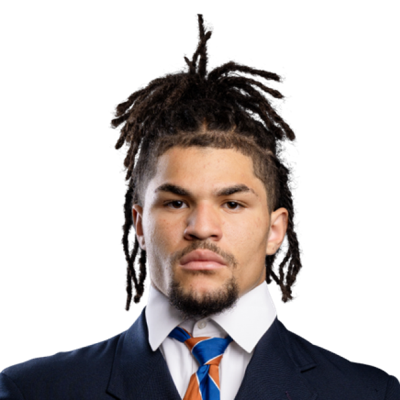


Dominik Calhoun
SAN FRANCISCO - A federal judge has ruled the governing body for California high school sports doesn’t have to face a class action regarding its transfer regulations, but may need to address litigation regarding name, image and likeness compensation for high school athletes.
Dominik Calhoun, a former football and track athlete who graduated from Pittsburg High School last spring and now is a safety at Boise State University, sued the California Interscholastic Federation and its 10 regional sections, along with a group of media and technology companies, alleging illegal limits on transfers, compensation and the ability to sign sponsorship deals.
In an opinion filed Jan. 9, federal Magistrate Judge Laurel Beeler refused to dismiss the claim outright. According to Beeler, Calhoun challenged the CIF rules and claimed the media companies monetize high school sports without paying players or facing competitive pressure. Those entities are PlayOn! Sports, which owns MaxPreps, NFHS Network and the GoFan ticketing service; Playfly, a California signage, sponsorship and outreach marketer; SBLive Sports, which offers scorekeeping and software; and Spectrum SportsNet, which holds certain CIF broadcasting rights.
Calhoun challenged three CIF rules: one that defines an athlete’s amateur status, another intended to limit students from transferring schools based on athletic considerations, and a third that allows students to license their names, images and likenesses, but only if there is no affiliation with their school, league or the CIF.
In seeking dismissal, the CIF sought to invoke 11th Amendment immunity protections for government entities. Beeler found it did not meet eligibility criteria.
“School districts have general control of interscholastic athletic policies, and CIF, a voluntary association, has the authority to enact and enforce rules relating to the administration of interscholastic athletics,” Beeler wrote. While the member schools have 11th Amendment immunity, and while the CIF is “subject to classic government requirements such as open meetings under the Brown Act and public-records requirements,” she continued, the law creating it “does not explicitly characterize CIF as a government instrumentality and instead allows its existence as a voluntary organization.”
Beeler further noted public and private school delegates approve and impose CIF bylaws, not state officials, and said its funding comes from dues, revenues and sponsorships. She also said state courts have treated certain CIF decisions as state actions under California law, but those instances don’t establish the Federation as an official government entity.
No state body appoints CIF members, nor does the state dictate or enforce the group’s eligibility rules, Beeler said. She also rejected the contention that a $10.5 million general fund appropriation as a Covid relief measure is a meaningful data point in the larger context of the primary CIF funding mechanisms.
Yet although the CIF cannot invoke blanket immunity from Calhoun’s putative class action, Beeler explained there is a “state-action immunity doctrine” barring antitrust litigation if such claims seek to throttle activities the legislature directed.
“The California Education Code prohibits high school officials from exerting undue influence in a student’s decision to join a particular athletic program, prohibits recruitment of athletes from other schools, prohibits consideration of athletic performance or targeting students based on athletic skills, and authorizes the uncompensated use of student athletes’ NIL,” Beeler wrote.
She further said state law allows schools to join groups for the purpose of administering regional or statewide sports and said that “regulatory scheme demonstrates that the Legislature anticipated and intended restraints on competition in favor of the objectives of amateurism and prioritizing education. Rules relating to payment, transfers and use of NIL without permission are reasonably foreseeable results of a regulatory scheme that forbids undue influence on enrollment decisions, bars recruitment of athletes from other schools or consideration of athletic performance and allows the use of NIL without compensation. More specifically, the amateurism rule (with its limits on cash payments) and the rules on transfer are reasonably foreseeable results of the regulatory scheme.”
There is more nuance, however, regarding rules about NIL compensation. Whereas broadcasters and other companies don’t need permission to use student’s names and images, CIF bylaws limit students from profiting off their own identities as athletes.
Beeler found nothing in the record showing state lawmakers “clearly intended to deprive student-athletes categorically of revenues derived from their NIL that includes their school-affiliated identities” or that the limitation “is a reasonably foreseeable result” of a rule allowing uncompensated NIL use in broadcasts. As such, state-action antitrust immunity is not available on those claims.
Beeler also found the media defendants don’t have a connection to or influence on the rules Calhoun challenges beyond entering into contracts under an established framework. And while “high school athletes do not have a statutorily enforceable right to payment for the use of their NIL in broadcast footage,” she wrote, Calhoun “concedes that he lacks standing for injunctive relief and intends to amend to add plaintiffs with standing.”
She granted him leave to amend his filing and said she’d consider the standing issue in the context of an amended complaint. But she also said Calhoun didn’t have a plausible explanation for why the NIL value of a California high school athlete isn’t “reasonably interchangeable with the NIL of high-school athletes from other states,” a distinction that hampers his anticompetitive market allegations. She also said allegations under California’s Unfair Competition Law only survive to the extent they can fall under the surviving antitrust claims.
Beeler said amended complaints are due by Feb. 2.
Calhoun is represented in the case by attorneys Joel Benjamin Young, of the Tidrick Law Firm, of Walnut Creek; and Yaman Salahi and Nicole Cabañez, of Salahi P.C., of San Francisco.
The CIF is represented by attorney C. Scott Lent and Daniel B. Asimow and others with the firm of Arnold & Porter Kaye Scholer, of San Francisco, New York and Sacramento.
Playfly is represented by attorney Randall S. Luskey and others with the firm of Paul Weiss Rifkind Wharton & Garrison, of San Francisco, New York and Washington, D.C.
Spectrum Sportsnet is represented by attorney Britt M. Miller and others with the firm of Mayer Brown, of Chicago and Palo Alto.
Defendants 2080 Media, Inc.; VNN Media, LLC; MaxPreps, Inc.; NFHS Network, LLC; and Huddle Tickets, LLC are represented by attorney Yehudah Buchweitz and others with the firm of Weil Gotshal & Manges, of New York, Washington, D.C., and Redwood Shores.
SBLive Sports is represented by attorney Dana J. Finberg and others with the firm of O’Hagan Meyer, of San Francisco and Richmond, Virginia.