
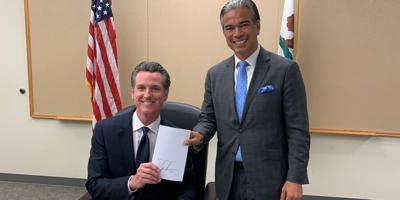


From left, California Gavin Newsom and California Attorney General Rob Bonta
SAN FRANCISCO — California can't force companies to report the so-called "greenhouse gas" emissions of all of their suppliers, nor can the state force businesses to self-report the "climate risk" posed by their businesses, a federal appeals court has ruled.
But by leaving other reporting requirements in place, the decision still leaves the door open to future state laws potentially requiring "disclosures" from businesses and potentially even individuals on a host of other potentially controversial social and political topics, in the name of advancing other policy goals preferred by state officials, a dissenting judge said.
On Nov. 9, a divided three judge panel of the U.S. Ninth Circuit Court of Appeals ruled 2-1 to block much of California's legal regime mandating so-called "climate disclosures" from businesses.
The decision comes as the latest steps in the court fight over the fate of two California laws. Known as Senate Bill 253 and Senate Bill 261, the measures were enacted by the state's Democratic governing supermajority and signed into law by Gov. Gavin Newsom in 2023.
Together, the laws would empower California emissions regulators to require businesses to publicly report their so-called "greenhouse gas" emissions. Supporters say the measure will help the state advance California Democrats' goal of reducing carbon emissions, which they blame for so-called "climate change."
SB 253 specifically would force companies to not only "disclose" their own estimated "greenhouse gas" emissions created in the course of their business operations, but also fold in the estimated emissions of all suppliers and contractors who aid their businesses.
And then, under SB 261, the state further would require businesses to assess the "climate risk" posed by their business operations, using terms and risks defined by the state.
The laws were challenged in 2025 by business groups led by the U.S. Chamber of Commerce and California Chamber of Commerce, asserting the laws would trample the free speech rights of businesses under the First Amendment.
Further, the business groups claimed the measures amounted to an unprecedented attempt to force an untold number of businesses, not only in California, but across the globe, to massively enhance California's ability to enforce its emissions rules and advance its regulatory agenda. And the business groups said the laws would force businesses to make themselves targets for political pressure campaigns, in part by forcing the public posting of "inexact, misleading" statements concerning the state's definition of their "climate risk."
A Los Angeles federal judge refused the Chambers' attempt to block the laws, saying the mandated disclosures are simply government regulation of "commercial speech." He agreed with California Attorney General Rob Bonta that the laws merely compel companies to disclose information needed by investors and consumers to make informed economic choices.
On appeal, however, the Ninth Circuit judges said the question was not nearly that cut and dry, and reversed much of the lower court's decision denying the injunction.
The majority decision was authored by Ninth Circuit Judge Jacqueline Nguyen, joined by U.S. District Judge Kiyo Matsumoto, a New York federal judge who was seated on the panel by designation.
Ninth Circuit Judge Mark J. Bennett dissented, in part.
Nguyen was appointed by former President Barack Obama. Matsumoto was appointed by former President George W. Bush.
Bennett was appointed during the first term of President Donald Trump.
All of the judges agreed that SB 261 clearly transgresses the First Amendment by all but forcing businesses to speak in ways dictated by the state.
In the majority opinion, Nguyen said that measure forces companies to "answer a speculative and contested policy question" and "address climate-related risks in accordance with State-prescribed language."
And all of the judges further agreed that SB 253's mandates forcing companies to attempt to assess the "climate risk" posed by their supply chains and other companies involved in the production of their goods or services also runs afoul of the Constitution, as the companies cannot be forced to speak for others.
However, the judges differed on the ability of California to force companies to "disclose" their own "greenhouse gas emissions."
In the majority opinion, Nguyen agreed those mandates only address fact-based "commercial speech" designed to help investors, insurers and customers know more about the "climate risk" posed by the businesses and then advance California's goals of reducing emissions and combatting "climate change."
Nguyen said mandated disclosures don't transform commercial speech into more stringently protected forms of constitutional speech "simply because it 'can be tied in a some way to a controversial issue."
"The fact that emissions disclosures may, to some degree, bear on climate policy debates does not convert transaction-relevant disclosures into noncommercial speech," Nguyen wrote.
In dissent, however, Bennett said the majority's decision leaves a dangerous pathway for states and other governments to use to force companies and perhaps even individuals to make any host of "disclosures" on hot topics that could leave them exposed. Bennett said the list could potentially include mandatory disclosures on such subjects as abortion, immigration or even the political beliefs of business owners – all information that Bennett said "is ordinarily unavailable to investors."
"Because the majority opinion can be read as equating investors’ interest in companies with consumers’ interest in products, there may be 'no end to the information that states' can now 'require [companies] to disclose,'" Bennett wrote.
Bennett said both SB 253 and SB 261, in their entireties, unconstitutionally force businesses to speak on matters on which they may prefer to be silent.
"Here, the challenged laws compel the disclosure of information (and more) on the State's terms," Bennett wrote, even though the Supreme Court "has held that the creation and dissemination of information are speech within the meaning of the First Amendment."
The state, however, is not yet free to begin enforcing the surviving portions of SB 253. The appeals court sent the matter back to the federal district court for further proceedings on the question of whether the blocked sections of SB 253 should mean the entire law should be invalidated or if the blocked sections can be severed and allow the remainder of the law to remain valid and enforceable.
Following the ruling, the California Chamber praised the decision. In a statement, CalChamber President and CEO Jennifer Barrera said: “The appeals court has made it clear that both of these laws are clear examples of legislative overreach.
“... In both instances, California lawmakers failed to recognize that even when addressing the issue of climate change, the ends don’t justify the means.”
In a statement published by Courthouse News, Daryl Joseffer, president of the U.S. Chamber Litigation Center, said: “The Ninth Circuit’s decision to halt the most onerous parts of California’s climate disclosure laws is an important victory for businesses and the protection of their First Amendment rights.
“The injunction prevents the state from imposing massive compliance costs on companies, especially small businesses, and confirms that states cannot unilaterally impose sweeping, extraterritorial mandates.”
The U.S. Chamber and CalChamber were represented in the matter by attorneys with the firms of Gibson Dunn & Crutcher, of Los Angeles and Washington, D.C., and Eimer Stahl, of Campbell, California, as well as attorneys from the U.S. Chamber of Commerce.
California was represented by attorneys from the office of Attorney General Rob Bonta.
