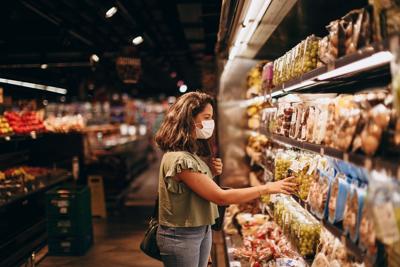



A woman shops for groceries packaged in plastics in a supermarket.
SACRAMENTO — Texas, Nebraska and other Republican-led states have stepped up their efforts to force an answer from a California federal court over their claims that California is attempting to unconstitutionally impose its environmental policies on the rest of the country, as they seek a court order blocking California from enforcing a law banning a host of disposable plastic packaging and products.
On Aug. 19, a coalition of attorneys general from 17 states, together with the National Association of Wholesaler-Distributors trade group, formally filed a motion for a preliminary injunction blocking the law.
"... California can implement California solutions to California problems reflecting California’s preferences—in California," the states said in their new filing. "But California may not impose California solutions on any other State, much less the entire nation.
"Doing so would violate the Constitution’s horizontal separation of powers, its guarantee of due process of law, and its prohibition against state regulation of interstate commerce.
"Yet that is exactly what California has done here," the states said.
The filing comes as the latest move in a legal action launched by the Republican-led states and NAW in late June.
At that time, the states, led by Nebraska Attorney General Michael Hilgers, and NAW filed a complaint in Sacramento federal court, similarly asking a court to strke down the California law.
The new filings largely restate the counts leveled in the original complaint.
However, the new filing now explicitly includes a motion for preliminary injunction, which typically triggers a more urgent timeframe, requiring the state of California to answer and defend the law more quickly.
Indeed, since the lawsuit was filed, the court docket indicates no response or even acknowledgment of the lawsuit has been filed by the state of California.
All of the actions specifically take aim at the state law known as the Plastic Pollution Prevention and Packaging Producer Responsibility Act, otherwise known as the "Plastics Act."
The Plastics Act was signed into law by Gov. Gavin Newsom in 2022. It would nominally require that, by 2032, all plastic packaging sold and used in California must be recyclable or compostable; all plastic packaging be cut by 25% compared to 2022; and 65% of all single-use plastic packaging be made of recycled materials.
The law also imposed $5 billion in costs on plastics manufacturers, payable to the state of California, which state officials claimed would be used to help achieve the law's goals.
However, earlier this spring, the California Department of Resources Recycling and Recovery, also known as CalRecycle, moved ahead with permanent regulations, which would spell out how the Plastics Act would be enforced. The so-called "Extended Producer Responsibility" program under the law would take effect in 2027.
The states and NAW responded to that action with their lawsuit. In the action, they claim the California law won't actually only apply to California. Rather, they assert that, because California is by far the largest state economy in the U.S., the law would force changes across the entire plastics industry, effectively forcing every other state to go along with California's preferred policies while not allowing the other 49 constitutionally equal states so much as a vote.
Further, they assert the law will harm manufacturers, distributors and consumers by raising prices everywhere and for virtually all products, but especially for essential products like food, medicine and other health care products.
"Whatever the (Plastic Act's) vague terms embrace, California clearly intends for it to be sweeping—that virtually every product packaged or shipped in plastic containers, as well as a significant number of other types of packaging materials, fall into the Act’s remarkable sweep," the states said.
"Either directly or indirectly, the Act purports to mandate a wholesale transformation of many products and related business models of innumerable businesses across the country..."
The legal challenges further take aim at California's attempt to absolve itself of the political fallout from the economic and other consequences of the proposal by forbidding companies from telling consumers about the causes of the price increases and other changes, and then delegating enforcement of the Plastics Act to the so-called Circular Action Alliance.
The CAA is designated by the California law as a so-called "producer responsibility organization." Under the law, plastics producers wishing to continue participating in California's markets are required to join the CAA and pay fees set by CAA. According to court documents, California has estimated those fees will collectively add up to $500 million per year to start, and will only increase from there.
The lawsuit asserts this compulsory participation violates the constitutional rights of plastics manufacturers and distributors, who will be forced to pay money to and abide by the decisions of an organization that is not elected, yet will hold opinions and take actions that the companies will likely disagree with.
And the new filings also note that some of the very recycling standards the state of California will seek to enforce through the Plastics Act and the plans and policies enforced by the CAA have already been blocked by a San Diego federal judge. In that ruling, U.S. District Judge William Q. Hayes blocked the state from enforcing a different state law governing plastics recycling, saying California Democrats had likely set up unconstitutionally vague standards concerning plastics recyclability that businesses cannot realistically comply with.
Similarly, the states and NAW said the Plastics Act also leaves plastics product makers guessing over how they can actually comply with California's dictates.
So, the states and NAW asked the judge hearing their case, U.S. District Judge Dena Coggins, to put enforcement of the Plastics Act and the new regulations on hold while the overall legal fight plays out.
"The (Plastics Act) has nationwide effects well beyond California’s borders, meaning California’s enforcement inflicts harms on producers in all 49 other States," the states and NAW said. "California’s interest is up against the interests of all other States. And the very purpose of the horizontal separation of powers and the dormant Commerce Clause is to protect the national economy from a single State’s prerogatives."
States included as plaintiffs in the action include Texas, Florida, Georgia, Nebraska, West Virginia, Missouri, Alabama, Indiana, Iowa, Idaho, Louisiana, Montana, South Carolina, Oklahoma, North Dakota, South Dakota and Utah.
California has not yet responded in court to either the original complaint or the new filings and request for preliminary injunction.