
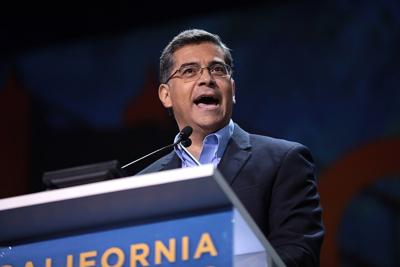


California Gov.-elect Xavier Becerra
SACRAMENTO — In the wake of the historic Democratic sweep up and down the ballot in California and throughout the country this month, Democratic lawmakers and progressive activists in Sacramento have indicated they believe the time is right to push forward on long-sought progressive policies.
And in California, those priorities may include slapping new taxes on large retailers, restaurant chains and other businesses who Democratic politicians, labor unions and others have accused of taking advantage of Medi-Cal, the Golden State's more generous version of Medicaid.
But it remains unclear just how committed California's incoming new governor, Xavier Becerra, may be to such a proposal.
And the ultimate fate of the proposal may yet be tied to the outcome of a court fight just joined on the other side of the country, in another Democratic state stronghold, New Jersey.
For years, a coalition of progressive activist groups, led by powerful labor unions and immigrant rights advocates, have urged Democratic lawmakers to enact the so-called "Fair Share Tax."
While details of any such tax remain unknown, activists and Democratic lawmakers have generally pushed for such a tax to require large employers to pay hundreds of dollars per year to the state for each employee they hire who is enrolled in Medi-Cal.
The tax would be based on the presumption that the employers are enhancing their profits by requiring the state to pick up the tab for their lower wage workers' health care.
To this point, the activist groups have succeeded in passing legislation at least requiring the California Department of Finance to develop proposals to present to lawmakers laying out ways the state might force the large employers to pay up. The department has until March 2027 to do so.
California state lawmakers and other officials have said any action on such a "Fair Share" tax plan would need to wait at least until they receive the Finance Department's reports.
However, observers believe the final proposal may not be too dissimilar from the "fees" New Jersey has imposed on large employers under that state's version of a "Fair Share" collection program.
In the Garden State, New Jersey Democrats passed legislation earlier this year, known as A-5324, requiring companies who employ at least 50 workers enrolled in Medicaid to pay from $325 to $725 per Medicaid-enrolled employee, with the "fees" increasing based on the company's total payroll.
The legislation was jammed through on June 30, the final day of the legislative session on party-line votes. N.J. Gov. Mikie Sherrill signed it into law that same day.
New Jersey has estimated penalties collected under the program would raise about $145 million per year, ostensibly to help the state cover the state's spending on health care for those lower wage workers.
The law also includes mandates for employer health plans that business advocates say would force employers to redesign their health benefit plans.
In August, a coalition of businesses and their advocacy groups, led by the National Retail Federation, Restaurant Law Center, International Franchise Association and American Hotel and Lodging Association filed suit in federal court, seeking to have the law declared unconstitutional.
At the time, the National Retail Federation said the New Jersey law "amounts to a penalty on employers that create jobs, provide health care coverage and drive economic growth."
The lawsuit asserts the New Jersey law conflicts with federal law, specifically pointing to the federal Employee Retirement Income Security Act (ERISA). They said the ERISA law was created by Congress in the 1970s to encourage employers to provide health insurance coverage to their workforces without fear of being bogged down in a patchwork of laws and regulations created by different states.
Should New Jersey be allowed to keep the law in place, the business groups warn, "would undermine the national framework protecting employee benefits that has been in place for more than 50 years."
A N.J. federal judge has not yet ruled on any aspect of the legal challenge, including the business groups' request for an injunction blocking N.J. from enforcing the law.
The outcome of that case could play a role in how the push for similar taxes in California ultimately play out.
While a decision in the N.J. case would not be binding on California or potentially any other Democrat-led state that decides to pursue similar plans, it would serve as an important marker in what would likely be an expanding legal battle that could end at the U.S. Supreme Court in coming years.
But regardless of what happens in the N.J. case, the debate over imposing similar large employer taxes in California may be only beginning.
Business advocates have begun issuing warnings to lawmakers that any such program would not only harm the state's business reputation and its economy, but also result in harm to the very workers supporters of such measures say they want to protect.
Earlier this fall, the California Center for Jobs and the Economy published a report warning lawmakers that such a plan will only make California's "vulnerable job market" worse.
The CJE report said the proposal is not only unworkable and potentially illegal, but is based on "flawed math."
They said any proposal will likely rest on assumptions that corporations will pay fees of hundreds of dollars per year for each of more than 700,000 workers enrolled in Medi-Cal. All told, the CJE said it believes supporters of the tax and penalty plan believe such a program could bring in at least $2.3 billion annually.
But the CJE said 80% of those workers are part-time or seasonal workers who either don't work enough hours or who don't remain with an employer long enough to qualify for coverage.
"The workers who actually trigger this fee are not full-time employees denied coverage," the CJE report said.
To meet the desired revenue goals, the CJE said, California would need to impose "massive, unfeasible rate hikes" or even tax charitable non-profits, too.
And the CJE warned such stiff penalties will persuade many employers that hiring more workers that could leave them exposed to potentially ever-increasing "Fair Share" penalties and taxes is not worth the cost.
"The proposed Medi-Cal employment tax is built on a broken foundation," the CJE said.
Concerns over how the proposal could change hiring practices and harm workers has led some normally progressive groups and community activists to join business groups in questioning the program's ulimate benefits.
They have warned that the "Fair Share" taxes and penalties could lead businesses to ultimately choose to hire fewer workers who may be eligible for Medicaid or invest in kiosks and other technologies that allow them to hire fewer workers in general.
The list of those potentially impacted under such a scenario, for instance, could include those convicted of crimes who are attempting to rehabilitate their lives and start over after serving their sentences, say those who advocate for people who have been convicted of felonies or otherwise entangled in the criminal justice system.
In California, everyone released from prison is automatically eligible for Medi-Cal even before they are released from incarceration.
Despite such concerns and the threat of a potential legal challenge and defeat in court similar to that faced by New Jersey, supporters of the measure have ramped up their push following the November midterm elections, asserting that Democratic gains nationwide make now the time for California to enact the policy.
And after the election, they are attempting to force Becerra to abide by his campaign comments generally supporting such "Fair Share" penalty and tax programs.
On his campaign website, for instance, Becerra specifically hailed California's move to begin crafting proposals to implement the taxes and penalties on employers and said he would "look forward to working with the Legislature to turn that groundwork into a real, enforceable policy."
"I will pursue a fee on large employers who do not offer health coverage to their low-wage workers who qualify for Medi-Cal, so that corporations who shift their healthcare costs onto taxpayers pay their fair share," Becerra said on his campaign site.
However, since the election, Becerra bristled at reporters who attempted to exact a "commitment" from him on such issues once he is sworn into office.
At a Nov. 5 press conference alongside California's legislative leaders, Becerra merely pledged again to work with lawmakers on crafting the ultimate details of such a penalty and tax program, after the Department of Finance presents lawmakers with possible proposals.
“Guys, don’t play this game about asking me to commit, because I didn’t get elected doing that,” Becerra said at the press conference. “A lot of other folks make these wild promises, and they’re not the governor-elect.”
