
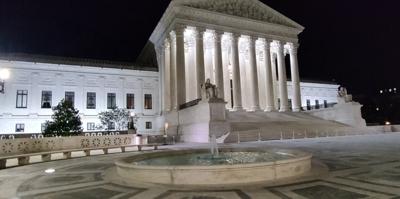


U.S. Supreme Court
WASHINGTON, D.C. — In coming months, the U.S. Supreme Court may render a decision on the ability of the city of Boulder, Colorado, to continue suing oil and gas companies over the alleged harms of so-called climate change, allegedly caused by carbon emissions.
And in that fight, Democratic state attorneys general from across the country, including from states including California, New York and Illinois, have lined up to urge the court to not pull the plug on the Boulder case, saying to do so could also strip them of the flexibility to use their state courts to target the same companies from that same industry, and potentially a long list of others, for potentially massive paydays.
On Monday, Oct. 5, the U.S. Supreme Court is scheduled to hear arguments in the appeal from energy companies Suncor and ExxonMobil.
The arguments will center on claims that the Colorado Supreme Court and a lower court state judge were wrong to allow Boulder to proceed with the core claims of that city's lawsuit against the energy companies.
Boulder's lawsuit, however, is just one of dozens of similar lawsuits lodged by cities, counties and state governments which are currently pending against oil and gas companies in U.S. courts.
The lawsuits are all built around similar claims accusing the companies of allegedly duping American consumers and businesses into using gasoline, diesel, natural gas and other petroleum-related fuels to drive vehicles, heat homes, power furnaces and factories, electrify the power grid, and otherwise energize the U.S. economy, when the companies allegedly knew emissions from using such fuels were causing a host of harms associated with so-called climate change.
In response, the companies have argued the lawsuits amount to an attempt by the governments, left-wing activist groups and the trial lawyers who are representing them bypass democratically elected governments and enacted laws and rules, and attempt to impose their so-called "green" agenda and extract payments, likely worth many billions of dollars or more, through the courts from an industry roundly disfavored and routinely pilloried by Democratic politicians.
The companies have argued in court the lawsuits should be blocked by constitutional principles which delegate to the federal government alone the authority to set U.S. regulations on energy production and emissions for fuels that are sourced, refined and used globally to power much of the modern world.
The Supreme Court agreed in early 2026 to hear the case.
At the Supreme Court, the dispute has sharply divided the states, largely along partisan lines.
On one side, states whose chief legal officers are Republican, including Texas, Florida, Pennsylvania and a wide swath of states from the South, Midwest, and Mountain West regions, backed the energy companies.
In a brief filed in 2025, those states argued the Boulder lawsuit and others like it amount to unconstitutional attempts to use state courts in Democratic-led states to punish energy companies for producing fuels that are not only legal, but essential to modern life.
They further argue the largely-Democrat-led legal actions amount to an effort to use the courts and threat of massive lawsuits to force the rest of the country to bend to the policy goals of states like California and New York, regardless of the wishes of voters anywhere else.
In response, however, those Democratic states have joined with Boulder in arguing the lawsuits essentially should be seen as threading a constitutional needle. They argue the state and local government lawsuits aren't attempting to interfere with federal authority to regulate emissions or energy production.
Rather, they say, they are only attempting to use their state laws to "hold accountable" companies for the alleged harms caused by the energy production and emissions the federal government has allowed.
To this point, those arguments have held up in some state courts, where lawsuits are continuing.
And in a brief filed in August, the Democratic attorneys general urged the high court to find a path to force the companies to continue to face lawsuits in state courts in Colorado and elsewhere, with no recourse other than settlements or trials with huge potentially huge financial, economic and policy stakes.
The Democratic attorneys general argue that allowing the companies to shut down Boulder's and other governments' state law-based climate lawsuits would itself upend the U.S. constitutional order, because it would deprive states of the ability to use their state laws to sue large companies over alleged societal harms caused by common and otherwise legal products.
The Democratic attorneys general assert a ruling in favor of the energy companies would instead create a "sweeping, judge-made policy" that they say "intrudes on state sovereignty" and "would permit large tortfeasors (companies accused of causing harm) to escape ... liability when their actions cause tangible harm."
Suncor, however, has argued it is Boulder and the Democratic attorneys general who have the question backward:
If states and local governments are all allowed to use their own laws and courts to target the same companies over the same claims related to a supposedly global phenomenon, it will allow those states and local governments to essentially strip Americans elsewhere of the ability to have a say in how energy production and emissions are regulated in their own states.
And the Republican state attorneys general framed the dispute as essentially an unconstitutional legal conflict between the states, with the Democratic-led states in the position of aggressor.
"The States, upon entering the Union, gave up the right to use their laws to wage this sort of interstate conflict," the Republican attorneys general wrote. "They gave up the right to impose their policy choices on other States and activities entirely outside the home State's jurisdiction."
The Supreme Court, they said, should shut down the Boulder lawsuit and similar actions now, "before any further damages is done" to the U.S. economy and America's constitutional order.
