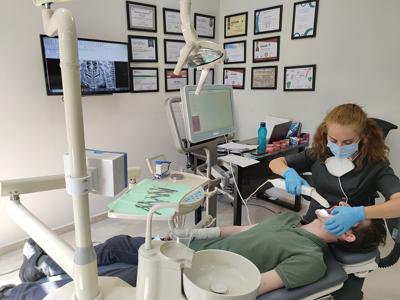



Invisalign scanner in operation
SAN FRANCISCO — A federal appeals panel won’t let the makers of Invisalign escape an antitrust class action, even as one appellate judge warned the majority's decision would create a "freewheeling" standard that would be used to convert failure-to-deal claims into antitrust lawsuits.
Align Technology, which makes Invisalign and iTero, a handheld intraoral scanner dentists use to take precise mouth measurements, was the subject of two class actions in which different plaintiff groups claimed the company schemed to monopolize the market by terminating an agreement with another company that made a scanner originally compatible with Invisalign.
U.S. District Judge Vince Chhabria granted summary judgment to Align, explaining that while killing that deal could’ve had roots in a desire to weaken a competitor, there also was a legitimate business justification sufficient to overcome alleged violations of the Sherman Antitrust Act.
That prompted a challenge before the U.S. Ninth Circuit Court of Appeals. Judges Sidney Thomas and Richard Paez concurred in the per curiam opinion, filed Oct. 5. Judge Eric Miller agreed with the outcome, but wrote a special concurrence asserting the majority opinion improperly expanded legal standards.
The panel explained iTero and Invisalign are digitally integrated, meaning the scanner software can directly order Invisalign products, and while iTero also can order aligners from other companies, “the process is costly and cumbersome, so iTero and Invisalign effectively constitute a closed system.”
Although Align agreed to make Invisalign compatible with scanners from 3M and Dentsply, the class actions hinge on its relationship with 3Shape and its TRIOS scanner. According to the panel, 3Shape intended TRIOS to be an open system so it would be compatible with other aligner products — up to about 10% of the marketplace — while Align insisted on exclusivity.
In December 2017, Align told 3Shape it was terminating the three-year agreement inked two years earlier. The panel said the timing was concurrent with Algin’s concerns about expiring Invisalign patents and the fear TRIOS’ increasing popularity would ultimately undercut Invisalign’s market share.
Align took action on its agreements with 3M and Dentsply, but filed six patent actions against 3Shape. The companies settled. Align also offered steep iTero discounts to dentists if they made minimum Invisalign order commitments and negotiated promotional agreements with exclusivity clauses.
The first litigation, in 2020, came from dental practices led by Simon & Simon. In 2021, 16 people who personally used Invisalign filed their own lawsuit. Judge Chhabria ultimately consolidated the cases and certified a nationwide damages class of direct Invisalign buyers, a class of indirect aligner buyers who could pursue an injunction and a damages class of indirect buyers in 10 states.
The panel said the relevant precedent for what it called “refusal to deal” allegations is a 1985 U.S. Supreme Court ruling, Aspen Skiing v. Aspen Highland Skiing. It also pointed to its own 2004 opinion, MetroNet Services v. Qwest, because it “identified three circumstances present in Aspen Skiing that the Supreme Court has ‘found significant’ in analyzing refusal-to-deal claims.” It then reviewed those circumstances in explaining the reasoning for remanding the Align litigation to the district court, largely dealing with the question of when business moves that might harm a competitor cross into illegality and whether anticompetitive harm outweighs procompetitive benefits.
After first rejecting Align’s framing that the relevant marketplace is digital interoperability, rather than aligners in general, the panel said “it is abundantly clear” the plaintiffs established Align’s refusal to deal when it ended a profitable agreement, walking away from retail price sales that TRIOS scanners would’ve facilitated but maintaining similar deals with other companies.
However, the panel also said Align met is burden of showing that treating 3Shape differently had the business justification of ending the agreement “to strengthen its position in patent litigation.” While Judge Chhabria said enforcing patent rights was a “presumptively valid business justification,” the panel disagreed, finding “genuine disputes of material fact” on whether Align was legitimately promoting competition or if its justification was pretextual.
The panel said Align is entitled to the presumption, but ultimately said Judge Chhabria didn’t properly assess “whether that presumption was sufficiently rebutted.” It noted the plaintiffs produced a patent expert who testified terminating the deal actually weakened Align’s position while strengthening 3Phase’s in regards to the patent actions as “most of 3Shape’s equitable defenses were based on Align’s decision to enter into an interoperability agreement with 3Shape in the first place.”
Because a reasonable juror could agree, the panel said, there is a legitimate dispute over Align’s motives and justifications. It further explained that “what matters at this stage of the analysis is whether Align’s real motive for terminating interoperability was to strengthen its position in the patent litigation. If terminating interoperability did not strengthen Align’s position, a trier of fact could reasonably infer that this was not Align’s purpose at all.”
The plaintiffs’ evidence included an internal Align email celebrating revenue growth tied to cutting off 3Shape, an internal presentation explaining the elimination of primary competition and a note from the Align CFO suggesting the CEO approve an end to litigation but cautioning against reinstating interoperability.
The panel further said Align’s timing was “especially suspect” since it waited about two years to initiate patent actions. While acknowledging “there are multiple ways of interpreting the circumstantial evidence,” it reasoned that lack of clarity made summary judgment improper. It also said that when the case resurfaces in district court, Align can’t rely on deposition testimony from CEO Joseph Hogan regarding his decisions while also shielding from discovery the legal advice underpinning his thought process. The panel further added that Judge Chhabria can determine if he should consider any remaining claims contributing to anticompetitive allegations beyond refusal to deal.
In his special concurrence, Judge Miller said Judge Chhabira was correct in refusing to take up the plaintiffs on their insistence that he “balance the anticompetitive harms of the defendant’s conduct against its procompetitive benefits.” Miller said the Supreme Court’s only concern about “liability for refusal to deal turns on the presence or absence of a legitimate business justification” and explained the factual disputes the panel identified were sufficient to order a remand.
“Current law allows plaintiffs to prevail by rebutting a defendant’s proffered business justification as pretextual or anticompetitive,” Miller wrote. “It may be that Aspen Skiing is ‘underinclusive to some degree’ in the sense that it permits some refusals to deal that cause anticompetitive harms with little offsetting benefit. Even so, some underinclusivity is far preferable to the freewheeling balancing rule endorsed by the court today, which risks transforming virtually every refusal-to-deal claim into an inquiry into whether the defendant’s asserted business justification outweighs the harm to competition — effectively requiring courts to balance the costs and benefits of unilateral business decisions that antitrust law ordinarily leaves to the marketplace.”
The plaintiffs are represented by Berger Montague, of San Francisco and Philadelphia; Hagens Berman Sobol Shapiro, of Berkeley, Calif., and Seattle; and Radice Law Firm, of Princeton, N.J.
Align Technology is represented by Paul Weiss Rifkind Wharton & Garrison, of Washington, D.C.; Paul Hastins, of San Francisco, Chicago, Los Angeles, New York and Washington, D.C., and Kirkland & Ellis, of Chicago.