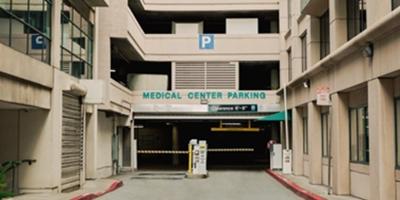


1635 Divisadero Medical Center Parking Garage, San Francisco
SAN FRANCISCO - Parking garage operators in California could face the threat of a rash of class action lawsuits under a California law governing the use of so-called automatic license plate readers, after a state appeals court revived just such a lawsuit from a parking garage customer who argued the garage operators broke the law by not informing customers they were scanning their license plates as the entered and exited the garage.
On Feb. 5, a three-justice panel of the California First District Court of Appeal ruled in favor of plaintiff Brendan Bartholomew, of Pacifica, in his legal action against Parking Concepts Inc.
In the decision, the appellate justices tossed out a ruling from a San Francisco County Superior Court judge, who had ruled the lawsuit should end because Bartholomew and his lawyers never proved he nor anyone else could show they were actually harmed by a license plate scan.
But the appeals judges said it is enough for plaintiffs to show a parking garage had violated customers' "right to know" their license plates were being scanned, by whom, and "how it is being used and maintained."
Violations of this notice provision, they said, can open parking garage operators up to potentially massive financial payouts under the California state law, which allows for plaintiffs to demand $2,500 per alleged violation. When multiplied against thousands of potential customers per garage, potential damages could quickly skyrocket into the many millions of dollars.
The decision was authored by Justice Mark B. Simons. Justices Gordon B. Burns and Danny Y. Chou concurred in the ruling.
"... Requiring ALPR operators to establish and make public a policy governing use and maintenance of this data is a primary focus of the ALPR Law," Simons wrote in the court's opinion. "This requirement ensures both that ALPR operators consider and make deliberate decisions on this issue, and that individuals can know when and how their ALPR information is being collected and used.
"In other words, while the ALPR Law does not impose specific restrictions on the use of ALPR information, it grants individuals the right to know which entities are collecting their ALPR data and how it is being used and maintained."
The case has been in California state courts since it was first filed in February 2024 in San Francisco County court on behalf of Bartholomew by attorneys L. Timothy Fisher and Brittany S. Scott, of the firm of Bursor & Fisher, of Walnut Creek. Other attorneys from the firm representing plaintiffs include Julia K. Venditti and Philip L. Fraietta.
The lawsuit centered on alleged scans of the license plate on Bartholomew's car by an ALPR system installed at a parking garage at 1635 Divisadero Medical Center Parking Garage, which is owned and operated by Parking Concepts.
According to the complaint, Bartholomew parked at the facility multiple times in 2022 and 2023. On each occasion, Bartholomew said his license plate number was printed on a ticket he received from the parking garage's automated system upon entry, and then was displayed again on a screen at a kiosk as he exited.
According to the complaint, this amounted to violations of California's 2015 law governing such Automated License Plate Recognition systems.
He asserted the company illegally collected his license plate information and then fed it into a database.
Parking Concepts asserted it did not operate an ALPR system, as defined under the state law, because it did not collect and maintain the data in a searchable database. Further, they argued Bartholomew couldn't show how reading and displaying his license plate number harmed him, because the company didn't mishandle the data or share it with anyone else.
San Francisco Superior Court Judge Ethan Schulman sided with the parking garage operators and tossed the lawsuit.
On appeal, however, the justices said the lower court was too strict in interpreting the ALPR law.
The appellate judges agreed that Bartholomew and others shouldn't be allowed to sue under the ALPR law simply because license plates had been scanned.
Further, they agreed that parking garages operating a system of one or two ALPR cameras were not the intended target of the law by California state lawmakers, who wished instead to use the law to protect Californians against large scale surveillance using such systems.
But they said the law encompasses parking garage operators, nonetheless. And under that law, they said, anyone operating a license plate reading system must notify people about the scans and how they will use and store the data.
So, they said, parking garages can be targeted with such class action lawsuits.
In the original lawsuit, plaintiffs did not specifically identify how many additional plaintiffs may be included in their class action. But they estimated that number is likely in "the thousands."
The appeals court sent the case back to San Francisco County Superior Court for further proceedings.
Parking Concepts is represented in the action by attorneys Craig J. Mariam, Michael J. Dailey and Katiuska Pimentel Vargas, of the firm of Gordon Rees Scully Mansukhani, of Los Angeles.