
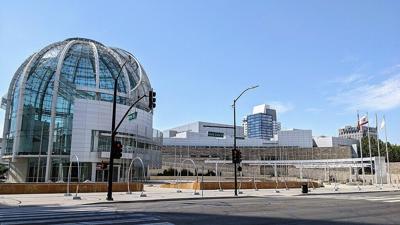



San Jose City Hall
SAN JOSE - A federal judge won’t let San Jose escape a lawsuit from a massage studio owner who was the victim of repeated rape and extortion at the hands of a former city inspector.
Dai Trang Thi Nguyen sued the city and two city supervisors, Joseph Hatfield and Rachel Roberts, alleging they allowed the conduct of former code inspector William Gerry, who is serving a 34-year prison sentence for the crimes he committed while inspecting the massage business in 2019.
U.S. District Judge Edward Davila filed an opinion Jan. 22 resolving three motions, two regarding expert testimony and the defendants’ requests for summary judgment.
Nguyen said the city should be held liable for a practice of sending male inspectors alone and unsupervised to businesses like hers as well as assigning such tasks to Gerry “despite the several prior complaints received” about his conduct, Davila wrote, adding she also said a “fragmented reporting and supervision policy” is responsible for his continued offenses.
To support her position, Nguyen cited insight from Anthony Flores, a San Francisco Police Department officer since 1982, and Leonard Powell, former director of the California Association of Code Enforcement Officers and author of the California Code Enforcement Officer Standards Act.
The experts said the “city’s practice presented obvious risks of harm,” Davila wrote, especially in light of five complaints against Gerry they said should’ve cost him his role as a field inspector. San Jose countered that with a report from Dr. John Greene, who conducted a psychiatric independent medical examination on Nguyen. Both sides asked Davila to strike their opposition’s expert testimony.
Nguyen’s first claim about a report against Gerry dates to 2015. The complainant was a city employee, but the allegations transpired before Gerry joined the Code Enforcement Officer. San Jose said it found no wrongdoing and noted Hatfield and Roberts weren’t aware of the report when they became Gerry’s supervisors two years later.
There also was a 2018 report from the husband of a massage worker. Ngyuen said Cheryl Parkman, a senior executive analyst in the Office of Employee Relations discounted, that report and didn’t notify anyone in the code office.
“Hatfield and Roberts learned of this report for the first time during their deposition and both expressed shock,” Davila wrote. “Roberts stated that she felt ‘gobsmacked’ and testified that she would have expected to be informed of this complaint.”
Also in 2018 the Code Enforcement Office took a report of Gerry’s car being parked outside a massage business for a long time, but Gerry told Roberts he was there on official business and there was no further investigation. But later that year the city got four handwritten letters accusing Gerry of misconduct, which were routed to several city employees and the police.
Roberts thought Gerry was being blackmailed, but San Jose Police Lt. Paul Messier later “testified the photographs were immediately concerning because they suggested an inappropriate relationship with a woman in a regulated establishment, but he had no authority over Gerry’s supervision as a code inspector,” Davila wrote.
Then in December 2018, the city’s whistleblower hotline got an anonymous phone call alleging Gerry was improperly touching masseuses, insisted he get massages, took cash bribes and claimed video and photo evidence could corroborate the claims. Again Parkman didn’t disclose the complaint to the enforcement office, and although Messier was “very concerned” he had no authority to restrict Gerry’s duties.
After Gerry was arrested, Mayor Sam Licardo “issued a public statement on the city’s failed reporting systems,” Davila wrote, explaining he acknowledged “the city lacked defined procedures for ensuring that complaints were routed to the appropriate supervisory officials and indicated that the city would implement new protocols to ensure similar allegations were handled properly in the future.”
Davila refused to disqualify Powell, saying although defense attorneys might question his credibility, that doesn’t inherently mean his opinions are unhelpful to a potential jury. He further said San Jose wrongly argued Powell’s professional experience working for the cities of San Rafael and Fremont is too narrow, citing the full context of his professional background, and found his report relies on industry expertise and not simply common sense. Flores’ record withstood similar scrutiny, as Davila noted San Jose took Flores’ testimony out of context in an attempt to challenge his expertise and reliability.
Nguyen didn’t challenge the admissibility of Greene’s opinions but did seek to exclude his report on procedural grounds. Davila explained Greene’s role as rebutting the damages opinion of another psychiatrist. While Davila agreed the timing of Greene’s report and exam were unusual, he said Nguyen didn’t show a reason to exclude the testimony so long as his exam findings were only used to challenge the opinions of Nguyen’s expert on the same subjects.
Turning to summary judgment, Davila rejected San Jose’s arguments there was no evidence of municipal policy as a leading cause of Nguyen’s legal injury and also said the city failed to mount a satisfactory position against the allegation of deliberate indifference.
“The evidence here is that Gerry raped and extorted (Nguyen) under the color of law,” Davila wrote. “A reasonable jury could find under these circumstances that (Nguyen’s) injuries would not have occurred but for the city’s practice and policy that provided Gerry with the authority and lack of oversight necessary to abuse (Nguyen).”
Davila again acknowledged “many disputed facts that a jury might consider” that are relevant when viewed favorably to Nguyen and highlighted the importance of the allegations that several reports about Gerry never went to his supervisors.
“It is true, as the city contends, that it has its own side to this story,” Davila wrote. “It has explanations for how each report was investigated and why they did not result in Gerry’s removal from the field. It also has arguments to impeach the opinions of (Ngueyn’s) experts who opine on the obvious risk inherent in sending solo male code inspectors into massage businesses unsupervised. But these arguments merely highlight the inappropriateness of this issue for summary judgment. A jury, not the court, must weigh these facts, and despite the city’s explanations and arguments, it remains that a reasonable jury could interpret the evidence in (Nguyen’s) favor and find the city deliberately indifferent.”
Regarding Nguyen’s due process rights, Davila noted she said she paid Gerry $34,000 believing he would use it to secure a business permit, but when she reported him to the city it closed her business for operating without a permit.
As for Hatfield and Roberts, Davila said they did not have enough information to be “on notice of Gerry’s sexual misconduct and extortion,” and to the extent they did know anything they took some actions. While stating they could “and perhaps should have done more,” he said, they did enough to “go beyond the willful blindness required to show deliberate indifference” and are therefore entitled to summary judgment, while the city itself must continue as a defendant in the litigation.
Nguyen is represented by attorneys Philip J. Kearney, Christopher R. Ulrich and Kevin D. Cardona, of the firm of Murphy Pearson Bradley & Feeney, of San Francisco.