
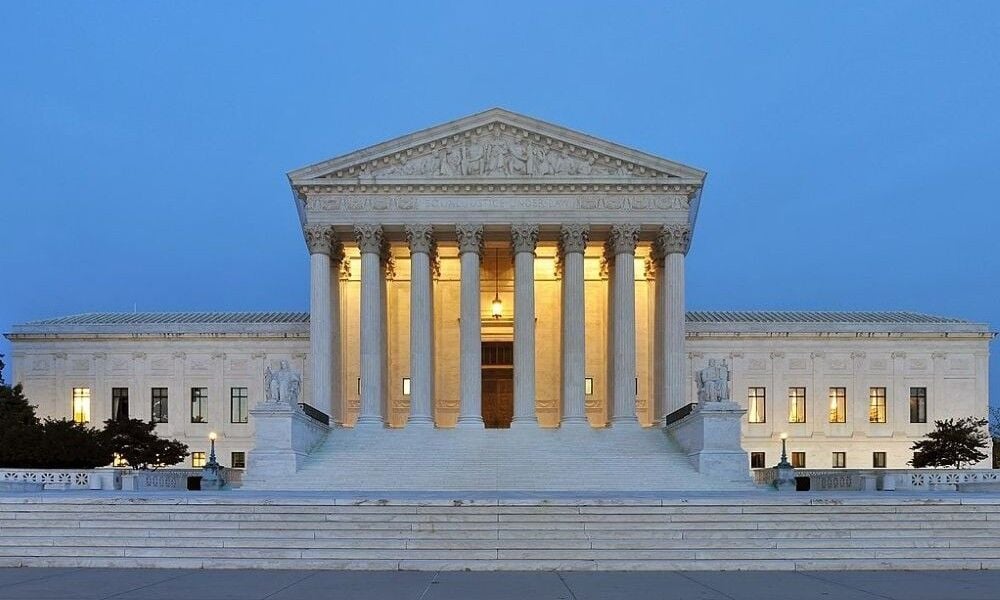
U.S. Supreme Court
WASHINGTON, D.C. - The U.S. Supreme Court will not block California from moving forward with its new mid-decade gerrymandered congressional district maps approved under Proposition 50.
On Feb. 4, the Supreme Court issued an order denying a petition for review filed by California Republicans, who had argued the new map violated the U.S. Constitution and federal anti-racial discrimination law by illegally drawing districts specifically to increase the relative political power of California Latinos.
The court's order did not explain the court's reasons for the denial. It also included no dissents from any of the court's member justices.
The denial marked a potentially big victory for California Democrats, who had redrawn the map to all but wipe out Republican-majority districts in the state amid an expected tight race for control of the U.S. House of Representatives in mid-term elections in 2026.
The denial also let stand a ruling from a special judicial review panel, assembled by the U.S. Ninth Circuit Court of Appeals, that essentially declared Republicans couldn't challenge the Democratic-dominated map as an illegal "racial gerrymander" unless they could somehow prove California voters had voted for the maps with pro-Latino discriminatory intent.
In their petition to the Supreme Court, Republicans had warned that allowing that reasoning to stand would establish a precedent allowing states to violate anti-discrimination protections by merely giving voters the chance to approve discriminatory maps.
"The majority’s apparent belief that a State may launder a mapmaker’s unconstitutional line-drawing through a legislative or popular vote not only would lead to untenable results, but also directly contravenes decades of this Court’s cases...," the Republicans had written in their petition, filed in mid January.
The new maps had been created by California Democrats, led by Gov. Gavin Newsom, amid a special mid-decade gerrymandering initiative, in a brazen bid to increase Democratic representation in Congress.
Newsom and his fellow Democrats had asserted the move was needed to counteract efforts by Republicans in other states, and Texas, in particular, to favor the election of Republicans in 2026 and reduce the chances of a midterm Democratic takeover of the U.S. House.
Unlike those other states, California's process required Democrats to take another step: Securing approval from voters directly through a special referendum to "temporarily" amend the state constitution and allow the state legislature to draw the new maps, rather than the state's constitutionally established independent redistricting commission.
The referendum question was submitted under the title of Proposition 50.
Voters approved Prop 50 in a special election at the beginning of November, appearing to clear the way for the map to be approved.
After the election, California Republicans challenged the law, and were later joined by the Justice Department under President Donald Trump. The lawsuits asserted the new gerrymandered maps were illegally designed to "shore up" support for Democrats from Latino voters.
While the U.S. Supreme Court has explicitly refused to strike down gerrymanders intended to increase partisan power, the court has considered challenges based on accusations district maps are drawn to favor or dilute the political power of certain racial groups.
Plaintiffs noted the man credited with drawing the maps, identified as Paul Mitchell, explicitly and publicly said he and Democrats intended to use the Prop 50 process to create more majority Latino districts.
Those statements were also echoed by Democratic state lawmakers as the maps were advanced in Sacramento.
However, the Supreme Court let the California judicial panel's decision stand, without comment.
The new ruling comes nearly two months since the Supreme Court also upheld Texas' new congressional map. That ruling specifically set aside a ruling from a different three-judge panel, which had sided with Democrats in finding the Texas map was a "racial gerrymander" which had illegally diluted the voting power of black and Latino Texas residents.
However, in a 6-3 decision, the Supreme Court majority said the lower court panel had "improperly inserted itself into an active primary campaign, causing much confusion and upsetting the delicate federal-state balance in elections.”
Further, the high court majority noted Texas had argued the map only reflected a desire to increase Republican chances to win a majority of House districts, not a desire to racially discriminate against black and Latino voters who happen to make up a large proportion of the Democratic Party's voter base in the Lone Star State.
The Supreme Court majority agreed that the lower court panel had improperly leaped to finding Republicans had violated the law and Constitution, without giving state lawmakers the deference they are owed under the Constitution.
That ruling had illustrated the uphill battle Republicans faced in challenging the California maps on similar grounds – even if the judges in the California case ultimately agreed that California Democratic state lawmakers and their hired mapmakers may have discriminated in favor of Latinos, but still ruled that it didn't matter.
The Supreme Court's decisions in the matters mean both California Democrats and Texas Republicans will be able to use their respective maps in the 2026 congressional elections.