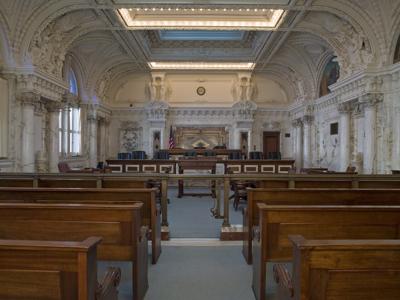


Courtroom One, James R. Browning Federal Courthouse, San Francisco, home of the U.S. Ninth Circuit Court of Appeals
SAN FRANCISCO — A federal appeals panel has ruled one of California’s largest medical systems can’t try to assess the sincerity of an employee’s religious beliefs when deciding if they should be fired for refusing to take a Covid vaccine.
The underlying dispute pits Mimi Weiss against Permanente Medical Group. Permanente had initially granted Weiss an employee exemption to its Covid vaccine mandate, but revoked her exemption when they say she didn’t fully respond to a query for additional information about her beliefs.
After Permanente fired Weiss, she filed a Title VII religious discrimination lawsuit, also bringing claims regarding her rights under California’s Fair Employment and Housing Act.
U.S. District Judge Richard Seeborg granted Permanente’s motion to dismiss the complaint, finding Weiss didn’t provide proper notification of a conflict between her beliefs as a Christian Jew and the company’s mandate.
Weiss challenged that dismissal before the U.S. Ninth Circuit Court of Appeals. Judge Danielle Forrest wrote the panel’s opinion, filed July 24; Judges Richard Paez and Carlos Bea concurred.
According to court records, Weiss started working for Permanente in August 2000 and was a managerial senior consultant — a fully remote position in the health-engagement consulting department — when she lost her job. Weiss said she began identifying with Messianic Judaism in 2016 and recommitted to the faith during the pandemic. Her request for a vaccine exemption cited passages from the biblical books of Deuteronomy and I Corinthians, among other information.
Weiss said Permanente initially accepted the application, but three weeks later asked for more information, citing “findings and concerns about a pattern of insincere religious-exemption requests among its employees,” Forrest wrote. The panel noted Weiss declined to answer questions about her medication history, invoking privacy concerns, and also that when Permanente placed her on unpaid leave the managers she contacted didn’t respond to inquiries.
The panel relied on a 1993 Ninth Circuit ruling, Heller v. EBB Auto, which said the question of how much notice a worker needs to provide an employer regarding a religious conflict with a work obligation boils down to “only enough … to permit the employer to understand the existence of a conflict” because “any greater notice requirement would permit an employer to delve into the religious practices of an employee in order to determine whether religion mandates the employee’s adherence.”
Forrest wrote the panel had “little difficulty concluding” Weiss gave sufficient notice under Title VII through only the initial exemption request.
“She identified herself to TPMG management as ‘a Christian Jew’ and described specific religious doctrines that she asserted prohibited her from receiving the COVID-19 vaccine,” Forrest wrote. “These doctrines included the Torah’s prohibition against ‘accepting foreign material into our bodies,’ Deuteronomy’s counsel against ‘needle wounds except for direct curative benefit’ and the professed requirement under Jewish law to ‘maintain (one’s) body and blood uncontaminated.’ She also stated that receiving a COVID-19 vaccine would be contrary to her belief that she should not ‘introduce foreign substances into (her) body temple that change how (her) Creator designed it.’ ”
Permanente said it was allowed to seek additional information because Weiss didn’t explain why she’d received other vaccines, meaning the initial application didn’t inform the company of a sincerely held belief.
The appellate judges disagreed.
“Weiss acknowledged that she had previously received vaccinations, and she explained that her present concern arose not because the COVID-19 vaccine was different, but because her religious commitment had changed,” Forrest wrote. “Additionally, TPMG’s initial approval of Weiss’s request for a religious exemption demonstrates that TPMG understood she was asserting a religious conflict with the company’s mandate.”
While agreeing the record shows Permanente doubted the sincerity of the conflict Weiss claimed, its additional questions probed the depth of her professed tenets and not whether the exemption she sought had a religious nature. Those are separate inquiries, the panel said, and Permanente’s arguments blurred the distinction, as did Judge Seeborg’s ruling.
“The notice requirement measures only the sufficiency of the employer’s information about the employee’s religious beliefs or practices, not the validity of those beliefs and practices,” Forrest wrote, again pointing to Heller. “Nor does the notice requirement invite employers or courts to consider whether an employee’s ‘religion mandates the employee’s adherence’ to the beliefs or practices asserted.”
The panel reversed Seeborg’s dismissal and remanded Weiss’ complaint for further proceedings.
Weiss is represented by the Becket Fund for Religious Liberty, of Washington D.C.; the Stanford Law School Religious Liberty Clinic; and the Church State Council of Westlake Village.
Pemanente is represented by Seyfarth Shaw, of San Francisco.