
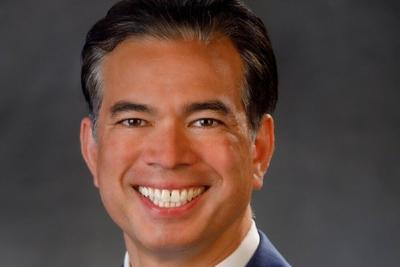


California Attorney General Rob Bonta
OAKLAND — Days after publicly brushing aside a threat by Paramount to relocate from California unless the state's attorney general agree to end a multi-state bid to block Paramount's merger with Warner Bros., California Attorney General Rob Bonta has announced a settlement with Paramount to end that litigation.
And among other terms, Paramount has agreed to remain in California as part of the deal.
The settlement was announced Sept. 21 in motions and other documents filed in Oakland federal court.
In announcing the deal, Bonta was joined by representatives of Hollywood unions, whose ability to continue working in southern California's film industry would have been significantly impacted, should Paramount have followed through on its threat to pull out of the Golden State.
Bonta said he and his fellow state attorneys general and other supporters of their legal action still do not support the merger.
But he indicated they were willing to drop their legal action at this time to avoid any negative consequences for the L.A. film industry, which is estimated to be worth more than $117 billion to the California economy.
"When we get down to brass tacks, what we heard over and over from people who would be most directly and immediately impacted by the merger is that what matters most is consistent film output, domestic production, and protecting the livelihoods of workers above and below the line," Bonta said in a statement announcing the settlement.
"As such, our settlement provides court-enforceable commitments for more films, an infusion of an additional $1.5 billion into home-grown film production, and protections for workers who are impacted by the merger. There’s no Hollywood without the people who work on and off screen to make the magic happen, and today’s settlement protects workers, jobs, and Hollywood.”
Under the deal, Bonta said he has agreed to advance legislation in Sacramento to "uncap the California Film and Television Tax Credit in order to strengthen California's competitiveness, encourage productions to spend and hire more in the state, and support jobs and businesses across the state."
For their part, Paramount has agreed the new company resulting from the Warner Bros. merger will increase U.S. film production and spend at least $1.5 billion more over five years.
As California film production tax credits increase, Paramount would also boost its domestic film production by a matching rate, up to at least 40% of all its film production. Currently, about 5% of Paramount's film production work is in the U.S.
Paramount has also agreed to release at least 30 films per year in the two years following the merger, and 32 films per year in years 3-5. Paramount had publicly indicated no objections to such targets.
Bonta also highlighted Paramount's agreement to spend $47.5 million in a "Workforce Fund" to help "workers who are displaced by the merger."
And Paramount has agreed to the creation of a "News Editorial Independence Board" for CNN and CBS News to ensure the networks "maintain editorial independence" apart from Paramount leadership, and particularly the studio's CEO David Ellison.
Ellison had publicly addressed those concerns in an op-ed published in August in the New York Times. In that column, Ellison said: "There has been speculation about my politics, my loyalties, my intentions. Unfortunately, I can’t give anyone a view into my heart and mind, but I can share this: I have regularly voted for candidates of both parties; I hold some views that would be called conservative and others that would be called liberal, just like most Americans, and when it comes to our news operations, I do not aspire to lead these companies to bend their newsrooms to my views. I believe that news should be based on facts and truth."
The settlement comes two months after a federal judge had put on hold the merger of Paramount Skydance and Warner Bros.
That July 21 order, in turn, had come in response to the antitrust legal challenge lodged by Bonta and a collection of other Democratic state attorneys general to the $110 billion merger.
The companies had announced their intent to merge in February, after Paramount reportedly beat back a bid by rival Netflix to acquire Warner Bros. and his holdings.
The combination would bring together two of the “big five” major film studios, responsible for film franchises like "Top Gun," "Mission: Impossible," "Harry Potter" and "The Lord of the Rings." Both companies also own more than 50 basic cable television channels; premium cable channels HBO and Showtime; subscription streaming services Paramount+, HBO Max and Discovery+; and three television production studios.
Bonta – joined by the attorneys general of Arizona, Colorado, Connecticut, Massachusetts, Minnesota, Nevada, New Jersey, New Mexico, New York, Oregon and Washington – filed a federal complaint to stop the merger on July 13.
The action alleged the merger would harm competition for the distribution of feature-length films in movie theaters, the distribution of blockbuster films, and the licensing of basic cable channels to cable distributors. According to the attorneys general, Paramount and Warner Bros. together control between 27 and 34 percent of these markets, respectively.
The state attorneys general complaint came after months of investigation into the likely competitive effects of the merger, an investigation initially conducted in conjunction with the federal Justice Department’s antitrust division.
The DOJ closed its investigation in early June without bringing any charges, however, and concluded the merger would be good for competition.
In addition to approval by U.S. antitrust authorities, the merger also has been cleared by 24 foreign jurisdictions, including those of Canada, China and Australia.
Paramount and Warner Bros. had pushed back against the state attorneys general lawsuit, arguing the deal is actually "pro-competitive, not anticompetitive."
"It will produce more high-quality content for consumers; it will incentivize investment in job-creating film production; it will stabilize basic cable television (which is gravely threatened by cord cutting); and it will increase the output of theatrical releases in a challenged entertainment landscape,” the companies argued in court filings.
U.S. District Judge Araceli Martinez-Olguin, however, sided in July with California and the other states, ruling the states had presented "compelling evidence that the combined firm resulting from the transaction will possess substantial market share in the wide-release theatrical distribution market."
However, while the court considered action to block the deal further, Ellison and Paramount took the dispute outside of the courtroom as well, mounting an apparent campaign to pressure the states into settling.
Under the terms of the merger deal, a delay past September could make the merger more costly for Paramount. As part of its agreement, Paramount committed to paying Warner Bros. a “ticking fee” of $0.25 per share for each quarter the transaction is delayed beyond Sept. 30. The company also agreed to pay a break-up fee of $7 billion if the merger does not close for regulatory reasons.
Against that backdrop, Ellison in early September notably threatened to pull Paramount out of its longtime home in Los Angeles to relocate to what the company believed to be a more business friendly state, should Bonta and his fellow Democratic state attorneys general not quickly move to resolve the litigation.
Bonta was asked about those statements.
And in response, according to published reports, Bonta downplayed the threats, saying: "If they make that choice to leave, that is their choice and their choice alone. They own it. It lies at their feet."
Settlement talks, however, appear to have resumed in the meantime, leading to the deal announced Sept. 21 to keep Paramount and Warner Bros. studios operating in the Los Angeles area.
In a statement published by Variety, Ellison said: "We are grateful to Attorney General Bonta and his fellow AGs, as well as the (Writers Guild of America), for engaging in good faith to find a path forward to a resolution that serves all parties, and to Governor (Gavin) Newsom for his support throughout this process. Our shared aim was an outcome that best serves consumers, workers and — most importantly — the creative community so vital to the art of visual storytelling. We’re confident this agreement does exactly that, memorializing a series of commitments that include 30+ films annually and expanded U.S. film production to help revitalize our industry here at home.”
Jay Brown contributed to this report.
