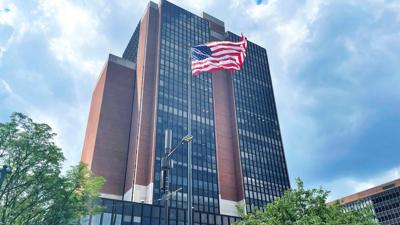



James A. Byrne U.S. Courthouse in Philadelphia
PHILADELPHIA – Lawyers will appeal the dismissal of their ambitious Big Food lawsuit after a Philadelphia federal judge who once called it “woefully deficient” tossed it last month.
Morgan & Morgan filed its notice of intent to appeal Judge Mia Roberts Perez’s ruling to the U.S. Court of Appeals for the Third Circuit on Wednesday, indicating the firm is not ready to give up on a case it spent a year preparing. It seeks to hold major food and drink companies liable for the health problems of a Pennsylvania man he attributes to ultra-processed foods.
The case likens companies like Kraft Heinz and Coca-Cola to Big Tobacco but ultimately failed because it listed 179 products without specifying which caused plaintiff Bryce Martinez’s type 2 diabetes and non-alcoholic fatty liver disease – diagnoses he received at 16 years old.
“Martinez casts a wide net in seeking to hold numerous food producers liable for illnesses resulting from his consumption of nearly two hundred products over the course of multiple years,” Perez wrote June 30. “Pennsylvania courts have not recognized industry-wide liability for plaintiffs in these circumstances.”
Morgan & Morgan partner Mike Morgan has said companies were “prioritizing profits over the health and safety” of customers. A 149-page complaint, the result of a year’s work at the firm, said tobacco companies Phillip Morris and RJ Reynolds bought major food companies in the 1980s and hoped to use the addiction playbook they’d used with cigarettes.
Perez was the first judge to reach the dismissal stage out of a handful of others handed UPF cases like these. Defendants in a lawsuit filed by San Francisco City Attorney David Chiu recently asked a state court judge to throw out that case.
“San Francisco asks this Court to declare that all so-called ‘UPF’ are deceptively labeled, cannot be sold without health warnings, and constitute a ‘public nuisance,” they wrote this month.
“But the complaint does not come close to alleging facts that would justify this Court overhauling the majority of the country’s food supply by judicial fiat. And the fact that San Francisco’s complaint was largely copied from a previously dismissed personal-injury complaint confirms how far afield this case is from a legitimate public-nuisance action.”
There are problems defining UPFs. U.S. Health Secretary Robert F. Kennedy, Jr., formerly of counsel at Morgan & Morgan, said earlier this year that a federal definition of UPFs is coming, part of the Make America Healthy Again initiative. He has called them a “poison,” but public comments on his plan noted the difficulty of determining what exactly a UPF is.
“Not all processed foods are created equal, and some are shown to be beneficial to health,” the California Dairy Council wrote.
“Many processed foods – like frozen vegetables, canned beans or pasteurized milk – retain their nutritional value during processing and are essential for food safety, convenience and accessibility.”
Dozens of other plaintiff firms created UPF pages on their websites after the Martinez lawsuit and offered free consultations for clients willing to hire them on contingency fees. Plaintiff attorneys hope the theory sticks and leads to a massive payoff, much like the tobacco litigation of the 1990s.
But the lawsuit was “woefully deficient” in establishing a causal link between the food and illnesses, Perez wrote last year. She added in June that there is no formal federal definition of UPFs, so those foods are held to the same legal standards as others.
Other federal judges in Mississippi, New York, Arkansas and Louisiana are handling UPF cases. The stakes could be massive, as this legal strategy was wildly successful for plaintiffs lawyers who scored government contracts to sue the tobacco industry in the 1990s. San Francisco hired Morgan & Morgan, DiCello Levitt and Andrus Anderson to sue over UPFs in December under state-law theories like public nuisance and violation of the California Unfair Competition Law.
“This case is not about food that is merely ‘unhealthy,’” San Francisco’s complaint says. “This case is about food products with hidden health harms, that Defendants designed to be cheap, colorful, flavorful and addictive.”
Should cases elsewhere be found to be specific enough to proceed, the food industry will still have other defenses available, considering the products and their labeling were approved by the federal government.