
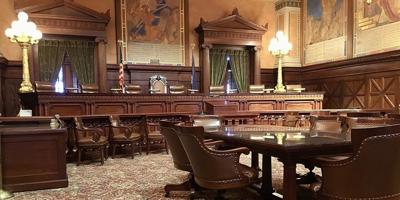


Pennsylvania Supreme Court Chambers, Harrisburg
HARRISBURG — Pennsylvania state officials wrongly denied a Muslim family a request for a religious exemption to the state's rules otherwise limiting how much a household can receive through a Medicaid program that pays parents and other relatives caring for people with disabilities, the state's highest court has ruled.
In the nominally 5-2 ruling, the Pennsylvania Supreme Court justices said lower courts were wrong to find that the plaintiffs – two female Syrian Muslim immigrants who are in-home caregivers to a young man with Down syndrome – needed to show a "substantial burden" on their religious exercise to sue the state for reducing how much they can collect as a family through a Medicaid program.
They said, under U.S. Supreme Court precedent, it was enough for the plaintiffs to show the state had placed any burden on their "religious practice by demonstrating" that the state's policy "required (them) to make a 'forced choice' — forgo the benefits or abide by (their) religious beliefs."
The case centered on the effort by the family of named plaintiff Mohamad Alsyrawan to secure a waiver from the Pennsylvania Department of Human Services to escape a policy limiting their payment through the Home and Community-Based Service program.
That program allows states, operating outside of federal Medicaid rules, to pay families to care for people with disabilities in their homes, rather than in more expensive institutional settings.
Alsyrawan, who has Down syndrome, was cared for in his family home in Philadelphia by his mother and sister. All members of the families were described in the court documents as immigrants from Syria who had been in the U.S. since 2001.
According to court documents, Alsyrawan requires "constant supervision," with "varying degrees of assistance with daily life activities," including "washing, using the toilet, dressing," and other needs inside and outside the home.
According to court documents, the mother and sister were each paid for 60 hours of work per week.
However, in 2017, the Pennsylvania Department of Human Services (PDHS) adopted the so-called "40/60 Rule," limiting payment to 40 hours per week for single caretakers and 60 hours per week for a family with multiple compensated caregivers.
The Alsyrawan family sought an exemption from that rule, claiming the restrictions within their Islamic faith concerning who can enter their home and provide assistance to the young man should allow them to continue receiving the full 60 hours per week per caregiver payment under the former rules.
That exemption, however, was denied, as state officials determined the family had other options that did not place a "substantial burden" on the practice of their Islamic faith.
That, in turn, prompted Alsyrawan's family to sue, claiming the state had discriminated against them under the U.S. Constitution and under Pennsylvania's religious freedom statute.
In court, the Commonwealth Court agreed with PDHS.
That decision was appealed to the state Supreme Court.
There, the justices largely agreed that under recent U.S. Supreme Court decisions concerning the interplay of state laws and regulations with individual religious freedom, the individual's so-called free exercise of religion claim should largely carry the day.
They particularly pointed to recent U.S. Supreme Court decisions which together establish a precedent under which state and local governments are forbidden from leaving religious objectors to laws or policies in the position of either violating their religion or surrendering government benefits to which they would otherwise be entitled.
While prior Supreme Court rulings had been interpreted to find that plaintiffs must prove a law or policy creates a "substantial burden" on their faith, under the new decisions from the U.S. Supreme Court's conservative majority, plaintiffs seeking to be exempted from the laws, rules, or policies must now need only demonstrate a real burden of any kind under a "forced choice."
"... A litigant satisfies the threshold showing of a burden on their religious practice by demonstrating that they must choose between receiving a government benefit or abiding by their religious beliefs," wrote Justice Daniel D. McCaffery in the majority opinion.
So, they said, the family of Alsyrawan should be free to resume their action demanding their exemption from the 40/60 Rule to possibly secure double the amount of money to which they would have been allowed.
All of the other six justices concurred at least in part.
Chief Justice Debra Todd concurred in full, along with Justices Christine Donohue, Kevin M. Dougherty and P. Kevin Brobson.
However, he ruling drew somewhat soft dissents from two justices, David N. Wecht and Sallie Updyke Mundy.
Both dissenting justices concurred in part, but also disagreed with the final ruling.
Justice Mundy, a Republican, asserted the majority erred in finding Alsyrawan's family should prevail under the Pennsylvania Religious Freedom Protection Act.
And Wecht, a Democrat, wrote in dissent only to call out the U.S. Supreme Court for, in his words, departing from the "text, history, and meaning of the First Amendment," by not properly balancing the need for the state to make "neutral" laws that apply to religious adherents as they do to those of secular or differing beliefs.
However, Wecht said the majority opinion in this case "correctly assesses and channels the current state of play" in constitutional disputes over the limits of religious freedom.
