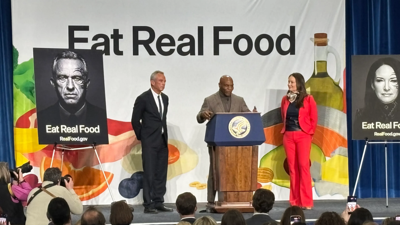



Health and Human Services Secretary Robert F. Kennedy, Jr. and Agriculture Secretary Brooke Rollins joined with legendary former heavyweight boxer Mike Tyson for a campaign to promote new dietary guidelines and eating "real food," Feb. 11, 2026.
PHILADELPHIA – A Philadelphia judge has again rejected a first-of-its-kind lawsuit by the firm Morgan & Morgan that likens the food industry to Big Tobacco, claiming ultra-processed foods were sold to create addicts now suffering consequences like diabetes.
Bryce Martinez’s case is a sort-of trial balloon that spawned similar litigation nationwide, most notably by the City of San Francisco. But Judge Mia Roberts Perez tossed the case last year as long on ambition but short on causation, calling it “woefully deficient,” and yesterday she refused to let Morgan & Morgan file a proposed amended complaint.
This likely sets up the chance to appeal her ruling from last year that dismissed the case, filed against companies like Kraft Heinz and Coca-Cola over 179 products.
“Martinez casts a wide net in seeking to hold numerous food producers liable for illnesses resulting from his consumption of nearly two hundred products over the course of multiple years,” Perez wrote. “Pennsylvania courts have not recognized industry-wide liability for plaintiffs in these circumstances.”
Morgan & Morgan partner Mike Morgan said companies were “prioritizing profits over the health and safety” of customers. A 149-page complaint, the result of a year’s work at the firm, said tobacco companies Phillip Morris and RJ Reynolds bought major food companies in the 1980s and hoped to use the addiction playbook they’d used with cigarettes.
The plaintiff is Martinez, of Bucks County, who was diagnosed with type 2 diabetes and non-alcoholic fatty liver disease at 16. His lawyers blamed the diet allegedly forced on him by the food industry, and other firms noticed.
Dozens of other plaintiff firms created UPF pages on their websites and offered free consultations for clients willing to hire them on contingency fees. Plaintiff attorneys hope the theory sticks and leads to a massive payoff, much like the tobacco litigation of the 1990s.
But the lawsuit was “woefully deficient” in establishing a causal link between the food and illnesses, Perez wrote last year. Yesterday she added that there is no formal federal definition of UPFs, so those foods are held to the same legal standards as others.
“Accordingly, a plaintiff seeking to hold producers of food liable in tort must show the products they consumed caused the harm they suffered,” she wrote. “This creates a unique challenge for plaintiffs, like Martinez, who consume a large number of products over a lengthy period of time.”
U.S. Health Secretary Robert F. Kennedy, Jr., formerly of counsel at Morgan & Morgan, said earlier this year that a federal definition of UPFs is coming, part of the Make America Healthy Again initiative. He has called them a “poison,” but public comments on his plan noted the difficulty of determining what exactly a UPF is.
“Not all processed foods are created equal, and some are shown to be beneficial to health,” the California Dairy Council wrote.
“Many processed foods – like frozen vegetables, canned beans or pasteurized milk – retain their nutritional value during processing and are essential for food safety, convenience and accessibility.”
The public-interest law firm Washington Legal Foundation also filed a comment, calling the use of federal resources to define UPFs for regulatory purposes “the wrong choice.”
Emulsifiers are used to help liquids mix. The FDA’s request for information mentions them, but WLF notes they are used in baby formula – “a literal life-saver for children with latching issues or whose parents are unable to breastfeed,” it says.
“The term ‘ultra-processed’ is not ‘the best term to use,’ devoid as it is of any inherent meaning or scientific consensus,” WLF wrote.
“But there is no better ‘term.’ The problem is the search for a universal term that focuses on food preparation and construction, rather than nutritional content itself.”