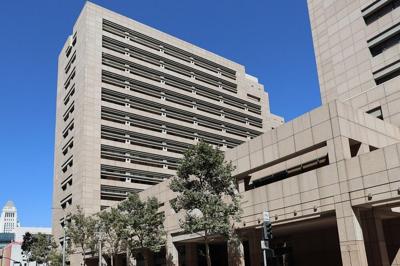


Ronald Reagan State Building, home of the California Second District Court of Appeal, Los Angeles
LOS ANGELES — A state appeals panel has ruled the Los Angeles Unified School District misled voters about the actual impact a $9 billion bond referendum would have on their property tax bills.
Plaintiffs Shawn Osborne and Lawrence Sand had asked a judge to require changes to how the district worded ballot language for its 2024 request. The lawsuit also named Dean Logan as a defendant in his capacity as county registrar, recorder and clerk. According to court records, the district’s voter information materials presented the financial impact in terms of cents per $100 of assessed property value, while the actual language on the ballot presented the math as a rate of dollars per $100,000, as required by state law.
Los Angeles County Superior Court Judge Curtis Kin denied that request at the time, allowing the election to proceed.
The measure passed with support from 68% of voters.
In court, Osborne and Sand conceded the matter is technically moot and abandoned a bid to overturn the results.
But the plaintiffs nonetheless asked the California Second District Appellate Court to determine the district acted illegally by putting their own spin on the financial impact estimates, presenting numbers different from what state law required.
Justice John Segal wrote the panel’s opinion, filed July 24; Justices Gonzalo Martinez and Gail Feuer concurred.
“Though the appeal is moot,” Segal wrote, the panel agreed it was proper to address the question because of “an exception to the mootness doctrine that often applies in election cases: appeals presenting issues of general public interest that are likely to recur.”
According to court records, district leaders in August 2024 finalized a ballot language submission including the question: “Shall Los Angeles Unified School District’s measure be adopted authorizing $9,000,000,000 in bonds at legal rates, levying approximately 2.5¢ per $100 of assessed valuation (generating $456,123,000 annually) until approximately 2059, with audits/citizens’ oversight?’”
Segal said voters see such text on the ballot, “a condensed combination of what the Elections Code defines as the ‘ballot title and summary.’ ” But when it mailed voters the required tax rate statement and sample ballot for what came to be known as Measure US, the panel continued, the board “described the ‘best estimate of the average annual tax rate’ as ‘$25.04 per $100,000 (2.504 cents per $100),’ the ‘best estimate of the highest annual tax rate’ as ‘$45.01 per $100,000 (4.501 cents per $100)’ and the ‘best estimate of the total debt service’ as ‘$15,964,303,000.’ ”
When Los Angeles County Counsel conducted its required analysis of Measure US, the panel noted, it used the per $100,000 figures and didn’t state any rates in terms of cost per $100. The panel also acknowledged the district submitted the question on the last possible day to get it placed on the general election ballot, and when Logan agreed to an expedited briefing schedule on the litigation, the hearing date of August 29 left no time for any review of Judge Kin’s decision because Logan’s office had to start printing election materials.
Before the appeals panel, Logan and the district argued the only legal obligation was to state the tax rate accurately, and 2.5¢ per $100 was a correct figure. Segal acknowledged the specific statutory subdivision section at issue doesn’t define the term “rate” or spell out how a ballot should express the rate. However, he said, the larger context of the Election Code and other laws make it clear the plaintiffs had a winning argument.
Because California lawmakers also have enacted rate disclosure requirements specific to bonds and made subsequent amendments to other state law provision, Segal wrote, with a stated purpose of giving “voters the most accurate available information,” the panel couldn’t accept an approach of using different denominators for a ballot label and information guide.
“Various committee analyses of (a) 2024 amendment discussed interchangeably how to express the tax rate in the sample ballot materials and in the ballot, using the same terminology,” Segal wrote. “The analyses also described the issue the bill would address as whether the Legislature should ‘require all ballots to express tax rates on a per $100,000 basis.’ ”
That discussion, the panel reason, suggested lawmakers “believed the ballot label tax rate for bond measures was already connected to the rates stated in the voter information materials” the relevant statute governs. The panel also said allowing “the district to state the bond tax rate one way on the ballot and another way in ballot information materials would create exactly the kind of voter confusion the Legislature has sought to avoid.”
The panel reversed Judge Kin’s motion denying the plaintiffs’ petition for a court order and directed him to dismiss it as moot. It also denied the district’s motion to dismiss the appeal and said all parties will bear their own legal costs for the appellate proceedings.
The Law Offices of Jason A. Bezis represented the plaintiffs.
Logan is represented by Los Angeles County Counsel Dawyn Harrison.
The district is represented by Strumwasser & Woocher.