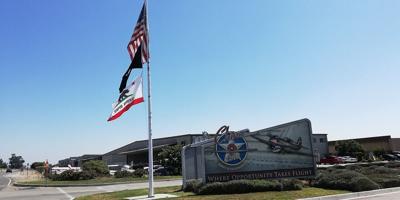


Chino Airport, Chino, California
CHINO, CALIFORNIA — A federal appeals panel has ruled San Bernardino County might be entitled to a $162 million insurance payout covering environmental remediation at an airport, an increase of $144 million over what the carrier hopes to pay.
The county said the Insurance Company of the State of Pennsylvania is supposed to pay up to $9 million per occurrence of property damage at its Chino Airport, while ICSOP claims its policy obligates it to cover that amount per year. Although U.S. District Judge John Walter ruled in favor of the carrier, the county convinced a U.S. Ninth Circuit Court of Appeals panel to reverse in its favor.
Judge Jay Bybee wrote the panel’s opinion, filed April 23; Judges Richard Clifton and Ana de Alba concurred.
“The facts giving rise to this case date back to the Second World War,” Bybee wrote, saying the federal government leased Chino from the county and in 1942 bought adjoining land. “Operations on the site during these years, including the dismantling and melting of surplus World War II aircraft into ingots, generated significant industrial waste, which was then discharged into the ground.”
San Bernardino took back full ownership of the airport in 1949, including the land the federal government used, and soon began leasing parcels to various businesses. During the Vietnam war era, Bybee wrote, Chino “again became a locus of wartime efforts: Its tenants produced napalm, bombs and other incendiary devices, all sold to the federal government.”
Environmental remediation efforts began in 1990 when the California Regional Water Control Board raised concerns about hazardous chemical levels downstream of the site. The Board issued a cleanup and abatement order to the country, then issued superseding orders in 2008 and 2017. The county then launched investigations into more than 20 potential contamination sources, drilled and sampled more than 200 soil borings, installed and sampled 75 groundwater wells, disposed of 10 underground storage tanks, 310 hazardous waste drums and 51 napalm containers, among other efforts, with costs still accruing today.
ICSOP’s involvement concerns three successive, identical policies it wrote for the county from 1966 through 1975. After primary insurers denied claims, San Bernardino sought coverage under ICSOP’s umbrella policy in 2008; it started making payments in 2012. But by 2021, ICSOP told the county it had maximized its payout for the year.
After reviewing policy language, Bybee explained the primary argument is a dispute over interpretation of the policy’s aggregate limit: “Are products liability and personal injury by occupational disease the only categories covered by the aggregate limit? Or is there a general aggregate limit for covered losses and a separate aggregate limit for products liability and occupational injury?”
ICSOP said its maximum exposure should be $81 million, calculated as a $27 million maximum liability for each of the three-year policies. Judge Walter agreed, finding property damage was subject to the policy’s annual aggregate limit.
“Supposing there are 18 occurrences during the policy period — a number the county has proposed in this case — then ICSOP’s liability could be as high as $162 million,” Bybee wrote. “Indeed, if there is no annual aggregate limit on liability for property damage, then the county would theoretically have unlimited coverage because a theoretically unlimited number of occurrences could take place during the same year.”
The panel noted the first year of litigation focused on how many occurrences were compensable, not whether the policies had an aggregate limit. At one point the carrier said its policies didn’t “contain any aggregate limits of liability that apply to the Chino Airport claim,” though it convinced a magistrate judge to let it withdraw that admission in early 2023.
Bybee said both parties offered reasonable readings if ICSOP’s policy language, rending the coverage ambiguous, and rejected as controlling ICSOP’s citation to a 2005 state appellate court ruling, Garamendi v. Mission Insurance. While acknowledging that is a principal case in California, Bybee explained that panel itself addressed a more relevant opinion: Weyerhaeuser v. Commercial Union Insurance, a 2000 Washington Supreme Court 5-4 ruling.
That court found the challenged policy to be unambiguous and said if Commercial Union intended there to be a property damage aggregate limit, it would’ve written one into the policy. The California panel in Garamendi said the Weyerhaeuser dissent was more in line with California law, Bybee wrote, and ICSOP argued the same concerns about potentially ambiguous contract law favored its position.
The Ninth Circuit panel disagreed. Bybee said the most important intent question is what parties understood when reaching the agreement in the 1960s, not what the Garamendi court ruled in 2005. The panel then noted “important factual differences between our case and Garamendi,” including policy provisions that weren’t in the Garamendi contract or, if present, didn’t surface during litigation.
Still, Bybee wrote, the Ninth Circuit agreed the contested language is “not just ambiguous, but nearly incoherent,” then explained a fundamental disagreement with Weyerhaeuser and said it would turn to extrinsic evidence to resolve the dispute. The county suggested the industry’s era-standard form Commercial General Liability policies and more recent ICSOP documents disavowing an aggregate limit.
In ruling for ICSOP, Judge Walter wrote that “it would make no sense for an insurance company to operate under the threat of unlimited exposure for covered injuries other than products liability and occupational injury.” Despite that common sense understanding, Bybee said, the panel found “no rule of contract construction that imputes post-hoc rationality to the parties. Things get overlooked all the time. We have to deal with the policies as written, not as we would have written them.”
The panel further said the standard policy forms from the 1940s through the mid-1980s strongly favor the county’s position, noting a 1966 terminology change from insurance against “accidents” to “occurrences.” That was the year ICSOP first wrote a Chino Airport policy.
“At the time, the per occurrences provision was the industry’s focus and was thought to be the principal means of limiting its liability,” Bybee wrote. “The aggregate limit was an overlooked backstop.”
Those policies predated environmental and asbestos-related tort litigation, the panel said, which indeed “triggered a crisis in the insurance industry.” Bybee pointed to a 1986 General Accounting Office report to Congress concerning “open-ended risks” drawing from a lack of aggregate limits. And while flaws in some standard form policies are not determinative, the panel put great weight on the county’s citation to four internal ICSOP documents, as far back as 2012, demonstrating reasonable people — including company employees — could adopt the county’s framework.
The panel ultimately determined ICSOP’s Chino policies are ambiguous, but said the well-established legal canon points to resolving that uncertainty in favor of the policyholder.
“This was a standard form policy, drafted in an era when the industry did not anticipate the consequences of not specifying the aggregate limits for umbrella and excess policies,” Bybee wrote. “We conclude that these policies do not specify an aggregate limit for property damage. In light of our conclusion, the district court will need to reconsider the county’s request for declaratory relief.”
The county is represented by Reed Smith, of Los Angeles and Pittsburgh; Morgan Lewis & Bockius, of Los Angeles; and its own attorneys.
ICSOP is represented by BatesCarey, of Chicago; and Herold & Sager, of Encinitas.