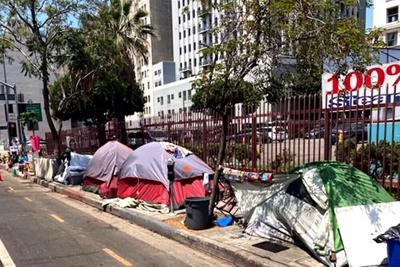


Homeless encampment, Los Angeles
LOS ANGELES — A legal agreement between homeless advocates and the city of Los Angeles earlier this month ends a two-year legal dispute into whether the city disobeyed a court order aimed at reducing the homeless population in the region.
But the settlement approved by federal Judge David Carter in the Central District of California comes at a cost for local taxpayers. Under the terms of the agreement, the city will pay $1.9 million to the plaintiff, the LA Alliance for Human Rights, and intervenors Los Angeles Community Action Network and LA Catholic Worker $300,000 to cover two years of attorney fees and costs related to monitoring the initial homelessness agreement negotiated in 2022
In an email reacting to the May 8 agreement, Paul Webster, the alliance’s executive director, said the agreement will require the city to create 14,000 housing or shelter units by June 30 of next year – an increase over the shelter provisions in the original settlement. In addition, the city must keep at least 12,915 of those housing opportunities open through June 30, 2029.
The parties also agreed that the city should no longer be required to reduce a set number of homeless encampments. Instead, Los Angeles has pledged to move 19,600 homeless individuals into shelters or housing units the city promised to create in the 2022 settlement.
“We believe this better focuses on what ultimately matters – getting people off the street – and the prior metric was simply not working due to dramatic data failures by both the city and the LAHSA (Los Angeles Homeless Services Authority),” Webster said. “If people are off the street, encampments go away.”
One of the alliance’s attorneys, Matthew Umhofer, said the latest settlement commits the city to spending more to reduce homelessness in the region.
“The city has previously indicated that its commitments under the initial settlement agreement amounted to approximately $3 billion,” Umhofer told the Southern California Record in an email, “and so this increase in beds takes us over $3 billion overall.”
Umhofer stressed that homeless advocates brought the federal current case for two main reasons: to expand the number of beds available to the homeless while reducing the number of homeless encampments and to bring more accountability to the city’s efforts to end homelessness.
“The legislative and executive branches of the city have failed on both fronts, as has the electoral process, but our case has succeeded at both by bringing judicial enforcement into play,” he said. “Increasing the number of beds so significantly and growing the rate of encampment reduction means less people on the street and more people inside.”
More needs to be done to end homelessness in the region, according to Umhofer, but the case offers a template for how the legal system can bring about change “when everything else is failing.”
The agreement also calls for an independent data monitor, Nardello & Co., to review every one of the city’s reports about its efforts to reduce homelessness. The cost of the data monitor is limited to $150,000 annually, according to the settlement provisions.
“The city’s days of self-grading its own homework are over,” Webster said.
Quarterly reports on the city’s progress at expanding homeless shelters and services will include outreach efforts by City Council districts, encampment counts, housing vacancy data and the number of people offered shelter, he said.
Webster said the alliance gave ground by agreeing to end contempt proceedings without any formal court findings, but the gains in housing capacity, accountability and the elimination of appellate proceedings that could have eroded the settlement make up for it.
The homelessness litigation has been largely carried out by private attorneys, with the Los Angeles firm Umhofer, Mitchell & King LLP representing the plaintiff and Gibson, Dunn & Crutcher LLP representing the city.