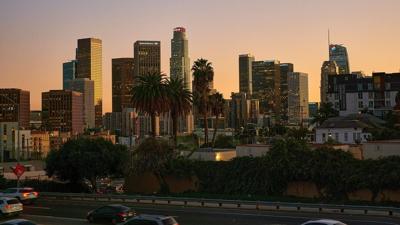



Los Angeles city skyline
LOS ANGELES — A state appeals panel has agreed Los Angeles wasn’t required to seek voters’ permission before allowing a utility to impose surcharges on city residents.
Annie Nguyen’s complaint stems from a 2022 franchise agreement between the city and Southern California Gas, a 21-year deal that required the utility to pay a franchise fee equivalent to 5.5% of gross receipts from natural gas sales. Nguyen alleged the company passed on 3.5% of that amount to customers through a surcharge, which the California Public Utilities Commission approved.
Seeking to represent a class, Nguyen alleged the surcharge is actually a tax and therefore was imposed illegally because a California Constitutional clause — approved by referendum in 2010 — requires voters to approve such taxes. Los Angeles County Superior Court Judge Lawrence Riff granted summary judgment to the city, finding the franchise fee and surcharge are exempt from that clause in that they are “A charge imposed for entrance to or use of local government property, or the purchase, rental, or lease of local government property.”
Nguyen challenged the ruling before the California Second District Appellate Court, also arguing Judge Riff erred by failing to apportion the franchise fee between how much SoCalGas paid to use city property and the other amounts linked to its general operational privileges as well as granting summary judgment at all in light of a factual dispute over whether the fee is reasonably related to the franchise value and if the amount stemmed from legitimate negotiations.
Justice Kenneth Yegan wrote the panel’s opinion, filed June 22; Justices Hernaldo Baltodano and Tari Cody concurred.
According to Yegan, SoCalGas extended its 1992 agreement several times before executing the 2022 deal. Under the earlier contract, the utility paid a one-time $6 million fee and 2% of gross receipts. The 1992 agreement also meant SoCalGas was exempt from paying the Street Restoration Damage Fee the city adopted in 1998 as a means of recovering expenses whenever an entity had to excavate or cut municipal roads. Before negotiating the 2022 deal, the city estimated it was losing between $15 million and $18 million annually through that exemption.
Nguyen argued the franchise fee shouldn’t be exempt because, in addition to allowing access to physical property, the agreement also conveys the right to operate a business in the city, an intangible property right. The city argued the two rights are indivisible as access to property in order to install and maintain natural gas delivery infrastructure has no value without the right to operate the system.
The panel agreed with the city, noting there is no precedent establishing a requirement for apportioning or dividing the payments.
“SoCalGas’ use of city property to construct, repair, maintain and operate its natural gas system is indistinguishable from its use of that system to distribute natural gas,” Yegan wrote. “The franchise fee is paid in exchange for the entire franchise.”
Yegan further said the exemption that clears the franchise fee from going before voters doesn’t require a showing the fee is substantively reasonable relative to the value of the utility. But to the extent any such requirement may exist, the panel continued, the city has proved its point, including with the fact “undisputed evidence established that the franchise fee was the product of bona fide negotiations.”
The sides met at least 14 times and exchanged numerous proposals, the panel said, rejecting Nguyen’s argument SoCalGas lacked incentive to negotiate a lower fee by noting any business would want to maintain goodwill with customers by charging customers as little as possible.
“Additionally, we note that SoCalGas applied for and received CPUC approval of the surcharge,” Yegan wrote. “This approval reflects the CPUC’s finding that the surcharge is just, reasonable and nondiscriminatory. SoCalGas had an incentive to negotiate a reasonable franchise fee because CPUC would not have approved the recover from customers of an unreasonable fee.”
The panel also noted SoCalGas avoids double payments through credit against its franchise fee for street damage fees for amounts attributed to infrastructure maintenance, and if a customer specifically requests work that triggers the fee, that customer pays the amount.
“This means the city collects the SDRF only once, either from an individual customer for site-specific work, or from SoCalGas for infrastructure maintenance work,” Yegan wrote. “The franchise fee is reduced by the amount of SDRF paid by SoCalGas, so it pays the SDRF only once. There is no double collection.”
The panel affirmed Judge Riff’s ruling.
Nguyen is represented by Haffner Law and the Law Offices of Neil R. Anapol.
The city is represented by its attorney’s office.