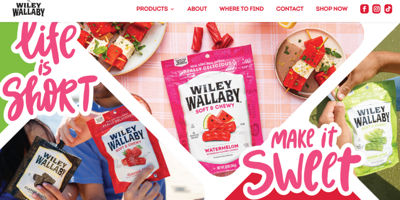


Screenshot of Wiley Wallaby candy website
SAN DIEGO — A federal appeals panel has revived a class action accusing the makers of Wiley Wallaby licorice candies of misleading consumers about whether its products are “natural.”
Mark Trammell sued KLN Enterprises in 2023, alleging it made berry-flavored products with an artificial petroleum substrate while advertising they contained no artificial flavors. His lawsuit focused on Wiley Wallaby Very Berry Licorice and specific product packaging language such as “Natural Strawberry & Raspberry Flavored Licorice,” “Naturally Flavored” and “Free of … Artificial Colors & Flavors.”
But U.S. District Judge Marilyn Huff granted the company’s motion to dismiss the claim, finding Trammell’s allegations lacking and rejecting a chance to amend the complaint.
The U.S. Ninth Circuit Court of Appeals reversed Huff’s ruling. Judge Eric Tung wrote the panel’s opinion; Judges Kim McLane Wardlaw and Ana de Alba concurred.
According to Tung, Trammell alleged the company violated the California Consumers Legal Remedies Act and other state laws and accused it of unjust enrichment and breach of express warranty. Tung further said the complaint centered on the presence of malic acid in the candy. Trammell acknowledged the acid can exist naturally or be artificially synthesized and alleged the acid in the candy was the kind “manufactured in petrochemical plants from benzene or butane — components of gasoline and lighter fluid, respectively — through a series of chemical reactions, some of which involve highly toxic chemical precursors and byproducts.”
Judge Huff said Trammell didn’t “plead with sufficient particularity that the malic acid used in the product is artificial” and also found the product labeling wasn’t “unambiguously deceptive,” in part because the back label “discloses both natural and artificial ingredients in plain text.
“... Nowhere on the front or back label does it state that the product is ‘all natural,’ ‘100% natural’ or ‘free of artificial ingredients.’ … Nothing about this product — a brightly colored, shelf-stable licorice candy — would lead a reasonable consumer to conclude (it) is free of artificial ingredients when the product labels make no affirmative representations saying as such.”
The Ninth Circuit panel concluded neither of Huff’s reasons for dismissing the complaint had merit. Tung first explained the allegations satisfy the requirements of a fraud complaint: KLN sold a product marketed as free of artificial flavors and colors, Trammell bought it in May 2023 from a Target in Encinitas and he now believes the marketing to be knowingly false. He identified a specific laboratory that tested the candy and cited its qualifications and KLN had the opportunity through discovery to test the validity of those claims.
Still, Tung continued, Huff ruled to dismiss based “on three trial-level decisions.” Yet the panel found “those decisions are nonprecedential and inapposite” because they didn’t include the level of detail the panel found in Trammell’s complaint.
Tung further explained why Trammell’s allegations about the product language are sufficient, including that he plausibly claimed the “Free of … Artificial Colors & Flavors” was specific enough to raise the possibility it could be ruled misleading or false. And while Huff didn’t find the back label misleading based on an ingredients list, the panel said that list “does not disclose, on its face, which of the ingredients are artificial or specify whether the included malic acid is the naturally occurring sort."
“A reasonable consumer, not being a chemist, is not in a position to make that assessment when buying the product,” Tung wrote. “What a reasonable consumer can understand is the product’s representation that there are no artificial flavors. When that clear representation is placed next to an ingredients list — a list that does not make apparent which ingredients are flavors and which of those ingredients are artificial — a reasonable consumer could plausibly be (mis)led into believing that the product does not contain artificial flavors.”
The panel also said Huff observed the product doesn’t claim to be “100% natural” or “free of artificial ingredients,” but Trammell didn’t argue that was the case because his allegations focus specifically on artificial flavors. It likewise rejected Huff’s thoughts about the candy’s bright colors and shelf life.
“Again, the claim is not that the product falsely purports to be free of artificial ingredients; the claim is about flavors,” Tung wrote. “Colors and stability may go to the artificiality of the coloring and preservative; they do not necessarily bear on the artificiality of the flavors.”
Finally, KLN argued U.S. Food and Drug regulations define malic acid as a flavor enhancer, not a flavoring agent. The panel said the relevant standard is a reasonable consumer expectation, not an industry expert’s knowledge.
“And here, Trammell has plausibly alleged that a reasonable consumer expects the product to be free of artificial flavors and that it would be misleading to that consumer if the product contained an artificial petroleum substrate as a flavoring,” Tung wrote, “whether as a flavor itself or as a flavor enhancement.”
The panel reversed Huff’s ruling and remanded the complaint for further proceedings.
Trammell is represented by attorney Charles C. Weller, of San Diego.
KLN is represented by Foley & Lardner, of San Diego and Los Angeles.