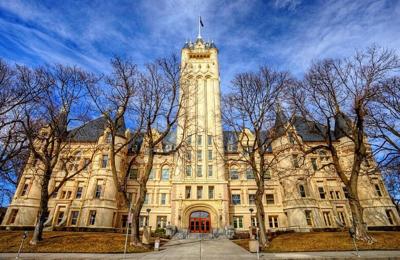



Spokane County Courthouse
SPOKANE, Wash. – Lawyers hoping to convince juries that diesel exhaust causes a certain type of cancer have lost one of their most prestigious experts - a celebrated researcher who helped coordinate care for Chernobyl victims.
Despite Dr. Robert Gale’s long list of credentials, a Washington appeals court this month disqualified him from a lawsuit blaming BNSF for a worker’s colorectal cancer. It found fault with the conclusions Gale was set to tell jurors before a Spokane judge found his testimony unreliable, which resulted in plaintiff Judy Cundy losing her lawsuit.
Among the issues were a misrepresentation of sources he reviewed, having included in his report that the International Agency for Research on Cancer found some studies showed engine exhaust could cause cancers of the larynx and colon.
But that section of the IARC report, submitted by the firm Marc J. Bern & Partners, did not include what he said. Instead, it found an association between diesel exhaust and lung and urinary bladder cancers.
“Dr. Gale’s selective quotation from this subsection was a material misrepresentation of the information…” Judge Megan Murphy wrote.
Gale had reviewed literature and epidemiological studies to form his opinion that diesel exhaust can cause colorectal cancer, but the court said jurors can’t hear testimony that rests on speculation or subjective belief.
Of 16 studies on the issue, only one suggested an association – which he cited in his report without mentioning the other 15. Murphy called it “selective engagement” and criticized Gale for not taking a “weight-of-the-evidence approach.”
“All authoritative bodies classify diesel exhaust as carcinogenic to humans based, primarily, on lung cancer, with weaker evidence for bladder cancer, and insufficient evidence for all other sites,” she wrote.
“Dr. Gale nevertheless extrapolated lung-cancer potency factors to colorectal cancer solely because diesel exhaust contains mutagenic compounds. He cited no animal, mechanistic or human data supporting site-specific causation for colorectal cancer.”
It’s not the first time Gale has been disqualified in a diesel-exhaust case. A Nebraska court struck his testimony in the case of a firefighter/engineer who developed lung cancer and Chronic Obstructive Pulmonary Disease when Gale and another expert attributed his illnesses to diesel exhaust, asbestos and coal dust, among other things.
What Gale didn’t blame, however, was that the plaintiff had smoked two packs of cigarettes a day for 40 years.
“Having failed to both properly rule in occupational exposures as a cause of Ronald’s lung cancer, and then failing to rule out any other potential sole causes for the cancer, Dr. Gale failed to reliably perform the differential diagnosis,” former U.S. Magistrate Judge Cheryl Zwart ruled in that case.
But other courts have found him fit to testify. Also in Nebraska in 2020, Union Pacific lost its bid to exclude his opinions in a case involving diesel exhaust and tonsil cancer over calls that he had not considered the plaintiff’s history of HPV, smoking and drinking.
And Gale is not strictly a plaintiffs expert. When a Maine man sued Central Maine Power Company over radiofrequency radiation from its smart meters, CMP hired Gale to refute claims it exacerbates non-Hodgkin lymphoma.
The man’s doctor had warned against RF radiation emitted from smart meters, but CMP charged extra for its replacement with an analog meter. Gale opined that RF radiation is “less likely than not” to worsen the plaintiff’s condition, and the judge in that case found his findings reasonable.