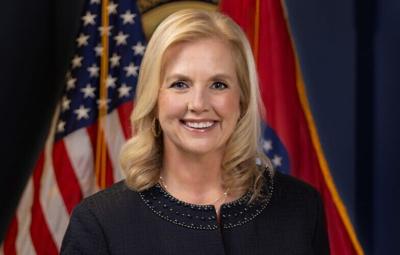



Missouri Attorney General Catherine Hanaway
JEFFERSON CITY — Attorney General Catherine Hanaway announced that Missouri is leading a coalition of 23 states in support of Indiana’s voter identification law, filing an amicus brief with the U.S. Court of Appeals for the Seventh Circuit and urging the court to reverse a federal district court ruling that blocked portions of the measure.
According to the attorney general’s office, the filing seeks to defend states’ authority to enact election integrity measures and argues that Indiana’s voter identification requirements are constitutional safeguards designed to protect the electoral process.
The coalition’s brief was filed in support of Indiana officials seeking reversal of an April 14 ruling by U.S. District Judge Richard Young that temporarily blocked enforcement of part of Indiana’s Senate Bill 10, enacted in 2025.
The law prohibits voters from using certain nongovernment-issued identification documents to verify their identity when voting.
Hanaway said the states have a strong interest in protecting election systems and maintaining public confidence in elections.
She described government-issued photo identification requirements as a “commonsense safeguard” intended to ensure votes are lawfully cast while preserving access for eligible voters.
The attorney general said states should not be required to wait for fraud to occur before adopting measures aimed at securing elections.
The Missouri-led brief contends that Young’s ruling conflicts with prior decisions recognizing state authority to regulate elections and safeguard election integrity.
The filing argues that states possess a significant interest in administering elections, preventing fraud, protecting voter confidence and ensuring orderly election procedures.
It further maintains that election regulations do not become unconstitutional merely because they may impose limited inconveniences on some voters, particularly when alternative means of compliance remain available.
The brief points to previous judicial decisions upholding voter identification requirements and argues that states have broad constitutional authority to establish election rules through their legislatures.
According to the filing, election laws that do not substantially burden the right to vote are generally evaluated under a deferential legal standard that allows states to advance legitimate governmental interests, including preserving election integrity and preventing fraud.
The states argue that Indiana’s law is rationally related to those interests and therefore should be upheld.
Missouri Solicitor General Lou Capozzi said the Constitution assigns responsibility for establishing election rules to elected state lawmakers.
He said the coalition’s effort seeks to protect that authority and prevent judges from substituting their own policy preferences for decisions made by state legislatures.
The amicus brief also emphasizes that states have long been permitted to enact measures intended to secure elections and preserve public confidence in election outcomes.
According to the filing, courts have repeatedly recognized election integrity and fraud prevention as legitimate governmental interests.
The coalition argues that states may take preventive action to protect the electoral process and are not required to demonstrate that fraud has already occurred before adopting safeguards.
Indiana’s Senate Bill 10 became the subject of litigation after opponents challenged restrictions on the use of certain identification documents for voting.
Young’s ruling temporarily blocked enforcement of the challenged provisions, finding that the law violated constitutional voting rights.
Missouri and the other states participating in the appeal argue that the district court improperly discounted the state’s interests in election administration and failed to give appropriate weight to precedent recognizing the authority of states to regulate voting procedures.
The coalition supporting Indiana includes attorneys general from Alabama, Alaska, Arkansas, Florida, Georgia, Idaho, Iowa, Kansas, Kentucky, Louisiana, Mississippi, Montana, Nebraska, New Hampshire, North Dakota, Oklahoma, South Carolina, South Dakota, Tennessee, Texas, Utah, West Virginia and Missouri.
The case now moves before the Seventh Circuit, where the coalition is asking the appellate court to reverse the district court’s order and allow Indiana’s voter identification requirements to take effect while the broader legal challenge proceeds.
Missouri officials said the outcome could have implications for the ability of states to enact and defend election integrity measures across the country.
U.S. Court of Appeals for the Seventh Circuit case number: 26-1783