
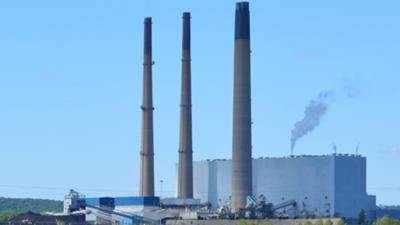



Ameren Missouri's Labadie Energy Center has consistently been ranked as one of the highest emitters of the carbon dioxide, nitrous oxide and sulfur dioxide, according to the U.S. EPA.
ST. LOUIS — A federal judge in the Eastern District of Missouri has granted a motion to dismiss a lawsuit brought by Iowa, Missouri and the American Free Enterprise Chamber of Commerce against New York Attorney General Letitia James and New York State Department of Environmental Conservation Commissioner Amanda Lefton, finding the court lacks personal jurisdiction over the New York officials.
U.S. District Judge Henry Edward Autrey issued the opinion, memorandum and order Aug. 11, granting the defendants’ motion to dismiss under Rule 12(b)(2) of the Federal Rules of Civil Procedure.
The judge denied as moot the defendants’ alternative request to dismiss the case for improper venue under Rule 12(b)(3). The court said it would issue a separate order of dismissal.
The plaintiffs filed the suit on May 14, challenging New York regulations that establish a mandatory greenhouse gas reporting program.
The regulations require reporting information about greenhouse gas emissions from emission sources.
According to the complaint, the rules require fuel suppliers, including ethanol and biodiesel producers and distributors, to register with and report to New York the amount of liquid fuel that may be sold in the state, regardless of where the fuel was initially sold or produced.
Iowa, Missouri and the chamber alleged that the regulations reach fuel suppliers in Iowa and Missouri, as well as the chamber’s members in the biofuels industry.
They contended that the reporting rules are unconstitutional and are preempted by the federal Clean Air Act.
The plaintiffs asserted four claims against James and Lefton in their official capacities.
They alleged that the regulations violate the Constitution’s prohibition on extraterritorial state regulation, are preempted under the Constitution’s supremacy clause, violate the Due Process Clause of the Fourteenth Amendment and violate the Fourth Amendment’s prohibition on unreasonable searches.
They sought a declaration that the regulations violate the Constitution’s prohibition on extraterritorial state regulation, are preempted by the Clean Air Act and violate the Fourth and Fourteenth Amendments.
The plaintiffs also sought to block James and Lefton from enforcing the regulations under the Ex Parte Young doctrine, as well as attorney fees and costs.
James and Lefton argued that Missouri’s federal court had no personal jurisdiction over them because the complaint did not establish the constitutionally required minimum contacts with Missouri or meet the requirements of the state’s long-arm statute.
They also argued that the Eastern District of Missouri was not a proper venue because the conduct challenged by the plaintiffs occurred in New York rather than Missouri.
The plaintiffs did not file a response to the motion to dismiss before the deadline expired.
The court said the party seeking to invoke a federal court’s jurisdiction bears the burden of establishing that jurisdiction exists.
Autrey found that the complaint did not allege a basis for either general or specific personal jurisdiction over the defendants.
The court said James and Lefton are New York officials, are not Missouri residents and were not alleged to have continuous and systematic contacts with Missouri.
The judge declined to find that either official was “at home” in Missouri for purposes of general jurisdiction.
On specific jurisdiction, the court said the plaintiffs had not alleged that James or Lefton had any contact with Missouri.
The complaint did not say that the officials conducted business in Missouri, developed or implemented the regulations there, maintained offices in the state, sent letters to Missouri residents or made phone calls to Missouri residents.
Those allegations, the court concluded, did not show the required minimum contacts with Missouri to satisfy due process.
Because the plaintiffs failed to make a prima facie showing that the New York officials could be subjected to jurisdiction in Missouri, the court granted the motion to dismiss for lack of personal jurisdiction and did not reach the alternative venue argument.
U.S. District Court for the Eastern District of Missouri, Eastern Division case number: 4:26-cv-752