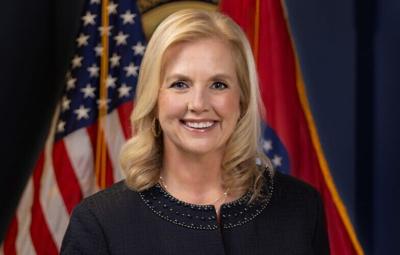



Missouri Attorney General Catherine Hanaway
JEFFERSON CITY — State Attorney General Catherine Hanaway’s office has opened an investigation into the Missouri State High School Activities Association (MSHSAA) after state Auditor Scott Fitzpatrick reported allegations that the organization barred a prospective board applicant from eligibility based solely on his race and sex.
The investigation follows a detailed letter from Fitzpatrick outlining the auditor’s months-long correspondence with MSHSAA regarding the whistleblower’s complaint and the constitutional provision the organization used to justify the decision.
Hanaway said the investigative action comes in response to what she described as an “immoral system” within the statewide activities association, which governs extracurricular programs for more than 700 junior and senior high schools and directly impacts more than 200,000 Missouri students.
She said that any governing body setting rules for public-school activities must ensure that leadership selection is based on merit rather than race or sex.
Hanaway noted that the state “does not tolerate race-based or sex-based discrimination” and said her office intends to move swiftly.
According to Fitzpatrick’s letter, his office received a whistleblower allegation more than seven months ago, asserting that the individual, who is white and male, was denied eligibility for an at-large board position.
Fitzpatrick wrote that MSHSAA informed the whistleblower that he could not seek the seat because Article IV, Section 2.b.2 of the association’s constitution requires at-large positions to be filled by candidates representing “the under-represented gender … or an under-represented ethnicity.”
Fitzpatrick said the organization explicitly acknowledged that the applicant was barred because of his race and gender, a point reinforced by email correspondence provided to the Attorney General.
Fitzpatrick said the policy raises significant concerns given MSHSAA’s statewide authority and reliance on public funding. In his letter, he noted that the association “derives much of its funding from public sources and plays an important role in the extracurricular life of Missouri’s children.”
He wrote that the alleged discrimination is “extremely troubling” and that the whistleblower’s experience demonstrates the rule’s direct impact on who may serve in leadership roles for programs involving students across the state.
The auditor wrote that MSHSAA defended its practice by arguing that the policy does not discriminate “in general” but only for specific board seats, an explanation Fitzpatrick rejected.
He stated that the facts remained unchanged: the whistleblower was barred from applying for the at-large position because of his race and gender.
Fitzpatrick pointed to the MSHSAA constitution, the email to the whistleblower, and the association’s subsequent responses as evidence that the policy is intentional and openly enforced.
In his letter, Fitzpatrick urged the attorney general to use the full resources of her office to address the issue.
He wrote that Missouri students “deserve to have the most qualified, most committed individuals working on their behalf rather than the correct mix of genders and ethnicities as prescribed by MSHSAA.”
Fitzpatrick asserted that choosing board members based on immutable characteristics instead of qualifications undermines the interests of students and the integrity of the organization responsible for overseeing statewide extracurricular programming.
Hanaway reiterated this position in the release announcing her investigation, saying that any organization governing children’s activities must choose leaders based on ability rather than “the color of their skin.”
She said the Attorney General’s Office will move forward with its investigation to ensure that MSHSAA is operating in accordance with constitutional standards and serving students fairly.
Fitzpatrick enclosed with his letter the email MSHSAA sent to the whistleblower and additional written exchanges in which the association defended the policy.