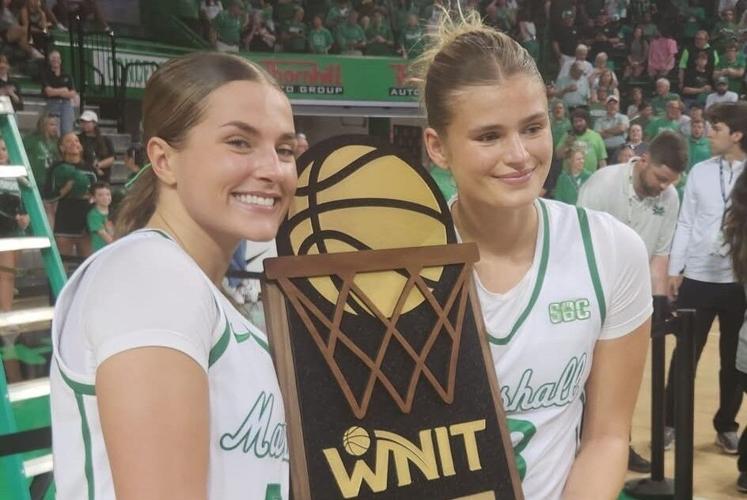


West Virginia natives Peyton Ilderton (left) and Meredith Maier helped Marshall’s women’s basketball team win the Women’s NIT earlier this year.
HUNTINGTON – A dozen Marshall University student-athletes are suing the NCAA over its newly expanded five-year eligibility window.
The 12 student-athletes who graduated high school in 2022 claim the NCAA shut them out while allowing other athletes – including former professionals – to play longer and get paid.
The complaint was filed July 6 in Cabell Circuit Court. The named plaintiffs are Meredith Maier, Peyton Ilderton, Dewain “Boogie” Trotter, Bryce Blevins, Cam Harthan, Bailey Fisher, Johanna Strom, Blessing King, Paige Simpson, Ryan Holmes, Momo Diop and Hannah Wyler.

New
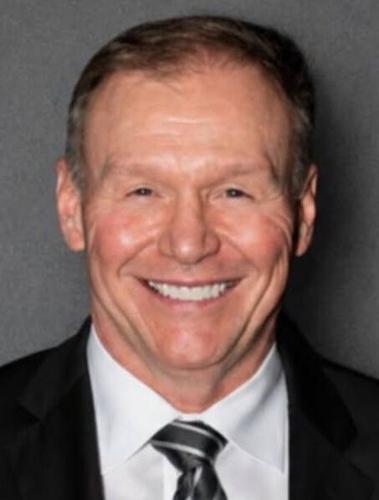
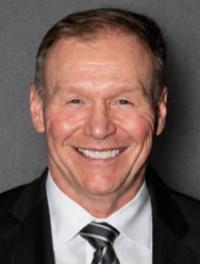
“I look forward to the court hearing our argument and attempting to get justice for these Marshall student-athletes,” attorney Steve New told The West Virginia Record.
On June 23, the NCAA approved an overhaul of its eligibility rules for Division I schools, allowing athletes to compete in five seasons over five years. Players previously were allowed four seasons of eligibility in five years.
In this complaint, the Marshall athletes say the NCAA’s recent decision to exclude their graduating class from a permanent rule change allowing five full seasons of competition “violates the covenant of good faith and fair dealing” and the West Virginia Consumer Credit and Protection Act. They seek immediate injunctive relief so they can play for the Thundering Herd during the 2026-27 academic year and sign scholarship, revenue-sharing and name, image and likeness (NIL) agreements.
Each plaintiff “first enrolled in college following graduation from high school in 2022, has exhausted four seasons of intercollegiate competition without a redshirt, and currently has a roster spot available at Marshall University contingent on a ruling on (his or her) eligibility for the 2026-27 season.”
They compete or seek to compete in football, baseball, soccer, women’s tennis, women’s basketball, softball and women’s cross country, according to the filing. Marshall is a Sun Belt Conference member, and the league has adopted a revenue-sharing framework “permitting direct payments to student-athletes consistent with the settlement preliminarily approved in In re College Athlete NIL Litig.”
For decades, the NCAA has enforced what the complaint calls the “Five-Year Rule,” under which Division I athletes had a five-year window to use their eligibility but were limited to four seasons of actual competition and could use a fifth year only as a redshirt season with “limited or no competition.”
The filing notes that beginning with the 2026-27 academic year, the NCAA announced it would allow “all athletes to compete in all five seasons of eligibility without needing to redshirt.”
The plaintiffs say the NCAA then carved out an exception that hits only their cohort.
“The NCAA has excluded from this change all athletes who graduated high school in 2022 and exhausted four seasons of competition without a redshirt during the 2025-26 academic year or earlier,” the complaint states. For the last four years, it adds, “2022 high school graduates have competed against older, more experienced athletes who were permitted five or six seasons of competition under a COVID-era waiver granted to athletes graduating high school and enrolling in college between 2017 and 2020.”
The athletes argue that they remain within five years of their initial college enrollment and should be treated like other classes who will benefit from five full seasons.
“Plaintiffs do not challenge the concept of a defined eligibility period or the Five-Year Rule as amended,” the complaint says. “Plaintiffs challenge the NCAA’s application of that rule to afford athletes from other high school graduating classes an additional year of competition while denying plaintiffs the same opportunity.”
The filing also targets a separate NCAA change that allows certain former professional basketball players return to college and play without losing eligibility.
“Over the past year, the NCAA made two changes affecting eligibility on a go-forward basis,” the complaint states. “First, the NCAA began permitting athletes to play a full season of professional competition before enrolling in college and still return to play four full seasons of college athletics, without any professional season counting against their college eligibility.”
By contrast, the athletes say, “Athletes who instead enrolled in college immediately after high school and competed even briefly as freshmen … used a full season of eligibility for that competition.”
The NCAA’s decision “to permit former professional basketball players to return to college without losing eligibility for any professional season played, while denying Plaintiffs an equivalent accommodation for far less significant competition, likewise breaches the covenant of good faith and fair dealing,” the complaint claims.
The plaintiffs say they relied on longstanding NCAA messaging that amateur status was required for college sports. For decades, the NCAA represented that “competing professionally in a sport would foreclose the athlete’s ability to return to that sport in college, and that amateur status was a prerequisite to collegiate athletic participation,” the complaint states.
Each plaintiff enrolled in college and “forwent professional opportunities in reliance on those representations,” only to see the NCAA “reverse that position and now permit former professional basketball players to return to college and compete without losing a season of eligibility for any professional season played.”
That reversal, they contend, is an “unfair or deceptive act or practice” under the West Virginia Consumer Credit and Protection Act, including statutory provisions that prohibit representing that services “have sponsorship, approval, characteristics, ingredients, uses, benefits or quantities that they do not have,” and the use of “any deception, fraud, false pretense, false promise or misrepresentation” in connection with the sale or advertisement of goods or services.
The complaint frames the NCAA’s Constitution and Bylaws, as set forth in the Division I Manual, as a contract among the association and its member schools, including Marshall. It argues that under state code, the athletes are “intended beneficiaries of the NCAA’s commitments in its Constitution and Bylaws regarding the fair and consistent administration of student-athlete eligibility and are entitled to enforce those commitments” as third-party beneficiaries.
Under that theory, every contract governed by West Virginia law carries an implied covenant of good faith and fair dealing. The complaint says the NCAA breached that covenant by selectively using its waiver authority under NCAA Bylaw 12.6.6, which gives the Committee on Student-Athlete Reinstatement discretion to grant an extra season in “extenuating circumstances.”
The association, the filing alleges, used that authority “to benefit former professional basketball players who played professionally before returning to college, crediting them with zero seasons of competition for that play, while categorically refusing to extend any comparable accommodation to Plaintiffs, who competed far fewer games at the uncompensated collegiate level.”
“This selective and inconsistent exercise of discretionary authority … favoring one class of athletes over another for reasons unrelated to any legitimate distinction between them, is a bad-faith administration of the contractual relationship,” the complaint states. As a direct result, the plaintiffs contend, they have been “denied a fifth season of intercollegiate competition, the associated revenue-sharing and NIL compensation, and the professional exposure that a final collegiate season would have provided.”
The athletes also say the NCAA made promises about amateurism and consistent eligibility administration that it “should reasonably expect to induce action or forbearance,” and that they “reasonably and detrimentally relied” by enrolling immediately after high school, rejecting professional options and structuring four years of athletic and academic effort around those expectations.
“Injustice can be avoided only through an order enforcing the NCAA’s earlier representations and recognizing Plaintiffs’ eligibility for the 2026-27 season,” the complaint states.
The filing also cites the U.S. Supreme Court’s decision in NCAA v. Alston, which held that antitrust scrutiny of NCAA compensation rules is appropriate under a rule-of-reason analysis and noted that the NCAA’s conception of amateurism has changed over time.
It references a separate challenge to NCAA eligibility rules by West Virginia University athletes in Robinson v. NCAA and says the current case arises from “a related but distinct feature” of the eligibility scheme: “the exclusion of the 2022 high school graduating class from the benefit of the NCAA’s own permanent five-season rule change.”
Because of immediate deadlines, the athletes request quick court action. They assert that Marshall has roster spots available for each of them for the 2026-27 academic year, but that those spots are “contingent on a favorable ruling on each plaintiff’s eligibility.”
Without an injunction, they argue, the university and other NCAA schools will finalize rosters before the case can be resolved, causing the plaintiffs to “lose the opportunity to compete during the 2026-27 season, to receive revenue-sharing compensation, and to enter into NIL agreements tied to that season.”
“Absent a temporary injunction, plaintiffs will suffer immediate and irreparable harm,” the complaint states, noting that Marshall and other institutions “are finalizing their rosters for the 2026-27 season, and plaintiffs must report for practice in advance of that season.”
If relief does not come soon, it says, Marshall will fill available roster spots “with other athletes, eliminating plaintiffs’ opportunity to compete and to earn revenue-sharing and NIL compensation for the 2026-27 season.”
The plaintiffs argue the balance of equities and public interest favor them because the relief they seek “does not require the NCAA to take any affirmative action; it would only prevent the NCAA from enforcing its eligibility limitation against plaintiffs and from enforcing the Rule of Restitution against plaintiffs or Marshall University.” They describe the association’s decision as “the NCAA’s arbitrary exclusion of a single high school graduating class from a rule change otherwise available to every other class of current college athletes, without imposing any corresponding harm on the NCAA or on other institutions.”
The athletes seek declaratory judgments that the NCAA’s exclusion of their class from the five-season rule breaches the covenant of good faith and fair dealing or, alternatively, that the NCAA is estopped from denying them that opportunity. They also seek a declaration that the conduct violates the state consumer protection act; temporary, preliminary and permanent injunctions preventing enforcement of the eligibility rule and the Rule of Restitution against them and Marshall. They also seek court costs, attorney fees and other relief.
The athletes are represented New of Stephen New & Associates in Beckley and by by Dusty Gwinn of Akers Gwinn in Charleston. The case has been assigned to Circuit Judge Sean K. Hammers.
Maier, Ilderton and King play women’s basketball, and Trotter plays football. Blevins and Carthan play baseball, and Fisher plays women’s soccer. Holmes and Diop play men’s soccer, and Strom plays tennis. Simpson plays softball, and Wyler is a member of the women’s cross country team.
They aren’t the first college student-athletes to file such a complaint. Last month, 15 basketball players filed a similar suit in Hamilton County (Ohio) Common Pleas Court.
In a response to that lawsuit, the NCAA said allowing those athletes to compete in a fifth year would “create chaos” and “throw the collegiate athletic landscape into turmoil.”
Cabell Circuit Court case number 26-C-315