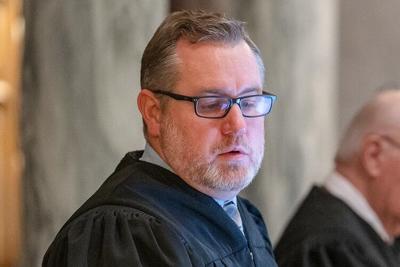



Former West Virginia Supreme Court Justice Tom Ewing
CHARLESTON – Tom Ewing says his years as a circuit court judge give him a perspective no one else currently on the West Virginia Supreme Court has.
Ewing, who was appointed to the court last year by Gov. Patrick Morrisey, is seeking election to the bench in the May 12 primary. He is being challenged by Wheeling attorney and House of Delegates member Bill Flanigan for one of two seats on the court in the nonpartisan race. The winner will serve the remainder of retired Justice Beth Walker’s term until 2028.
“I’ve seen most everything that comes before this court,” Ewing told The West Virginia Record. “I’ve made those decisions. I understand the law, and I understand what goes into making these decisions.
“I know what it’s like for a circuit court judge to make these decisions.”
Ewing served as a circuit judge in Fayette County for eight years before being appointed to the Supreme Court.
“Most of our (Supreme Court) decisions are about abuse of discretion,” Ewing said. “I see it as a circuit court judge being a referee, the Supreme Court being the replay booth. I know what it’s like evaluating that abuse and discretion.
“The most important thing is perspective … being someone who has made those decisions. I think that is incredibly valuable.”
Ewing said he prides himself on wanting to get to the right answer.
“I love what I get to do as an appellate judge,” he said. “It’s in my skill wheelhouse, even more than what I did as a trial judge. Now, I’m getting to do the research and writing. I’m open-minded, and I am willing to do the work to get to the right answer and to explain my reasoning.
“That’s what I’ve always done as a circuit judge. I thoroughly analyzed and explained, and I gave everyone a fair shot. I think it’s critical to do that on the Supreme Court and to continue to be open-minded on the issues that are before the court.
“My job is not to predetermine things. I look at the record below and make a decision about the appropriate resolution. In my experience as a circuit judge and on this court, I have demonstrated I’m willing to do that.”
Ewing says his judicial philosophy is simple.
“It starts with taking an oath to uphold the West Virginia and the U.S. Constitutions,” he said. “My first duty is the rule of law, and to ensure the law is applied equally to everyone. The law and facts of the case determine the result. Nothing else matters.
“There are times when you may not like the result, but it’s what dictated by the law and the facts. That’s what the result has to be. I’m committed strongly to the rule of law. I want to do what’s right and serve the people of West Virginia.”
Ewing said judges and justices also have an obligation to ensure the independence and integrity of the judiciary.
“It’s key to maintaining the rights we’re provided in the Constitution and given to us in statute,” he said. “I have to have integrity and hold myself to a higher standard. Your first and foremost duty is the rule of law. And as a judge, perception means you have to be even more protective of it than even if you’re an attorney.
“We personify the law to the public. If we’re viewed as not being fair, it’s going to impact what people perceive as justice.”
Ewing says the Supreme Court’s role is limited.
“We’re not lawmakers,” he said. “We’re not a super Legislature. Our role is to call whether that’s constitutional or in compliance with the statute. But it’s not our job to say whether that law is good policy or not.
“We defer to that policy decision by the Legislature. I view the Supreme Court’s job as a limited job to address the issues that come before us understanding the other branches makes those policy decisions.”
Ewing also notes the additional role of the five Supreme Court justices of being the administrative head of the unified statewide court system.
“We’re running a branch of government,” he said. “That includes a $177 million budget, technology and all aspects that affect the legal system from Charleston to every county courthouse in the state.
“It’s not just a legal role. There’s that administrative role. As a circuit judge, I am familiar with how the court system works with various programs. The only difference is the scale and managing a budget. It’s way more just what kind of legal decision are made.”
Ewing said he sees disqualifying or recusing himself from hearing certain cases is important, especially as a former circuit judge.
“We still have decisions I made as a circuit judge up here on appeal,” he said. “I disqualify myself from all of those. And when those cases come up, I’m not part of the discussion. I’m completely excluded. I think that’s part of our obligation to uphold the independence and integrity of the judiciary.”
Ewing said that kind of openness and transparency is a vital part of the Supreme Court, especially following the controversies that hit the court in 2018.
“The new court, as they call it, is very interested and very dedicated to being open and transparent and being out in the community,” he said. “That includes ensuring we are interacting with the public and with students.
“The Supreme Court sets the tone and culture for the court system and legal community. It’s important for us to be approachable, be out there, explain what we do and be transparent about what the court does.
“There is mystery among the public about what happens at the court. It’s our responsibility to continue to be ambassadors for the judicial system.”
Ewing said he knows the court system isn’t perfect, but he thinks the current court is working hard to make it better.
“I think the current members do a good job of assessing fiscal responsibility while making sure we are able to provide the services and support and pay to retain good people,” he said. “We do need to continue to look at ways to improve the time it takes for appeals. And we always could do more about being transparent.
“But we look at our processes constantly and look for ways to improve.”
Ewing says it has been an honor to have the opportunity to serve on the Supreme Court.
“Every time I step through those curtains for oral arguments, I have that moment of goosebumps,” Realizing the magnitude of what you’re doing in that moment. I know how critical the decisions we make are to the parties and to everyone in the state. These decisions affect everybody in the state.
“I don’t lose track of that. Every day I feel that.”
Ewing also said the finds the entire process fascinating.
“After we have the arguments, and we’re meeting … just the five of us debating the case,” he said. “Those discussions and arguments, the back and forth is the most fascinating part of this job. I’ve never had, in my legal career, never had anything that rivals that experience.
“I value really everything about this role. Getting to come to the Capitol every day. Seeing the various parts of our state government work together and to have some sort of role in that. It’s an enormous responsibility, but it’s also an honor to be able to have that kind of impact.”
“The whole experience has been great. It’s been like nothing else in my life before. I’m just trying to soak in every minute of it and value it for what it means to me and my family and to have a little bit of impact on what the law of the state is and how the legal system in this state works.”
Ewing presided over the Fayette County Adult Treatment Court when he was a circuit judge as well as the Fayette County Family Treatment Court, the Fayette County Teen Court and the Fayette County Truancy Diversion Program.
He grew up in Hico and attended Midland Trail High School. He was the captain of Glenville State’s basketball team, and later attended the West Virginia University College of Law. From 2004 until 2018, he worked at Kay, Casto & Chaney.
Ewing said running a statewide campaign has been a learning experience.
“It’s a bigger undertaking than what I imagined,” he said. “Trying to run all over the state and continue to do the job, because that’s first and foremost. I have kids and a wife at home, balancing work, campaign and family. And, for me, my most important job is being a husband and a dad.
“And, I’ve learned that someone is going to find something negative they want to say. You have to deal with that, work through it and process it. You’re putting ourself out there, so you have to deal with that. It’s just understanding you’re not going to make everybody happy as a candidate, a judge or a justice.
“But I’ve met a lot of great people. I’ve seen parts of the state I hadn’t seen. I’ve probably put 24 to 25,000 miles on the car. But that’s what it takes.”