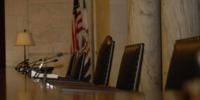


The chambers of the West Virginia Supreme Court of Appeals
CHARLESTON – The West Virginia Supreme Court has consolidated two cases in a vaccine dispute for oral arguments and a decision.
The justices also will allow attorneys for Gov. Patrick Morrisey to participate using part of the families’ allotted argument time.
The order, entered October 5, does not decide the underlying dispute or establish an argument date. The court’s clerk will notify attorneys of the date and time later.
The cases involve challenges by the West Virginia Board of Education, the Raleigh County Board of Education and other petitioners to rulings in a lawsuit brought by Miranda G. and Carley H. on behalf of themselves and their children, identified in the order as A.G. and E.G.
One case involves a petition for a writ of prohibition challenging the lower court’s certification of a statewide class action. The Supreme Court previously stayed the lower court proceedings in that case, including a November 26, 2025, order granting a permanent injunction and declaratory relief.
The second case is the education boards’ appeal of the circuit court’s final order. The Supreme Court’s order identifies the ruling being appealed as the November 26 decision from Raleigh Circuit Court.
The justices ordered the cases consolidated “for purposes of oral argument, consideration, and decision.” Justice Bill Wooton would have refused to consolidate them, according to the order, which does not explain his objection.
The court also granted Morrisey’s request to participate in oral arguments. The governor filed an amicus brief, and his attorneys sought permission to argue July 3, according to the order.
Attorneys representing Morrisey will receive five minutes of the respondents’ 20-minute argument period, leaving 15 minutes for the families’ attorneys. Justices H.L. “Kirk” Kirkpatrick and Bill Flanigan would have denied the governor’s request to participate, the order states. It does not give their reasons.
The court directed that arguments proceed under Rule 20 of its Rules of Appellate Procedure. Rule 20 includes cases involving issues not previously decided, matters of fundamental public importance, certain constitutional questions and conflicts among lower-court decisions. Each side generally receives 20 minutes to argue unless the court orders otherwise.
An argument date remains undetermined. Supreme Court Communications Director Jared Hunt said November 4 is the only remaining open oral argument day in the current term because the remaining October argument days already have cases scheduled.
The fall term ends November 13. Hunt said cases heard November 4 would need a decision filed by the end of the term.
The hot-button issue has been tied up in courts across the state for several months, and the impact of the ruling changes how the state’s long-standing compulsory vaccination law can be enforced in regards to public health, religious freedom and authority of state agencies.
Nearly 600 families across the state have received religious exemptions to the vaccination laws.
The state’s vaccination law requires students entering school for the first time to show proof of immunization against diphtheria, pertussis, tetanus, polio, measles, mumps, rubella, varicella and hepatitis B unless properly medically exempted.
West Virginia previously has been one of only five states that do not allow religious exemptions for vaccines, but Gov. Patrick Morrisey issued an executive order in January requiring the state to accept such exemptions, linking EPRA with the vaccine law that was written in 1937 and doesn’t explicitly include religious exemptions. The Morrisey administration then directed families to apply for exemptions through the state health department, but West Virginia school systems have not accepted them.
West Virginia Supreme Court of Appeals case numbers No. 25-836 (Raleigh Circuit Court case number 25-C-230) and 25-740 (Raleigh Circuit Court case number 25-C-230)