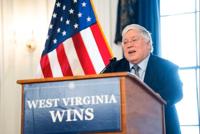


West Virginia Gov. Patrick Morrisey speaks during a January 5, 2026, press conference.
CHARLESTON – West Virginia Gov. Patrick Morrisey has announced a tax relief package proposal for the upcoming legislative session that includes a cut to personal income taxes, a reform of the historic rehab tax credit, an expansion of the Tourism Development Action tax credit and plans to conform with provisions from the Trump Administration’s One Big Beautiful Bill.
In announcing the plan January 5, Morrisey said the goal is to provide meaningful tax relief to every working West Virginian.
“We did the hard work first,” Morrisey said. “Strong revenues did not happen by accident, and they allow us to deliver meaningful tax relief without sacrificing essential services.
“West Virginians are spending more and contributing to a stronger state budget. That gives us the ability and the responsibility to return more money to the people who earned it.”
The Department of Revenue said collections were 5 percent above estimates in the first six months of the fiscal year, resulting in $128 million more being collected.
“I’m encouraged by the $128 million surplus halfway through this fiscal year and continuing growth in overall collections,” Morrisey said. “Sales tax revenue growth of 10.1 percent is particularly impressive in comparison with last year.
“Current trends bode well for the state as we prepare for the coming budget year.”
As for Trump’s bill, Morrisey said his administration plans to conform with tax relief measures to support families and encourage business investment, including enhancements to the Child and Dependent Care Credit, an increase in the annual limit for childcare flexible spending accounts, restoration of full bonus depreciation for qualified property, expanded immediate expensing of domestic research and experimental expenditures and a more generous treatment of business interest deductions.
“The Trump tax cuts provide significant savings for West Virginia and will allow for further economic growth,” Morrisey said, adding he wants to work with legislators to simplify the tax code to “put people first.”
“When we let West Virginians keep more of what they earn, all of West Virginia wins,” Morrisey said.
But some lawmakers want more information before they support more tax cuts.
“If we can show us a way that the math works, I’m excited to see it but the math has to work,” Sen. Tom Takubo (R-Kanawha) said January 6 on WCHS Radio’s 580 Live with Dave Allen.
Takubo and others prepared a tax cut plan in 2023 that has trimmed personal income taxes by more the 20 percent. Any further cuts have to be based on revenue triggers.
“When we did that, we put triggers in place with the goal of eventually getting our tax burden to zero and as our economy grows those triggers would jump in there,” Takubo said.
On social media, Del. Kayla Young (D-Kanawha) called Morrisey’s plan “fiscally irresponsible.”
“So the Governor wants another personal income tax cut (on top of the recent 27 percent cut) even though we didn’t meet the benchmark triggers for it to cut itself further, plus he’s forcing all state agencies to cut their flat-for-years budgets more,” Young said. “This is fiscally irresponsible.”
On 580 Live, Young elaborated.
“Our revenues are not up from before the pandemic so those tax cuts aren’t coming in – they didn’t come in this year – I don’t know how we’re going to afford another tax cut,” Young said.
Sen. Eric Tarr (R-Putnam) was Senate Finance Committee chairman in 2023. He said he wants to hear more details about the governor’s plan.
“I want to cut taxes too and we are cutting taxes,” Tarr said on MetroNews “Talkline.” “There is a system that’s is there to reduce these taxes safely and effectively to zero point over time. …
“I don’t want to make to where we can’t afford the business of the state that we were charged to do by the constitution that we all operate under because we left politics get too far ahead of practicality.”
The 60-day regular legislative session begins January 14.