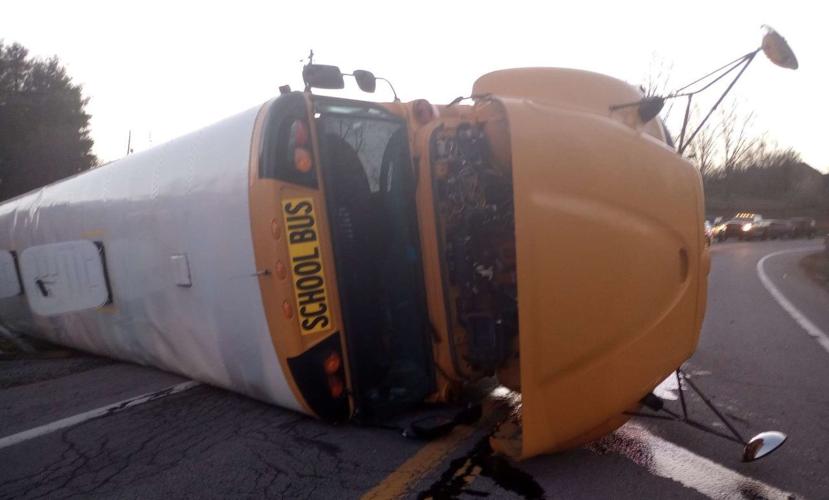



The crash happened along W.Va. 16 in Calhoun County.
CHARLESTON – The National Transportation Safety Board has ruled a Calhoun County school bus driver’s alcohol impairment caused a 2024 rollover crash that seriously injured three students.
The NTSB also says the accident underscores the need for alcohol detection systems and passenger lap/shoulder belts on school buses.

Brannon
At least nine civil lawsuits were filed related to the March 4, 2024, accident that took place on W.Va. 16 near Millstone. Bus driver Jeffrey Brannon and the Calhoun County Board of Education were named as defendants in the suits.
According to the NTSB, the bus driven by Brannon departed the right side of the roadway, returned to the roadway and rolled over onto its right side. Three students were seriously injured and 16 sustained minor injuries. Brannon was later found to have a blood alcohol concentration reading of 0.161, which is more than twice the legal limit in West Virginia.
Brannon was convicted last year and sentenced to 22 to 110 years in prison.
As part of its investigation, the NTSB reiterated its recommendation that West Virginia require passenger lap/shoulder belts on new large school buses and called on the state to establish enforceable procedures to ensure students use the seat belts properly on every trip.

Ben Salango
Attorney Ben Salango agreed.
“Seat belts and alcohol detection systems on school buses will save lives,” Salango, who represented 16 of the children injured in the crash, told The West Virginia Record. “We applaud the NTSB for advocating for seat belts and alcohol detection systems.
“This simple, inexpensive step to protect our children is long past due.”
Salango said the civil cases against Brannon and the school board were settled earlier this year.
The NTSB investigation found that alcohol impairment among school bus drivers occurs with concerning frequency.
A Stateline study found that, from 2015 through 2019, 118 school bus drivers nationwide were cited or arrested for operating a bus while impaired by alcohol, drugs, or a combination of both. NTSB also noted that active and passive alcohol detection technologies already exist that can prevent a vehicle from operating if driver alcohol impairment is detected. These systems are being used successfully on school buses in parts of Europe as a preventive safety measure.
As a result, the NTSB recommended that the National Highway Traffic Safety Administration require all new school buses to be equipped with vehicle-integrated alcohol detection systems.
NTSB investigations have shown passenger lap/shoulder belts on school buses provide increased protection in side impact and rollover crashes like the Millstone crash and a similar crash in Dale, Texas, which the NTSB examined as part of this investigation.
In these types of crashes, the compartmentalized seating design of large school buses alone may not prevent injuries because unbelted children can be thrown from their seating area, strike other occupants or hard surfaces, or be partially or fully ejected from the bus. In both West Virginia and Texas crashes, the unbelted students were thrown about the interior of the bus, resulting in the increased risk of injuries and ejections.
The full report is available on the NTSB’s website. The investigation page contains the report and the investigation docket. More information about school bus safety is also available on the NTSB’s website.
The NTSB says seven states currently require lap/shoulder belts on school buses. Those are Arkansas, California, Illinois, Iowa, Nevada, New Jersey and Texas.
“This is a tragic case that was absolutely preventable,” Salango previously told The Record. “Nineteen children were severely injured by the irresponsible actions of the defendants.”