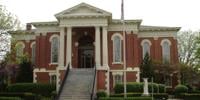


Illinois Third District Appellate Courthouse, Ottawa, Illinois
OTTAWA, ILLINOIS — A state appeals panel will allow a man who was struck by a car while walking to sue New Lenox for his injuries, because the man claims police officers were essentially obligated to drive him home after allegedly picking him up for trespassing at Silver Cross Hospital, rather than leaving him in a restaurant parking lot in Orland Park, near where he was later struck by the car.
According to court documents, New Lenox police officers Jacob Klepk and David Dileto responded to a criminal trespass call at the hospital around 11 p.m. Dec. 5, 2020. There they found Qusai Alkafaween, refusing to leave despite being discharged. Orland Park police and medical officers had brought him earlier in the night. The hospital treated him for a possible overdose.
After a lengthy exchange, both inside and outside the hospital, Klepk drove Alkafaween to the parking lot of Joey’s Restaurant, explained the location and suggested walking north on Wolf Road, according to court documents. About 45 minutes later, a car struck and severely injured him Alkafaween.
The next October, Alkafaween sued the village and two police officers. He filed a second amended complaint in July 2024. He has already settled medical negligence claims against Silver Cross and its employees. He said the police officers ignored hospital discharge orders instructing home release and failed to pursue several options for obtaining his home address or coordinating his release with Orland Park police.
Will County Circuit Court Judge Daniel Rippy granted summary judgment to the government defendants, finding the officers qualified for protections of the Tort Immunity Act. Alkafaween challenged that ruling before the Illinois Third District Appellate Court.
Justice Lance Peterson, wrote the panel’s opinion, filed June 15; Justices William Holdridge and Linda Davenport concurred.
On appeal, Alkafaween argued summary judgment was improper because there was a factual dispute over whether the officers, upon encountering Alkafaween at the hospital, were providing police protection services, which would trigger absolute immunity, or if they were executing or enforcing the law, which yields only limited immunity and specifically does not cover Alkafaween’s allegations of willful and wanton conduct.
“Although the police officers were initially dispatched to investigate a possible criminal trespass,” Peterson wrote, framing the New Lenox defendants’ positions, “the officers quickly pivoted to providing police protection or community caretaking services once it became apparent that plaintiff was not trespassing at the hospital.”
The panel agreed with Alkafaween that the question of whether officers are enforcing the law or providing protection is ordinarily a factual question and said a judge can make such a decision when the alleged facts support only a single conclusion. In this case, however, the panel said multiple conclusions are possible.
“Some of the facts established in this case support a finding that the officers were providing police protection or service during the encounter,” Peterson wrote. “Those facts include that the officers did not arrest, detain or handcuff plaintiff; that the officers kept the tone of their voices calm and conversational during the entire encounter; that the officers repeatedly assured plaintiff that they were trying to help him and repeatedly asked plaintiff where he lived and who they could call to give plaintiff a ride home; that Dileto told plaintiff that the officers could give him a ride part of the way to Orland Park, and plaintiff stated, ‘Ya, that’s good’; that other than the wording of the initial dispatch, there was no indication (Alkafaween) was trespassing at the hospital; that plaintiff agreed to leave the hospital and go outside with the police and security guard and was apparently not trespassing; and that the responding officers’ supervising officer opined that the responding officers were performing a police protection service or community caretaking function when they drove plaintiff to Orland Park and dropped him off.”
But other facts support Alkafaween’s version, the panel continued, such as the encounter originating with a criminal trespass call, attributed to hospital staff, the presence and conduct of Silver Cross security officers and record of Dileto telling hospital workers police would “dump” Alkafaween near the Will-Cook County border. That police didn’t arrest Alkafaween isn’t enough to settle the question, the panel said, as removing a trespassing suspect from a location is a reasonable law enforcement response.
“Indeed,” Peterson wrote, “a reasonable person could find, based upon the fact that the officers chose to ‘dump’ plaintiff — a person who was obviously experiencing mental health issues and was dressed in only a light coat and not wearing a hat, gloves or socks — in the parking lot of a closed business in an unfamiliar area at nearly midnight in December when they knew plaintiff did not even have a cell phone, that the officers were not conducting ‘community caretaking.’ ”
After reversing the ruling, the panel also addressed the government’s position that discretionary immunity should apply as a means of offering absolute immunity. Peterson said the factual record substantially frames the question as provision of protective services or executing a specific law, meaning the discretionary immunity option isn’t applicable.
Alkafaween is represented by Cucio & Casciato, of Chicago.
The New Lenox defendants are represented by Hervas, Condon & Bersani, of Itasca.