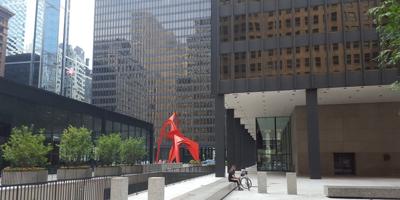


Dirksen Federal Courthouse, Chicago
CHICAGO — Saying the deal was crafted largely to ensure lawyers maintained at least a chance at a big future payday, a federal appeals panel has tossed a "creative" settlement that had appeared, for a time, to end a group of sprawling biometric privacy lawsuits against tech firm Clearview AI by giving plaintiffs and their lawyers a 23% stake in the company's stock.
On July 13, a three-judge panel of the U.S. Seventh Circuit Court of Appeals ordered Clearview and the plaintiffs and their lawyers, led by the firm of Loevy & Loevy, of Chicago, to return to the table to negotiate a new deal, and this time to make sure everyone involved in the lawsuit is properly represented in the talks.
"Class-action settlement requires structural assurances of fair and adequate representation, and those were lacking here," wrote Seventh Circuit Judge David Hamilton, who authored the opinion.
Hamilton was joined in the decision by circuit judges Nancy Maldonaldo and Rebecca Taibleson.
While it may not signal a complete reset in the case, the decision means talks may need to largely start over in the high-risk, but potentially high-reward legal action.
The settlement had been granted final approval by U.S. District Judge Sharon Johnson Coleman in March 2025, about nine months after the parties had first presented the novel deal in court.
The plaintiffs had been in court against New York-based Clearview since 2020, as they pressed claims that the company had allegedly violated Illinois' biometrics privacy law, as well as privacy laws in California, Virginia and New York. The lawsuit also included some lesser, more general counts accusing Clearview on a nationwide basis.
According to the lawsuits, Clearview scraped more than three billion photographs posted online, then used artificial intelligence to scan the facial geometry of people whose faces were imaged in those photos. The scans harvested unique biometric identifiers from the faces imaged in those photos, which Clearview then used to build databases to sell to law enforcement and others.
The lawsuits assert these practices violated the Illinois Biometric Information Privacy Act (BIPA) and other laws. In Illinois, the actions claimed Clearview had been required to first get permission from Illinois residents pictured in those photos before scanning their faces and to provide certain notifications concerning what Clearview intended to do with those scans.
Under BIPA, Clearview could have faced a potentially crippling payout worth hundreds of millions of dollars or more.
After years in court, the parties entered mediation, overseen by a former federal judge. In the brief outlining the settlement talks, the plaintiffs noted those talks were complicated by a number of issues. Most prominently, this included the potential for the lawsuits to financially ruin Clearview and leave no money available for any ultimate payment.
Court documents indicated the mediator judge agreed Clearview, as a relatively young startup company, could not satisfy the large cash payment initially demanded by the plaintiffs without risking bankruptcy and insolvency.
In the appellate decision, the judges noted that the mediator had "attested that Clearview could 'pay any judgment in the tens, never mind the hundreds, of millions of dollars.'"
At the same time, the plaintiffs also lost their ability to achieve even an injunction against Clearview, as the company had already agreed in 2022 to alter their business practices to comply with the Illinois BIPA law and other privacy laws under a separate deal to end a separate lawsuit brought by the American Civil Liberties Union.
The ACLU and co-plaintiffs were represented in that action by attorneys from the firm of Edelson PC, of Chicago.
As the Loevy firm and its plaintiffs noted in a 2024 brief seeking approval of their settlement: "Clearview and the Class members were trapped together on a sinking ship: the potential liability was massive, there was no money for a substantial settlement, and the costs of litigation itself would bankrupt Clearview before the case ever got to trial, leaving nothing for the Class members."
Instead, the parties entered into a novel deal, under which Clearview agreed to hand over 23% of its stock to the plaintiffs and their lawyers.
It remains an open question even nearly two years later how much the total deal could be worth. At the time the settlement was introduced, court documents estimated about $51.7 million could be on the table.
Lawyers could receive up to 39% of that total, or more than $20 million, at least.
The remainder of the stock and its value would be divided among potentially millions of plaintiffs throughout the country. However, that stock would not be divided equally. Rather, the deal would have given plaintiffs from Illinois 10 shares each; those from New York, California, and Virginia would receive five shares; and plaintiffs from everywhere else would receive one share each.
While Coleman approved the settlement, she did so over strong objections from potential nationwide class members. In district court and then on appeal, those objectors, represented by attorney Michael Kirkpatrick, of Chicago, asserted the deal was both weak and unfair.
The deal, they said, did not only allegedly shortchange the nationwide plaintiffs class members, but also consigned those nationwide plaintiffs to essentially joining forces with Clearview.
In their filings, objectors said the deal "ties" them to the company, linking any eventual payment they may receive to Clearview's success and "the continuation and expansion of the invasion of privacy that the case was brought to stop."
On appeal, Hamilton and his colleagues brushed aside the objectors' concerns about the lack of injunctive relief, saying the deal represented the plaintiffs' best chance to secure a win in the case, after the ACLU settlement.
And the appellate judges discounted the objectors' concerns about the "moral complexity" the deal might present.
While noting open questions remain about the appropriateness of Clearview's tech and business practices, the judges noted the plaintiffs can't point to any laws that the company's current practices violate.
In this case, they said, the court is tasked solely with determining if a settlement is fair.
With that in mind, the judges said they agreed the deal was not fair to nationwide plaintiffs' class members, who had no one to speak for them at the negotiating table, resulting in an unbalanced payout that particularly favored the Illinois plaintiffs.
Hamilton and his colleagues said this problem "should have been apparent from the beginning," but was overlooked, at best, by the Loevy lawyers and others involved in the talks, amid a push to secure a payout of any kind from the endangered litigation.
The judges said it may ultimately prove correct to weight the shares substantially in favor of Illinois plaintiffs, whose claims to a big money payout under the BIPA law were strongest.
"But it is difficult to accept any particular set of ratios as fair when those would get the short end of the stick ... were not represented separately in the negotiations and did not themselves agree to that short end," Hamilton wrote.
The judges declined to indicate what terms they believed the final settlement should include.
But Hamilton and his colleagues said any deal reached in further proceedings should demonstrate that the deal has "adequately protected the interests of the class, as opposed to the attorneys' interest in settling this litigation."
Clearview has been represented by attorneys James L. Thompson and Daniel Lynch, of Lynch Thompson, of Chicago.
Plaintiffs have been represented by attorneys Jon Loevy, Michael Kanovitz and Thomas M. Hanson, of the Loevy firm.